10 works in this view — arrow keys or swipe to move between them.
Dance in Art
Spanish dancing
Unknown artist
- Medium:
- Dance:
- Spanish/Flamenco
- Source:
- New York Public Library
- Rights:
- Public domain — free to use, share and adapt.
- Recorded as:
- public_domain
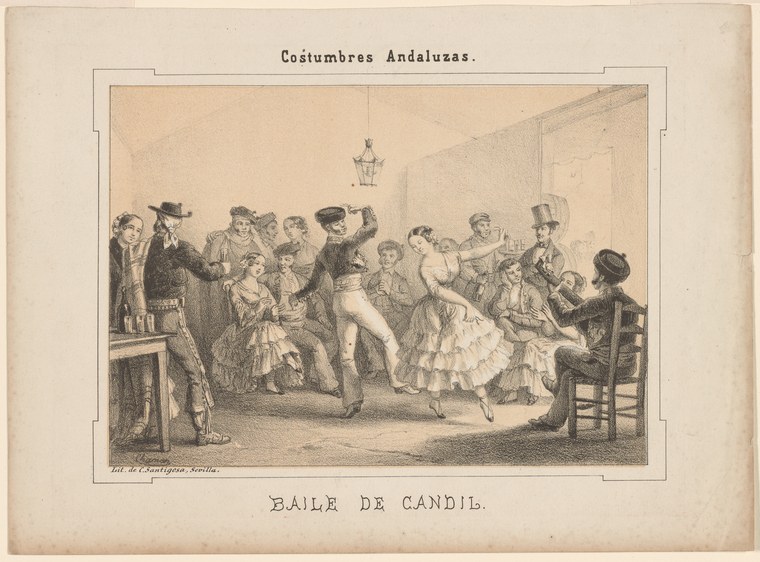
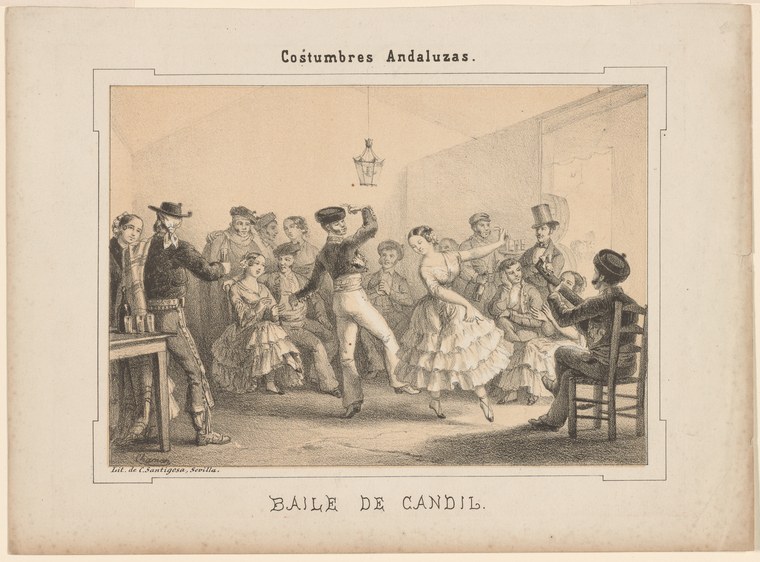
The candil is a precursor to flamenco and other Andalusian dance traditions, yet it is rarely illustrated in art historical sources. This image preserves evidence of how ordinary people danced in nineteenth-century Spain, including the prominent hip and torso movement that would later characterize flamenco. For dancers and historians studying the roots of Spanish dance and the relationship between folk practice and theatrical form, this is a rare and direct visual document.
What you are looking at
A lively indoor dance scene set in a modest room lit by a hanging oil lamp. A mixed company of men and women in nineteenth-century dress occupy the space: the women wear full skirts with multiple tiers of flouncing, and the men wear tailcoats and hats. In the center, a woman in a white dress executes a dynamic movement—her body arched, one leg extended, skirts flying—while a man in a dark coat stands close by, apparently her partner. Around them, other figures clap, gesture, and watch with evident pleasure. Some stand at the periphery; others cluster near the dancers. The composition is crowded and informal, with figures overlapping and turning toward the action. The setting and the energy suggest a candil—a neighborhood dance gathering—rather than a formal ballroom.
The dancing
The central female dancer is caught mid-movement with pronounced hip articulation and an arched spine, her weight shifted dramatically to one side and her skirts displaced by the force of her motion. Her male partner stands upright and close, in a supporting rather than guiding role. The surrounding figures are not in formal dance holds but are engaged as witnesses and participants in the social occasion—clapping, gesturing, some with arms raised. The overall frame is loose and social rather than ballroom-structured: bodies are at varied angles and distances.
The dance depicted
This is a candil or baile de candil, a Spanish social dance of the working and rural classes, popular in Andalusia in the nineteenth century. The candil (named for the oil lamp that typically lit such gatherings) featured improvised, energetic movement with prominent hip and torso articulation, often danced by a single couple while others clapped in rhythm and provided encouragement. The woman's arched posture, the male partner's close but non-directive stance, and the participatory clapping of the onlookers are all characteristic of the form. The image documents a moment of popular Spanish dance practice rather than the formal, choreographed dances of the salon.
How it was made
This is a hand-colored engraving or lithograph, executed in the Romantic era's taste for picturesque scenes of popular life. The technique allowed for precise rendering of costume detail and facial expression while maintaining the spontaneity of the composition. The use of light hatching and cross-hatching to suggest form, combined with the central illumination from the lamp, creates depth and focus. The print's circulation as a mass-produced image (reproduced from the NYPL collection) suggests it was intended for popular consumption and education about regional Spanish customs.
About this work
This image documents a candil, a Spanish popular dance of the nineteenth century, capturing the moment of performance in a working-class gathering. Unlike the formalized ballroom dances that dominated European dance art of the period, the candil represents an alternative, embodied tradition of movement rooted in regional Spanish culture. The engraving preserves not just the appearance of the dance but the social context of its performance—the clapping, the close quarters, the mixed gender participation, and the centrality of the female dancer's bodily articulation. It is a valuable visual record of a dance form that, while widely practiced, rarely entered the canonical art historical record.
How to look at it
Attend to the woman's spine and hip position: the pronounced arch and the off-center weight distribution are not ballroom posture. Notice the absence of a closed hold; the couple relates through proximity and the man's readiness rather than through a structured frame. Observe the clapping and raised arms of the surrounding figures—they are not merely audience but active participants in the music-making. The moment captured is one of maximal extension and energy, the peak of a movement rather than a traveling step, which is characteristic of the improvisatory, moment-based structure of Spanish popular dance.
The artist
The print is catalogued without attributed artist, but the style and subject matter suggest it is part of the nineteenth-century European fascination with costumbrismo—the depiction of regional and popular customs. Such prints were often produced in series and circulated widely through popular media, functioning as both entertainment and informal ethnographic documentation.
The period
This engraving dates to an era when Romantic artists and printmakers were actively collecting and romanticizing images of Spanish popular culture. Spain's regional traditions, especially those of Andalusia, held particular appeal to northern European audiences. Simultaneously, the theatrical ballet world was beginning to incorporate Spanish-inflected movement and costume into narrative ballets, creating a two-way flow: popular dances influenced theatrical form, and theatrical images shaped how popular dances were understood and represented. The candil sits at this intersection, already aestheticized for an urban audience while preserving genuine markers of its social and embodied practice.
Where it lives
This print is held in the New York Public Library collection and was digitized as part of their online holdings. It is catalogued as a costume print, part of the library's extensive visual documentation of nineteenth-century European dress and social customs.
Dance in this work
Questions about this work
What is a candil dance?
A candil (literally 'oil lamp') was a Spanish social dance, particularly popular in Andalusia, named for the lamp that lit the modest gatherings where it was performed. It featured energetic, improvisatory movement by a couple while others clapped and encouraged. The form emphasized hip and torso articulation and was danced in close quarters by working-class and rural communities. It is considered a precursor to flamenco and other Andalusian dance traditions.
How does this differ from ballroom dancing of the same period?
Ballroom dancing relied on codified steps, formal holds, and the couple's isolation as the focus of attention. The candil, by contrast, involved improvisation, loose proximity between partners, and active participation by onlookers who clapped and moved to encourage the dancers. The candil centered bodily articulation and release of the female dancer rather than the structured partnership of ballroom form.
Is this the same as flamenco?
Not quite. The candil is an ancestor of flamenco rather than flamenco itself. Both feature prominent hip and torso movement, but flamenco developed its own distinct rhythmic structures, footwork vocabulary (especially zapateado, or foot-stamping), and relationship to guitar music. This image shows candil in its nineteenth-century form, a folk dance of ordinary people; flamenco emerged as a more codified and eventually theatrical practice.
Who danced the candil?
The candil was a dance of the working and rural classes in Andalusia, Spain. Unlike the ballroom dances documented in formal portraiture, the candil belonged to the social world of laborers, servants, and small farmers. The print's title, 'Costumbres Andaluzas' (Andalusian Customs), signals that it was being documented as an example of regional popular culture for a broader, more privileged audience.
More Spanish/Flamenco artwork