49 works in this view — arrow keys or swipe to move between them.
Dance in Art
Premiere journée: marche du Roy, et ses chevaliers ...
Unknown artist
- Collection:
- Prints depicting dance
- Source:
- New York Public Library
- Rights:
- Public domain — free to use, share and adapt.
- Recorded as:
- Public Domain
This work is a rare surviving visual document of how ritual movement functioned in absolute monarchy: not as art for its own sake, but as a formal language that made hierarchy visible and enacted obedience. For dance historians, it shows the boundary between ceremonial movement and theatrical dance at a moment when both existed in the same court culture but served different purposes.
What you are looking at
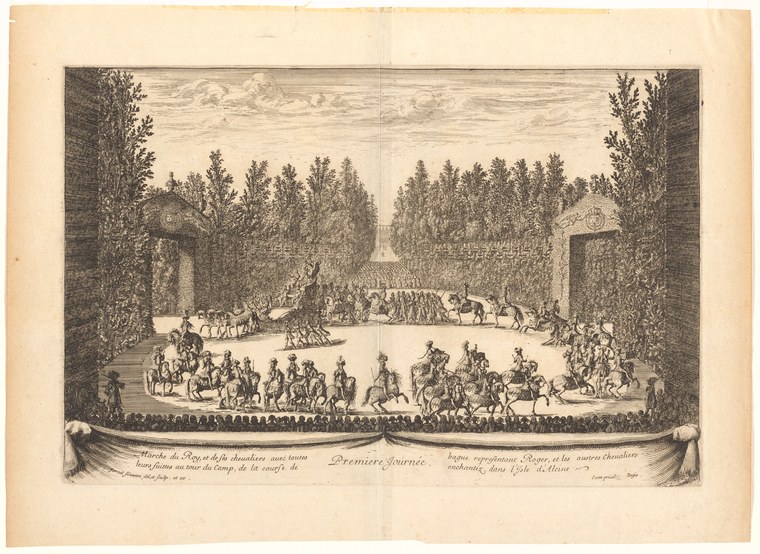
A formal processional or ceremonial dance unfolds in a grand parterre enclosed by tall, clipped hedges and formal garden architecture. The space is framed by architectural elements—a portico with columns visible on the right—suggesting a palace garden or court setting. Mounted cavalry and foot soldiers form ordered ranks around the perimeter, creating a boundary between the dancing space and spectators. The central action depicts a formal royal procession: figures in elaborate court dress—long coats, plumed hats, and heeled shoes—move in measured formation. The scene is rendered in a Baroque engraving style with fine cross-hatching to create depth and atmosphere. A draped curtain frame at the bottom of the composition, with tasseled ornaments, frames the entire scene like a theatrical proscenium, reinforcing the ceremonial and performative character of the event.
The dancing
The figures are arranged in formal ranks and processions rather than closed-hold couples. Their bodies are upright and composed, moving in aligned directions with controlled, measured steps. The dress is uniformly aristocratic—long-skirted coats, stockings, and heeled shoes visible on multiple figures—suggesting a unified elite social class performing together. The figures do not show the dynamic extension or elevation of later theatrical dance; instead, their geometry is horizontal and architectural, organized by rank and symmetry rather than by individual partnership. Mounted officers and attendants frame the action, their horses adding vertical accent and ceremonial weight.
The dance depicted
This depicts a formal royal processional or 'marche' of the kind performed at 17th-century European courts, most likely French given the inscription 'Marche du Roy' (The King's March) and the Baroque garden setting. Such processions were essential court ceremonies—ordered, hierarchical demonstrations of power and allegiance rather than entertainment dances. The movement is stately and frontal: participants walk or process in formation, their steps small and controlled, with weight carried upright in the formal posture required by heavy court dress. This is closer to ceremonial movement-protocol than to the developing forms of theatrical dance, though it shares the court's aesthetic of grace, order, and visual spectacle.
How it was made
This is an engraving, identified from the image by the fine parallel hatching lines used to create shadow, tone, and spatial recession—the characteristic technique of line-based printmaking rather than painting or etching. Engravings of this type were typically printed in editions and distributed as documentary records, prints for framing, or illustrations for publications about court life and ceremony. The composition's theatrical framing device—the draped curtain—suggests this was conceived as a record of a significant state occasion, meant for wide circulation among the court elite and those interested in courtly protocols.
About this work
This engraving documents a formal royal procession or ceremonial march at what appears to be a 17th-century European (likely French) court. The title 'Première journée: marche du Roy, et ses chevaliers' (First Day: The King's March and His Knights) identifies it as the opening event of a multi-day court ceremony or festivity. The work is a precise visual record of courtly movement protocol—the hierarchies, dress codes, spatial relationships, and controlled formal gesture that constituted power and allegiance at court. Rather than depicting a theatrical dance for entertainment, it shows dance or movement-protocol as an instrument of state ceremony.
How to look at it
Attend to the geometric precision of the composition: every figure is aligned, spaced, and directed according to strict protocol. The artist has frozen a moment of processional movement—not a jump or turn, but a measured step forward in rank. Notice how the mounted cavalry and attendants frame the central figures, emphasizing that this is a demonstration of order and loyalty rather than a display of individual virtuosity. The theatrical framing curtain signals that this event, though ceremonial, was understood as a spectacle—a performance of state power rather than a spontaneous celebration.
The artist
The artist is not recorded. The style and technique are consistent with 17th-century French court printmaking, when such ceremonial engravings were commissioned to document and disseminate images of royal occasions. The quality of the work and the detail suggest a professional court workshop familiar with Baroque engraving practice and court protocol.
The period
This engraving dates to a period when the French court—particularly under Louis XIV—was developing elaborate ceremonial and dance as instruments of political control. The 1650s–1680s saw the rise of court ballet as a formal state art, performed by nobles and the king himself. At the same time, formal processional movement and court etiquette were becoming increasingly codified and documented. This print belongs to a tradition of court documentation that recorded ceremonies for posterity and for circulation among the nobility and foreign courts.
Where it lives
Held in the New York Public Library's prints collection of dance imagery. The work is catalogued as a print documenting dance or movement, part of a broader archival effort to preserve visual records of dance practice and culture.
Dance in this work
Questions about this work
Is this a dance or a military ceremony?
It is both. At 17th-century courts, formal movement was not sharply divided into 'dance' and 'ceremony.' A royal march was a choreographed event—carefully composed for visual effect and performed in formation. It required training in posture and deportment but was not theatrical entertainment in the modern sense. It was instead a visible enactment of hierarchy and loyalty.
Who performed court marches?
The king, his immediate family, and the highest nobility performed them. This image shows a 'marche du Roy'—the king's march—which would have included the monarch himself and his closest courtiers. Participation in such ceremonies was a mark of status and access to power.
Why is this framed like a theatrical performance?
The curtain frame is a print convention of the period, used for important ceremonial and theatrical occasions. It signals that this event was staged and observed—it was a public or semi-public spectacle, not a private affair. Court ceremonies were performances in the sense that they were carefully orchestrated for effect and observation.
What does 'Première journée' mean?
'First Day' indicates this was one event in a multi-day celebration or festival. Court ceremonies of significance often lasted several days, with different marches, ballets, banquets, and processions scheduled for each day. This engraving documents only the opening event.
More dance artwork





