49 works in this view — arrow keys or swipe to move between them.
Dance in Art
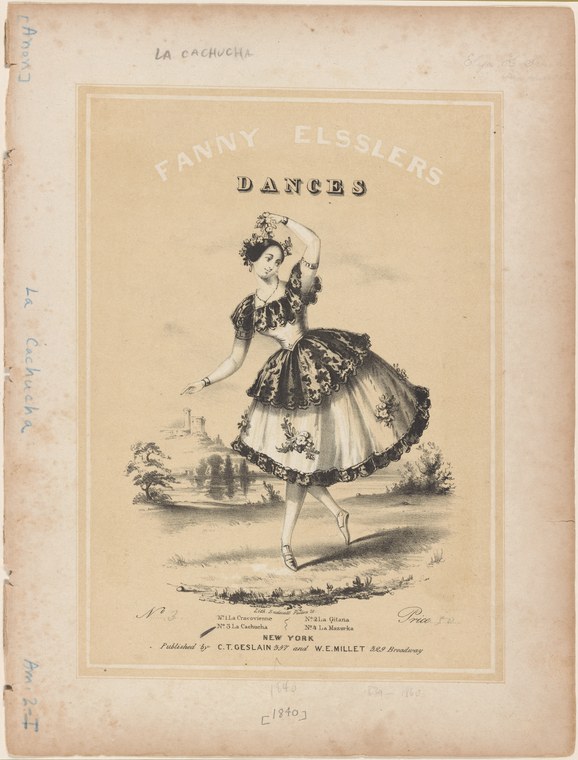
Fanny Elssler's dances: No. 1, La cracovienne, no. 2, La gitana, no. 3, La cachucha, no. 4, La mazurka
Unknown artist
- Collection:
- Prints depicting dance
- Source:
- New York Public Library
- Rights:
- Public domain — free to use, share and adapt.
- Recorded as:
- Public Domain
Fanny Elssler was one of the defining figures of romantic-era ballet, and her character dances were among the most celebrated and most frequently imitated works of her time. This image is primary documentation of her technique, her repertoire, and how she was presented and remembered. For historians of dance and theater, it offers rare visual evidence of what romantic-era character dance looked like and how it was marketed to paying audiences.
What you are looking at
A lithograph presenting four numbered dance scenes featuring a single female dancer in successive poses and costumes, each identified by title at the base. The dancer occupies the center of each vignette, posed against a landscape background rendered in soft sepia tones. In the largest central image (labeled No. 3, La Cachucha), the dancer appears mid-movement in a dark bodice with voluminous skirt caught in swirl, one arm raised, the other extended, her posture suggesting rapid rotation. The smaller surrounding scenes show her in contrasting costumes—including what appears to be Spanish or European folk dress in the upper registers. The whole is framed by an ornate double-line border, with publisher information at the base identifying the work as relating to Fanny Elssler's dances and crediting C. Tolsaint & Co. and W.E. Millet of 866 Broadway, New York. The paper is aged to a cream color with visible foxing and handling marks.
The dancing
The central figure is a female dancer drawn with delicate precision, shown in a balletic posture with turned-out legs and an upright carriage typical of trained theatrical dancers of the period. Her body occupies a narrow, vertical frame; weight appears to be distributed across the balls of the feet in movement, with knees slightly bent and arms positioned in varied port de bras across the four scenes. The torso is held erect, the head tilted and turned to suggest momentum and grace. No other figures are present; this is a portrait of individual technique and display.
The dance depicted
This is a promotional image documenting four of the dances in Fanny Elssler's celebrated repertoire during her career in the 1830s–1840s. La Cachucha, La Cracovienne, La Gitana, and La Mazurka were among her signature character dances—balletic works drawn from or inspired by folk traditions of Spain, Poland, and other European regions. Elssler was renowned for her ability to execute these dances with technical brilliance while maintaining the character and flavor of their geographical origins. The image captures the romantic-era ballet aesthetic: individual female dancers as the center of theatrical spectacle, their technique and interpretive ability displayed through a series of costume changes and geographical variations. The poses suggest a dancer of extraordinary elevation and control, trained in the classical idiom but able to inflect it with the particular rhythms and attitudes of character dance.
How it was made
This is a hand-colored lithograph, a reproductive medium that allowed mass circulation of theatrical imagery during the nineteenth century. The technique involved drawing on a lithographic stone with a greasy crayon, then rolling ink across the stone to adhere only to the drawn image; the paper was dampened and pressed against the inked surface. The color was applied afterward by hand or by separate stone passes—a process that made each print semi-unique and relatively affordable, enabling widespread distribution of theater publicity and celebrity portraiture. The soft, delicate line work and subtle tonal modeling visible here are characteristic of quality commercial theatrical lithography of the 1830s–1840s. The technique was ideal for capturing the light, graceful movement of the romantic ballet figure and for the fine detail required in costume representation.
About this work
This is a commercial lithograph produced to celebrate and publicize Fanny Elssler's signature character dances during her career as one of the most celebrated ballerinas of the romantic era. It belongs to the tradition of theatrical celebrity portraiture and dance documentation that flourished in the nineteenth century, when lithography made it possible to circulate images of famous dancers across an expanding urban audience. The work is both a document of how Elssler's dances looked in performance and a marketing object—a souvenir that theatergoers could purchase to commemorate an evening of entertainment and to display at home. It sits at the intersection of dance history, theater history, and the history of print culture, revealing how dancers became celebrities and how their image and technique were commodified and circulated.
How to look at it
Attend to the costumes and their variations across the four scenes: each dance is identified by its regional character (Spanish, Polish, Gypsy), and the costumes shift accordingly. Note the consistency of the balletic posture and frame across all four—this reveals what Elssler brought to each work: a foundation of classical technique that gave authority and elegance to the character material. Observe the moment captured in the largest central image: the dancer is caught mid-spin, weight articulated through the legs, arms in motion, the body tilted to suggest momentum. This is not a static pose but a moment of action, suggesting how these dances would have moved in performance. The softness of the lithographic line and the hand-coloring emphasize the delicacy and femininity that the romantic era prized in the female dancer.
The artist
The artist is not recorded on the lithograph. It was published by C. Tolsaint & Co. and W.E. Millet, a Broadway firm, indicating New York production. The style and quality suggest a commercial theatrical lithography workshop of the 1830s–1840s, a period when such firms employed skilled draftsmen to produce images of celebrated performers for sale to the public.
The period
This image dates to the height of the romantic ballet era, when the female dancer had become the primary focus of theatrical spectacle. The 1830s and 1840s saw the development of the pointe shoe, the tutu, and a new aesthetic of weightlessness and otherworldliness in ballet, exemplified by works like Sylphide (1832). At the same time, character dances—works that drew on folk traditions or that were set in exotic or foreign locales—were enormously popular. Fanny Elssler's career represented a peak of this tradition: she was celebrated throughout Europe and America for her ability to combine technical mastery with vivid characterization. The lithograph itself belongs to an expanding commercial culture of theatrical publicity and celebrity that grew with the expansion of urban theater-going and print reproduction technology.
Where it lives
This lithograph is held by the New York Public Library as part of its collection of prints depicting dance. It was produced and published in New York, indicating that Elssler's fame and popularity extended across the Atlantic and that the commercial dance print market was flourishing in America during her career.
Dance in this work
Questions about this work
Who was Fanny Elssler?
Fanny Elssler (1810–1884) was an Austrian-Italian dancer who became one of the most celebrated ballerinas of the romantic era. She was renowned for her technical brilliance and for her signature character dances, which drew on folk traditions from across Europe. She toured throughout Europe and America and was a celebrity of the first order—her rivals and admirers debated her merits in the press, and her image was widely circulated in prints and engravings.
What are character dances?
Character dances are balletic works that are inspired by or drawn from folk traditions of particular regions or nations. They maintain the vocabulary and technique of classical ballet but inflect it with the rhythms, attitudes, and flavors of their source tradition. La Cachucha, for example, is based on a Spanish folk dance; the Mazurka and Cracovienne draw on Polish traditions. For romantic-era audiences, these dances were exotic and alluring—they allowed the classical ballet body to travel imaginatively to distant places.
What does the image tell us about how these dances were performed?
The precision of line, the turned-out legs, the lifted carriage, and the delicate arm positions all indicate that these dances were executed within the classical ballet idiom, not as literal folk dances. The dancer's posture and technique are those of the trained theatrical ballerina. At the same time, the costumes and settings suggest that the dances carried a sense of geographical or cultural specificity. The image reveals the peculiar logic of romantic-era character dance: it was folk material filtered through the technique and aesthetic of classical ballet.
Why were these dances so popular?
The romantic era was fascinated by the exotic, the distant, and the foreign—by anything that seemed to offer escape from modern urban life. Character dances allowed audiences to travel imaginatively to Spain, Poland, or the Romani world, while remaining within the familiar and prestigious frame of ballet. They also showcased the dancer's versatility and technical range: a ballerina who could execute the same dances in multiple characters and costumes demonstrated supreme command of the form.
More dance artwork





