49 works in this view — arrow keys or swipe to move between them.
Dance in Art
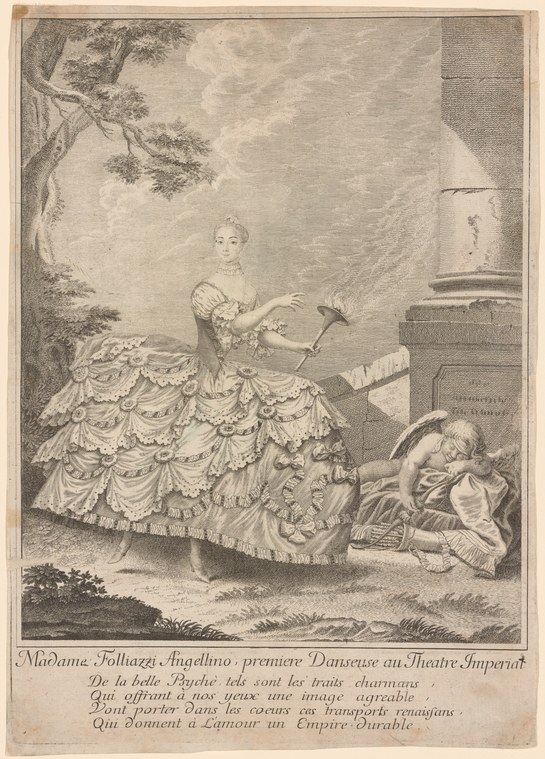
Madame Folliazzi Angellino, premiere Danseuse au Theatre Imperial
Unknown artist
- Collection:
- Prints depicting dance
- Source:
- New York Public Library
- Rights:
- Public domain — free to use, share and adapt.
- Recorded as:
- Public Domain
This work is essential evidence of how eighteenth-century court ballet was understood, marketed, and consumed. It shows that the primary way the public engaged with celebrated dancers was through their visual representation in formal dress, not through notation or description of movement, and that a dancer's professional identity was inseparable from her status as a court figure and erotic spectacle. The inscription praises her technical prowess ('charmans') and her power to move audiences, anchoring the visual beauty of the image to her actual fame as a performer.
What you are looking at
An eighteenth-century engraving depicts Madame Folliazzi Angellino, a prima ballerina at the Imperial Theatre, in a moment of theatrical display. She stands in a three-quarter pose wearing an elaborate court dress of white silk with richly gathered and festooned skirts, her small waist and décolletage emphasized by the cut of the garment. Her hair is styled high and close to her head in the fashion of the 1770s–80s, and she gestures with one hand toward a male figure at her feet—a youth or putto who kneels or reclines on the ground in an attitude of supplication or admiration. The setting is a garden or park, suggested by a large tree with drooping foliage at left and architectural elements (a structure or pavilion) visible at right. The light is diffuse and atmospheric, with soft clouds in the sky. The inscription below identifies her and quotes praise for her prowess at the Imperial Theatre.
The dancing
Folliazzi Angellino's pose is frontal and composed, with her weight centered and her body held upright in the formal stance of a court dancer. Her extended arm is graceful and controlled, with fingers extended in a gesture of acknowledgment or blessing toward the male figure below. The youth at her feet is rendered in a more dramatically posed attitude, his body twisted and reaching toward her in homage. There is no actual choreographic contact or partnering; rather, the composition is hierarchical and emblematic, with the prima ballerina as the focus of veneration.
The dance depicted
This is not a depiction of a specific dance in motion, but rather a portrait of a celebrated dancer in character—likely in a divertissement or intermède from a theatrical work at the Imperial Theatre (probably Vienna or St. Petersburg, given the context). The dress, pose, and theatrical setting suggest the conventions of late eighteenth-century court ballet or opera-ballet, in which celebrated dancers performed in classical or allegorical roles. The engraving records Folliazzi Angellino's prominence and the esteem in which she was held, but the still, posed quality tells us this is a representation of her theatrical persona rather than an action captured in time.
How it was made
This is an engraving, likely made in the 1780s–90s, executed with fine burin work to create delicate lines and graduated tonal effects. The technique of engraving allowed for precise rendering of textile detail—the festooned skirts, the silk sheen, the lace—and for broad circulation; this would have been a relatively inexpensive print, affordable to theater-goers and collectors of theatrical imagery. The quality of execution and the monumental treatment of the figure suggest this was made from a drawing by an accomplished artist, possibly a specialized theatrical portraitist, and published to commemorate Folliazzi Angellino's fame.
About this work
This is a formal portrait engraving of Madame Folliazzi Angellino, an eighteenth-century prima ballerina at the Imperial Theatre, rendered in the visual language of late Baroque and early Neoclassical court culture. The work celebrates her as a celebrated performer through dress, pose, and inscription, rather than by depicting her in the act of dancing. It belongs to a rich tradition of theatrical portraiture and celebrity culture in the eighteenth century, when dancers achieved prominence in European court and operatic circles and their likenesses were distributed as prints.
The engraving is a document of both dance history and print culture. It records not what Folliazzi Angellino did on stage, but how she was presented to the public imagination—as an idealized figure of grace, formal beauty, and imperial approval. Such prints were essential to the fame and legacy of eighteenth-century performers, making them accessible to audiences far beyond the theater.
How to look at it
Attend to the stillness and formality of the pose: this is not a dancer caught mid-leap or in a turn, but a dancer composed as if for a state portrait or a medal. The extended arm and the gaze are directed outward, making the viewer a witness to her superiority. Notice the extreme fineness of the engraving in the folds of the skirt and the delicate rendering of the hair and skin—these technical refinements convey the preciousness of the subject. The presence of the kneeling youth functions like a pedestal, elevating Folliazzi Angellino as an object of devotion. The overall effect is to consecrate her beauty and skill through the formality and technical mastery of the print itself.
The period
This engraving dates to the late 1770s or 1780s, when court ballet in Vienna and Russia was at the height of its splendor under imperial patronage. The Imperial Theatre at Vienna and the Imperial ballets of St. Petersburg were centers of European dance innovation, and dancers like Folliazzi Angellino achieved celebrity status comparable to operatic singers. The visual conventions of this portrait—the idealized beauty, the classical drapery, the allegorical attendant figure—reflect the Neoclassical taste of the period and the elevation of dance to a serious art form. Engravings of famous dancers became a standard genre of theatrical publicity and souvenir production, sold in cities across Europe.
Where it lives
This work is held in the New York Public Library's collection of prints depicting dance. It is a historical document of theatrical portraiture and dance celebrity in the late eighteenth century, part of the archive of European dance culture.
Dance in this work
Questions about this work
Was Madame Folliazzi Angellino a real dancer?
Yes. The inscription identifies her as 'premiere Danseuse au Theatre Imperial'—first dancer at the Imperial Theatre. She achieved sufficient fame to be commemorated in an engraved portrait, a marker of celebrity status in the eighteenth century. The title and the care taken in her representation suggest she was a celebrated and accomplished performer, though little else is known of her biography.
What dance is she performing?
The engraving does not depict a specific dance in motion. Instead, it is a formal portrait of Folliazzi Angellino in theatrical costume, likely representing a character or role from a court ballet or operatic divertissement. The still, composed pose is characteristic of eighteenth-century portraiture, not of dance notation or action.
What is the significance of the youth at her feet?
The kneeling or reclining figure serves an emblematic function, expressing adoration and homage to the dancer. This compositional device—elevating the principal figure by placing others below—was common in Baroque and Neoclassical art and emphasized the dancer's status and desirability. He may represent a figure from the theatrical work in which she performed, but his primary role here is symbolic.
Why is so much of the image devoted to her dress?
In eighteenth-century court ballet, the dancer's costume was as much a subject of artistic attention as her body and movement. The elaborate silk gown, with its festooned skirts and fine detail, was a sign of luxury, imperial patronage, and status. The engraver's technical skill in rendering fabric and texture was part of the work's appeal and value to collectors and theater-goers.
More dance artwork





