49 works in this view — arrow keys or swipe to move between them.
Dance in Art · 1913
Good-bye my tango
Unknown artist
- Source:
- Library of Congress
- Rights:
- Public domain — free to use, share and adapt.
- Recorded as:
- Public Domain
This image documents the aesthetic and technical standards of American theatrical dance in the early 1910s, when partner acrobatics and spectacular lifting were central to Broadway entertainment. It also preserves the visual record of a performance moment from one of the most influential theatrical productions of its era, showing how commercial theatre advertised and valued the dancer's body and skill. For historians of early American dance, it is primary evidence of what audiences came to see and what choreographers were commissioned to create.
What you are looking at
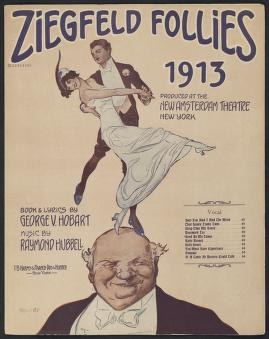
A poster for the 1913 Ziegfeld Follies centers on a male dancer lifting a female dancer in an exuberant aerial pose. The woman arches backward in the man's arms, her body nearly horizontal, her white gown and pale legs creating a stark contrast against his dark tailcoat. She wears what appears to be a short, classical Greek or Roman-inspired costume with a high waistline typical of early 1910s theatrical design. The man is shown in profile, muscular and animated, executing the lift with apparent ease. Below this central pair is an oversized caricatured head of what appears to be a theatrical personality—likely the producer or a featured performer—rendered in a cartoonish style with exaggerated features. The poster's typography dominates the composition, with "ZIEGFELD FOLLIES" and "1913" in large capitals. Text indicates this was produced at the New Amsterdam Theatre, New York. The color palette is muted—cream, tan, and sepia tones—typical of printed theatrical posters of the period.
The dancing
The male dancer maintains a deep lunge stance with bent knees, providing a stable base for the overhead lift. His upper body is relatively upright despite the weight, and his arms support the woman securely. The female dancer is in a dramatic unsupported arch, her body extended in a smooth curve from knees to shoulders, her legs extended and feet pointed. Her posture suggests training in balletic movement—the pointed feet and the control evident in the arch. The lift itself is a partner acrobatic move requiring significant strength and timing. The two bodies create a dynamic diagonal line across the composition.
The dance depicted
This is theatrical partner acrobatics, likely part of a vaudeville or musical theatre spectacle. The Ziegfeld Follies were known for featuring gymnastic and acrobatic partner work integrated into larger musical productions; this was not pure tango, though the title 'Good-bye my tango' suggests the number may have been framed with a tango narrative or Argentine tango styling in publicity. The lift shown—an overhead arch or extension—was typical of American theatrical dance of the period and may have been performed to tango music or with tango-influenced choreography, but the movement itself is acrobatic rather than strictly tango technique. The image documents the athletic spectacle that defined early 20th-century theatrical dance in American musical theatre.
How it was made
This is a lithographic poster, evident from the soft edges, the limited color palette, the hand-drawn quality of the figures, and the integrated text treatment typical of early 1910s theatrical printing. Lithography allowed for rapid, cost-effective production of large run posters for distribution to theaters and public spaces. The technique's reliance on bold forms and simplified color planes meant the artist had to capture movement and anatomy efficiently, which here has been done with considerable draftsmanship—the musculature of the male dancer and the arc of the female dancer's body are rendered with anatomical understanding despite the stylized medium. The caricatured head below suggests this was created by an illustrator practiced in theatrical advertising.
About this work
This is a promotional poster for the 1913 season of the Ziegfeld Follies, the influential American musical revue series produced by Florenz Ziegfeld. It advertises an act called 'Good-bye my tango,' featuring partner acrobatics set within a theatrical dance spectacle. The poster is both advertisement and documentation: it promises spectators the athletic partnered lifting that was central to American theatrical dance of the period, and it captures the moment of peak visual drama—the woman fully airborne and arched, her weight entirely dependent on her partner's strength and control.
The work sits at the intersection of dance, athletic performance, and theatrical spectacle. The Ziegfeld Follies were not ballet and not pure concert dance; they were commercially produced musical entertainment in which dance, acrobatics, comedy, and visual display were woven together. This poster celebrates the physical virtuosity of partner work—a form that would eventually evolve into modern ballroom, into theatrical jazz dance, and into contemporary circus arts.
How to look at it
Look at the moment of suspension: the woman is neither rising nor falling, but captured at the apex of the lift where her weight is fully transferred to her partner and she has achieved maximum extension. This is the instant of greatest visual drama and greatest physical demand. Notice also the artist's choice to show the male dancer's body in profile and relatively contained, so that the viewer's attention goes entirely to the woman's extended form. The contrast between her pale gown and pale skin against his dark coat emphasizes the lift itself rather than the partnership. The caricatured face below is not incidental—it claims authority and personality for the act, suggesting this was a featured performance by named performers whose faces were known to theatre-goers.
The period
The Ziegfeld Follies (1907–1931, with revivals) were modeled on the Paris Follies Bergère and represented American popular theatre at its height. They featured lavish production values, beautiful performers, and a sophisticated blend of comedy, music, and dance. The theatrical dance of this period was not yet categorized as 'modern dance' (that emergence came through concert artists like Ruth St. Denis and Martha Graham in the 1920s), nor was it classical ballet—American ballet as an institution would not fully establish itself until the 1930s. Instead, theatrical dance in the Follies drew from vaudeville, from ballroom and social dance, from acrobatics, and from European musical theatre. The tango craze had swept America and Europe in the early 1910s, making 'tango' a marketable theme for theatrical acts. The emphasis on the dancer's athleticism—the visible musculature, the difficulty of the lift, the drama of the unsupported arch—reflected both the period's fascination with physical culture and the competitive economics of musical theatre, where each act had to be more spectacular than the last.
Where it lives
This poster comes from the Library of Congress collections and represents the kind of commercial theatrical ephemera that documented American entertainment. Such posters were produced in multiple copies and distributed to theaters, street kiosks, and print shops; they are documents of how producers sold theatrical experience to the public.
Dance in this work
Questions about this work
Was the 'tango' in the title an actual tango dance?
The title suggests a tango theme, and the Ziegfeld Follies did perform tango-influenced numbers during the 1910s tango craze. However, what is shown in the poster is partner acrobatics—lifting and extensions—rather than tango footwork or hold. The number may have combined tango styling with acrobatic spectacle, or the tango title may have been marketing that played on the period's enthusiasm for the dance. Without seeing the actual performance, we cannot say definitively.
How did Ziegfeld Follies dancers train for these kinds of lifts?
Follies dancers came from varied backgrounds: some had vaudeville experience, some had studied ballet or acrobatics, some came from social dance. They trained in the specific choreography they were assigned and worked with male partners who were often acrobats or vaudeville performers as much as they were dancers. The partnership required strength, timing, and trust, but not necessarily the formalized technique of later theatrical dance.
Why is there a caricature at the bottom of the poster?
The caricatured head represents a personality associated with the act—likely the male performer or possibly a featured comedian or star of the Follies. Theatrical posters of the period often featured caricatures of well-known performers to attract audiences who came to see specific stars. It was a form of celebrity advertising.
What does this tell us about women dancers in 1913?
The woman is shown as an object of visual spectacle—passive, extended, supported entirely by male strength. She is beautiful and athletic, but the choreography does not give her agency or independent movement. This reflects the period's theatrical conventions, where women in revue were valued as beautiful moving objects rather than as autonomous performers. She is doing difficult acrobatic work, but the poster frames it as display rather than artistry.
More dance artwork





