49 works in this view — arrow keys or swipe to move between them.
Dance in Art · 1912
The Merry minuet
Unknown artist
- Source:
- Library of Congress
- Rights:
- Public domain — free to use, share and adapt.
- Recorded as:
- Public Domain
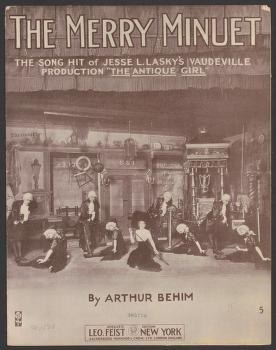
This poster reveals how social dance and historic dance forms like the minuet were commodified and staged in early commercial musical theater, as well as the crucial role of the visual arts—here lithographic poster design—in promoting theatrical productions. It documents the interface between dance, theater, graphic design, and popular culture in the early 20th-century entertainment industry, showing that minuet dancing in this era was not a concert or ballroom practice but a theatrical, comedic, and commercially packaged spectacle.
What you are looking at
A theatrical stage set depicting an interior parlor or drawing room, likely from a wealthy household. The space is framed by a proscenium arch and shows an elegant interior with period furnishings: a fireplace with mantelpiece on the left, windows with draped curtains, wall sconces, and furniture arranged to suggest a formal sitting room. Multiple figures in early 20th-century dress are positioned throughout the space in various poses of social interaction. The lighting is theatrical, with strong contrasts that emphasize the depth of the stage and the silhouettes of the dancers. The overall composition suggests a narrative moment—likely a romantic or comedic scene—from a musical production, with the carefully arranged figures suggesting choreographed blocking rather than naturalistic movement.
The dancing
At least six figures are visible, dressed in Edwardian or early 1910s fashion with long skirts for the women and formal suits for the men. The figures occupy different planes of the stage, some in the foreground closer to the viewer and others receding into the background. The poses suggest social interaction—some figures appear to be standing in conversation, others seated or in transitional movement. The women's skirts show volume consistent with the period's silhouette. The overall arrangement suggests this is a choreographed scene where the bodies are positioned for visual composition and narrative clarity rather than depicting continuous dance action.
The dance depicted
This is a theatrical musical scene, not a ballroom or concert dance performance. The title references a minuet, the historic baroque dance form (MIN code), and the staging suggests this is from a musical comedy or operetta that incorporates social dancing as part of its narrative. The minuet was popular in early 20th-century theatrical revivals and period comedies as a reference to 18th-century elegance and courtship. The scene captures a posed moment of social choreography rather than active dance movement, consistent with how dances were staged in theatrical productions of this era—as narrative beats integrated into dramatic action.
How it was made
This is a color lithograph, a printing technique that allowed for mass production and distribution. The poster format, bright colors, and compositional style are characteristic of theatrical publicity materials from the early 1910s. Lithography made such images affordable and accessible, widely circulated as promotional materials for theater productions. The technique's capacity for rendering interior detail, fabric texture, and theatrical lighting made it ideal for capturing the visual spectacle that would draw audiences to a show. The printed text at top and bottom confirms this is promotional material rather than fine art.
About this work
This is a theatrical poster for a musical comedy production titled 'The Merry Minuet,' based on Jesse Lasky's 'Vaudeville Production The Midnight Girl,' with music by Arthur Behim and published by Leo Feist in New York. The image shows the stage set and figures from what appears to be a key scene in the musical—an interior drawing-room setting where social dancing and romantic comedy unfold. The minuet, an 18th-century court dance, was a popular subject for early 20th-century theatrical pastiche, deployed to signal elegance, historical reference, and comedic potential. The work documents both the visual style of theatrical production design and the role of dance as narrative and spectacle in popular musical theater of the 1910s.
How to look at it
Observe how the artist has arranged the figures in compositional balance across the stage space, using the architectural frame of the interior set to organize the scene. The carefully staged poses and the formal interior setting—fireplace, windows, furnishings—create a narrative of social interaction and courtship rather than depicting active dance movement. Notice how the theatrical lighting creates depth and emphasizes the silhouettes of the figures, making the stage space feel architecturally convincing and dramatically engaging. The early 20th-century dress and the titled reference to the minuet signal that this is a historical pastiche, a theatrical wink at 18th-century elegance packaged for contemporary commercial entertainment.
The artist
Arthur Behim composed the music for this theatrical production. The poster itself was published by Leo Feist, a major music publisher in New York, though the designer of the poster is not credited in the visible catalogue information. Theatrical posters of this period were often produced by in-house design teams or freelance commercial artists whose names were not preserved.
The period
The early 1910s saw a flourishing of musical comedy and operetta in American theater, building on late 19th-century traditions of vaudeville and light musical drama. This was an era when theatrical spectacle—elaborate sets, choreographed movement, and period-dress comedy—were central to commercial entertainment. The minuet enjoyed a particular vogue in theatrical productions as a reference to aristocratic 18th-century culture, deployed for comedy, romance, and visual elegance. Jesse Lasky was a prominent figure in theatrical production during this period, later becoming a major film producer, and the shift from stage to film was already beginning. Lithographic poster design was at its height as a medium for advertising theatrical productions, before photographic methods displaced it.
Where it lives
This is a color lithographic poster published by Leo Feist of New York, a major music publisher of the era. The work is held by the Library of Congress. As a promotional artifact, it was produced and distributed to advertise the theatrical production, making it a document of popular culture and commercial entertainment design as much as a record of the production itself.
Dance in this work
Questions about this work
Is this image of actual minuet dancing?
No. This is a theatrical stage scene from a musical comedy, showing a choreographed moment of social interaction in an interior setting, titled to reference the minuet. The minuet in early 20th-century theater was typically a staged, narrative moment rather than a concert or ballroom performance of the baroque dance form itself.
Who created this poster?
The composer Arthur Behim is credited for the music. The poster was published by Leo Feist in New York, a major music publisher. The artist or designer of the poster itself is not identified in the available catalogue information, which was common for commercial theatrical publicity of the era.
Why is the minuet a subject for musical comedy in 1912?
The minuet was a fashionable reference to aristocratic 18th-century culture, deployed in early 20th-century theater for visual elegance, comedic courtship scenarios, and historical pastiche. It signaled sophistication and courtly manners while allowing contemporary audiences to enjoy the spectacle of period costume and staged dancing.
What is this poster's historical significance?
It documents the role of visual design and advertising in promoting theatrical dance and musical theater in the early commercial entertainment industry, and shows how historic dance forms were adapted as theatrical narrative devices rather than preserved as ballroom or concert practices.
More dance artwork





