49 works in this view — arrow keys or swipe to move between them.
Dance in Art · 1977
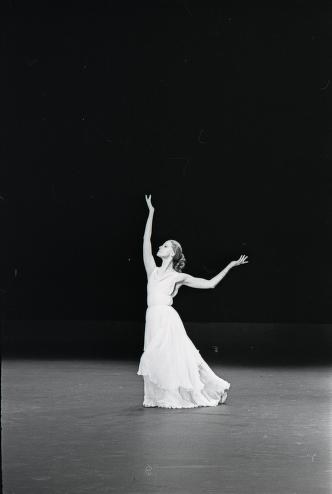
Maya Plisetskaya in the Role of The Great Barefoot.
Unknown artist
- Source:
- Library of Congress
- Rights:
- Public domain — free to use, share and adapt.
- Recorded as:
- Public Domain
Plisetskaya was one of the most celebrated and versatile ballet dancers of the 20th century, known for both classical roles and experimental contemporary work. This image documents her in a less-canonical role, suggesting the breadth of her repertoire beyond the standard classical ballet canon. For dance historians, it provides evidence of Soviet theatrical ballet's interest in blending classical technique with expressive, modernist movement during the 1970s.
What you are looking at
A solo female dancer stands alone on a dark stage, captured in a moment of lyrical extension. She wears a flowing white dress with a fitted bodice and a skirt that falls to mid-calf with soft, gathered folds. Her head is tilted back, her right arm raised overhead in an open, expressive gesture while her left arm extends outward at shoulder height, creating an open diagonal line through her body. The lighting is stark and sculptural, illuminating her pale figure against the black background. Her weight appears to be on one leg, the supporting leg straight, while the other leg is positioned in a relaxed extension behind or to the side—not a pointed position but a natural, unfixed line. The pose suggests a moment of emotional expression rather than technical display.
The dancing
The dancer stands in a turned-out position with a long vertical line through her torso. Her arms are held in a soft, open frame—neither strictly classical nor contemporary, but something between. The head is thrown back in a gesture suggesting abandon or emotion. There is no visible pointe work; her feet appear flat or in a simple relâché position. The overall carriage and arm placement suggest modern ballet or a transitional style between classical technique and something more expressive or theatrical.
The dance depicted
This appears to be modern or expressive ballet rather than classical technique. The white dress and turned-out stance indicate ballet training, but the movement quality—the open arms, the tilted head, the lack of precision in foot position—suggests a more romantic or lyrical approach, possibly from Soviet-era theatrical ballet. The catalogue identifies the dancer as Maya Plisetskaya in the role of 'The Great Barefoot,' which is not a standard classical ballet title and suggests either a contemporary or character role. Without access to the full choreography or production context, the exact style cannot be confirmed, but the image shows a dancer moving away from strict classical rigor toward emotional and gestural expression.
How it was made
This is a black-and-white photograph, likely a stage photograph or production still given the theatrical lighting and composed nature of the pose. The high contrast between the figure and background is characteristic of professional theater photography of the 1970s, which relied on dramatic side or front lighting to isolate the dancer against a black cyc or drop. The photographic medium captures a single instant, freezing movement into a sculptural pose—a common practice for documenting dance performance before video became standard. This type of photograph would have been used for publicity, documentation, or archival purposes.
About this work
This is a stage photograph of the acclaimed Soviet ballet dancer Maya Plisetskaya performing a solo role identified as 'The Great Barefoot' in 1977. The image shows her in a moment of expressive, arms-open movement in a white flowing dress, her body tilted back in an emotional gesture. The style sits between classical ballet technique and more modern, expressive movement—consistent with Soviet theatrical traditions of the period, which valued both technical mastery and dramatic interpretation. This is a document of a specific performance moment by one of the 20th century's greatest ballet dancers, capturing her in what appears to be a dramatic or romantic solo.
How to look at it
Note the moment chosen by the photographer: not a moment of technical display (no jump, no turn, no pointed extension) but a moment of stillness and emotional openness. The head-back pose and open arms frame a gesture of yearning, release, or dramatic intensity. Observe how the photographer used stage lighting to create a strong silhouette and to isolate the white-clad figure—a standard documentary technique that emphasizes form and gesture over the surrounding space. The pose itself is held, suggesting this is either a resting point in the choreography or a position held for dramatic effect rather than a fleeting moment in a rapid phrase.
The artist
The photographer is unknown. This is likely a professional stage or production photograph from a Soviet theater, possibly the Bolshoi Theater or another major institution where Plisetskaya performed. The quality and style suggest a trained theater photographer working with professional stage lighting, which was standard practice for documenting major dance productions.
The period
In 1977, Maya Plisetskaya was in the later but still active phase of her performing career (she lived 1925–2015). Soviet ballet in the 1970s was experiencing both continuity with the Vaganova tradition and increasing openness to contemporary choreography. Plisetskaya was known for championing new work and crossing boundaries between classical and contemporary styles. The photograph reflects a period when Soviet dance institutions were beginning to expand beyond the classical canon, with dancers like Plisetskaya taking on experimental or dramatically demanding roles.
Where it lives
The record indicates the photograph comes from the Library of Congress (loc) with a date of January 1, 1977. The collection or holding institution is not recorded. This appears to be a professional stage or production photograph, likely obtained as part of a general archive of dance documentation or press photography from major international performers.
Dance in this work
Questions about this work
Who was Maya Plisetskaya?
She was a Soviet prima ballerina (1925–2015) and one of the greatest dancers of the 20th century, known for her dramatic intensity, technical virtuosity, and willingness to dance both classical roles and experimental contemporary work. She was a principal dancer at the Bolshoi Ballet for decades and was celebrated internationally.
What does 'The Great Barefoot' mean?
This title is not a standard classical ballet work in the major canon. It may be a contemporary or character piece created for Plisetskaya, or a translation from a Russian title. Without additional documentation, the exact work cannot be identified, but it suggests a solo role with dramatic or experimental elements rather than classical technique.
Why is she not on pointe?
The pose shows flat or relâché feet, which suggests either a moment in the choreography when pointe work is not in use, or a deliberate choice to work without pointe—common in modern ballet or in dramatic/emotional passages where the choreographer wants a different quality of movement. Soviet choreography of this period often mixed classical technique with other movement qualities.
Is this a publicity photograph or a performance document?
It appears to be a professional stage photograph, likely taken during a performance or performance documentation session. The theatrical lighting and composed nature suggest it was taken under controlled conditions, either during a live show or as a studio documentation. Such photographs served both as publicity and as performance records.
More dance artwork





