49 works in this view — arrow keys or swipe to move between them.
Dance in Art · 1918
Dancing honeymoon
Unknown artist
- Source:
- Library of Congress
- Rights:
- Public domain — free to use, share and adapt.
- Recorded as:
- Public Domain
The dip was the visual shorthand for romantic surrender in early 20th-century theatrical dance, and this image crystallizes that moment. For dancers and historians, it shows how ballroom technique was adapted for stage performance and how dance was used to tell stories about desire, trust, and newlywed joy in the popular theater of the era.
What you are looking at
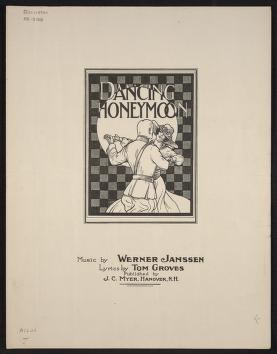
A woodcut or wood engraving in a checkerboard-framed border, probably from sheet music or a theatrical program cover. The central image shows a couple in a tight embrace, positioned as if mid-dance: the woman reclines backward at a steep angle, her body supported entirely by the man's arms and frame, her head thrown back and one leg extended. The man leans into her, his posture entirely devoted to catching and cradling her weight. Both figures wear early 20th-century dress—he in a dark suit, she in a light dress with a short skirt. The composition is intimate and theatrical, capturing a moment of maximum physical trust and abandon. The title "DANCING HONEYMOON" appears in bold lettering above the scene, and below are printed credits: "Music by WERNER-JANSSEN, Lyrics by WILL GROVER, Sung by J C Mille [?] Hoachwalt [?]".
The dancing
Two dancers in a closed ballroom frame, but inverted and exaggerated: the man stands upright while the woman reclines fully backward, her weight entirely in his arms—a dramatic drop or dip. Her body forms a long line from shoulder to foot, with one leg extended; his frame is vertical and controlled, demonstrating both strength and technical precision. The pose suggests a moment of high trust and theatrical vulnerability. This is not a standard ballroom hold but a theatrical extension of one, frozen at maximum expression.
The dance depicted
This depicts a couple ballroom dance—almost certainly a waltz or a foxtrot—rendered in the theatrical, exaggerated style of early 20th-century popular dance. The extreme dip was a signature move in both social and theatrical ballroom dancing of the 1910s–1920s, used to demonstrate a man's control and strength and a woman's confidence and malleability. The title suggests this is from a musical number about newlyweds, which places it squarely in the world of theatrical dance—likely a Broadway musical or vaudeville-adjacent piece. The engraving style and typography (Werner-Janssen was a composer active in film and theater in the 1920s–30s) suggest this is cover art for sheet music or a theatrical program.
How it was made
A wood engraving or woodcut, printed in black on cream paper and mounted on a larger sheet. The technique is formal and high-contrast, with crisp lines defining the figures and a neat checkerboard border typical of book or program design of the era. The medium—relief printing—was ideal for mass reproduction in programs, sheet music covers, and advertisements, making this a work designed for wide theatrical circulation. The bold, graphic style was well suited to promoting both the music and the dance moment it depicted.
About this work
A promotional wood engraving for a musical number, probably from the 1920s, showing a man and woman in an exaggerated ballroom dip—a theatrical signature pose of early 20th-century dance. The image combines technical ballroom vocabulary (the closed frame, the control required) with theatrical spectacle (the extreme angle and the couple's intimate positioning). It documents both a specific dance move and the culture of theatrical romance that popular musical theater sold to its audiences in this period. The work is evidence of how ballroom dance was understood—not just as social etiquette but as drama, passion, and publicly performed intimacy.
How to look at it
Attend to the geometry of the bodies: the man's vertical stability and the woman's complete horizontal extension. This is not a natural position—it is a demonstration of control, trust, and the theatrical heightening of a ballroom move. The artist chose the moment of maximum extension and vulnerability, not a moment of walking or standard closed-position dancing. Notice too the contrast between the woman's limp, trusting posture and the man's upright, commanding frame. The checkerboard border frames this as a product design—something to be reproduced and circulated—rather than a fine-art composition. This is an image made to sell a song, a show, and an ideal of romantic dance.
The artist
The credits list Werner-Janssen (composer), Will Grover (lyricist), and an unidentified performer. Werner-Janssen (1901–1988) was a composer active in film and musical theater; his concert and theatrical works place him in the world of American light music and Broadway-adjacent composition. The artist of the engraving is not recorded, but the style and finish suggest a professional theatrical designer or illustrator working for a music publisher or theater company.
The period
In the 1920s, ballroom dance was at the height of its theatrical visibility. The waltz and foxtrot, imported from Europe and adapted in America, had become staples of musical theater, cabaret, and vaudeville. The exaggerated dip—derived from the ballroom lexicon but pushed toward melodrama—was a stock device for representing passion, intimacy, and erotic charge in a form that was still respectable. At the same time, jazz and jazz-influenced social dance were transforming American dance culture; theatrical ballroom imagery like this one sat on the boundary between Victorian propriety and modern sensuality. The newlywed theme was a perennial in musical comedy, permitting displays of physical affection and romantic drama that would have been unthinkable in earlier decades.
Where it lives
The work is held by the Library of Congress and appears to be the cover or promotional art for sheet music or a theatrical program associated with a musical number titled "Dancing Honeymoon." The printed credits confirm its theatrical and commercial origin.
Dance in this work
Questions about this work
What is the dip and why was it so important in early 20th-century dance?
The dip is a drop in which one partner (usually the woman) is supported at an extreme angle by the other. It was essential to ballroom theater because it demonstrated both technical control and romantic drama. It became the visual symbol of masculine strength and feminine surrender, and was used constantly in musicals and stage shows to represent passion and trust.
Was this move actually used in social ballroom dancing, or only on stage?
Both. The dip exists in ballroom technique and was used in social dancing, but it was greatly exaggerated for theatrical effect. In social dancing, a dip is controlled and brief; on stage, it was pushed to the limit of balance and flexibility for maximum emotional impact. This image represents the theatrical version.
Who was Werner-Janssen and why is his name on this?
Werner-Janssen (1901–1988) was an American composer who wrote for theater, film, and concert. His name appears here because he composed the music for the song "Dancing Honeymoon." The engraving served as cover art for the sheet music, which would have been sold to the public and performed by singers and dancers.
What does the checkerboard border mean?
The checkerboard frame is a design convention of the period, used to create a discrete, formal frame around the image. It signals that this is a designed product—sheet music or a program—rather than a fine-art print. It was both decorative and functional, helping the image stand out when printed alongside text.
More dance artwork





