49 works in this view — arrow keys or swipe to move between them.
Dance in Art
Ancient dancing
Unknown artist
- Medium:
- Source:
- New York Public Library
- Rights:
- Public domain — free to use, share and adapt.
- Recorded as:
- public_domain
This image documents a crucial moment in European dance history: the shift toward Romantic ballet and the aestheticization of the dancing body as an expression of idealized beauty and emotional inwardness. The print medium and neoclassical framing offer insight into how dance was visualized, circulated, and understood among cultured audiences of the period—not as entertainment but as art aligned with sculpture, poetry, and philosophy.
What you are looking at
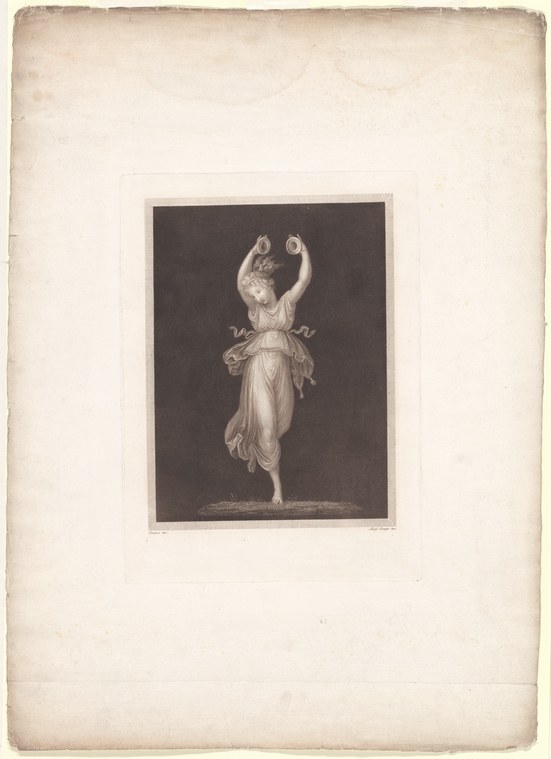
A single female figure dominates the composition, shown standing in three-quarter view against a dark background. She wears a high-waisted neoclassical gown of white or pale fabric with draped sleeves and decorative swags or garland-like ornaments at her hips. Her arms are raised above her head in a graceful arc, with her hands and forearms positioned as though holding or about to manipulate an invisible object. Her head tilts back, her body forming a gentle S-curve from the extended arms through the torso. The figure stands on a minimal ground line, creating an ethereal, weightless quality. The print technique—likely an engraving or stipple engraving—renders the figure in delicate tones of grey and cream against the stark darkness, emphasizing the contrast between the illuminated body and the void of the background.
The dancing
The dancer's frame is open and extended, with both arms raised symmetrically above and slightly behind the head—a position suggesting classical training and an inward, meditative moment rather than outward display. The torso is engaged but relaxed, supported on what appears to be a single leg with the weight centered, while the other leg is subtly bent or positioned to balance the upward lift of the arms. The head's tilt backward and the elongation of the neck suggest a vocabulary of movement concerned with vertical extension and grace rather than percussive or grounded technique. The overall silhouette is unified and sculptural rather than dynamic or kinetically complex.
The dance depicted
This appears to depict a figure from the neoclassical dance vocabulary of the late eighteenth or early nineteenth century—possibly a muse, an allegorical figure, or a representation of an idealized dancer engaging in a moment of lyrical, balletic movement. The raised-arm position and the overall aesthetic vocabulary suggest Romantic or pre-Romantic ballet idiom, though the figure is presented as a solitary study rather than within a narrative scene. The dress, posture, and neoclassical setting indicate this is not a contemporary social dance but rather a theatrical or aspirational image of an elevated art form. Without further inscription or context, the specific identity of the dancer or the precise choreographic moment remains unclear.
How it was made
This is a print, most likely an engraving or stipple engraving, executed in black ink on laid paper. The technique creates subtle tonal gradations through careful hatching or stippled dots, allowing the artist to render the folds of fabric and the modeled surface of the body with considerable delicacy. Engravings of this quality and finish were produced for circulation among collectors and connoisseurs, often as reproductive prints after paintings or as independent artistic works. The size and presentation suggest this was intended as a finished work suitable for framing or binding into a collection, rather than a preliminary study or ephemeral document.
About this work
This engraving presents an idealized neoclassical figure in a pose of lyrical extension and grace. The work exemplifies the late eighteenth-century fascination with linking dance, classical sculpture, and allegorical representation—a period when dancers and dance imagery were increasingly presented as embodiments of virtue, beauty, and refined taste. The solitary female figure, elevated on a dark ground, recalls both the sculptural tradition and the theatrical image, suggesting a moment of transcendence rather than social interaction or narrative action. The print format and execution indicate this was a work of some ambition and intended for an educated audience familiar with both neoclassical aesthetics and the culture of theatrical dance.
How to look at it
Observe how the artist has chosen a moment of apparent stillness or suspension rather than action—the raised arms and tilted head suggest a pause or a moment of internal emotion rather than a step or a turn. Notice the careful rendering of the fabric, which emphasizes the body's verticality and grace rather than any sense of weight or effort. The dark background serves to isolate the figure and heighten its ethereal, almost ghostly quality. The overall composition invites contemplation rather than excitement, inviting the viewer to see in the dancer's pose a reflection of refined sensibility and classical ideals.
The period
The late eighteenth and early nineteenth centuries saw an intense cultural investment in refining and elevating dance as an art form. Influenced by Enlightenment philosophy and neoclassical aesthetics, dancers and choreographers increasingly drew on idealized representations of classical antiquity, while the body itself became a vehicle for expressing sentiment and moral virtue—a shift that would culminate in Romantic ballet. Prints like this served as ambassadors for these ideas, circulating images of the idealized dancer to audiences who might never see a live performance. The combination of neoclassical dress, allegorical bearing, and refined printmaking technique reflects the period's aspiration to link dance with the fine arts.
Where it lives
This print is held by the New York Public Library and originates from their collection. Its catalogue entry is sparse, offering only the title "Ancient dancing" and a designation of unknown era and general dance content, which suggests it may have been acquired as part of a broader collection without detailed individual cataloguing.
Dance in this work
Questions about this work
Is this a portrait of a real dancer?
There is no evidence in the image or record to suggest this is a portrait. The allegorical pose, neoclassical dress, and idealized presentation indicate this is a study of an imagined or archetypal figure rather than a specific performer. It may have been inspired by a dancer or a theatrical image, but it functions as an idealized representation rather than a likeness.
What dance form is this?
The vocabulary—raised arms, extended frame, vertical emphasis, and ethereal bearing—aligns with the emerging ballet vocabulary of the late eighteenth century, particularly as it was influenced by neoclassical aesthetics. This is not a social dance or a folk form, but rather an image of theatrical or artistic dance imagined as an expression of refinement and grace.
Why is the background so dark?
The darkness serves multiple purposes: it isolates the figure, emphasizing her whiteness and luminosity; it creates a sense of otherworldliness or timelessness; and it was a practical choice of the engraving medium, where dark areas required less labor than fully detailed backgrounds. The effect is to present the dancer as a vision or study rather than as a figure within a narrative scene.
What era is this from?
Based on the style of the dress, the aesthetic vocabulary, and the printmaking technique, this was most likely created in the late eighteenth or early nineteenth century, during the neoclassical period and the emergence of Romantic ballet. The record lists the era as unknown, but the visual evidence points to this window of time.
More dance artwork