49 works in this view — arrow keys or swipe to move between them.
Dance in Art
The lure of the dance
Unknown artist
- Medium:
- Source:
- New York Public Library
- Rights:
- Public domain — free to use, share and adapt.
- Recorded as:
- public_domain
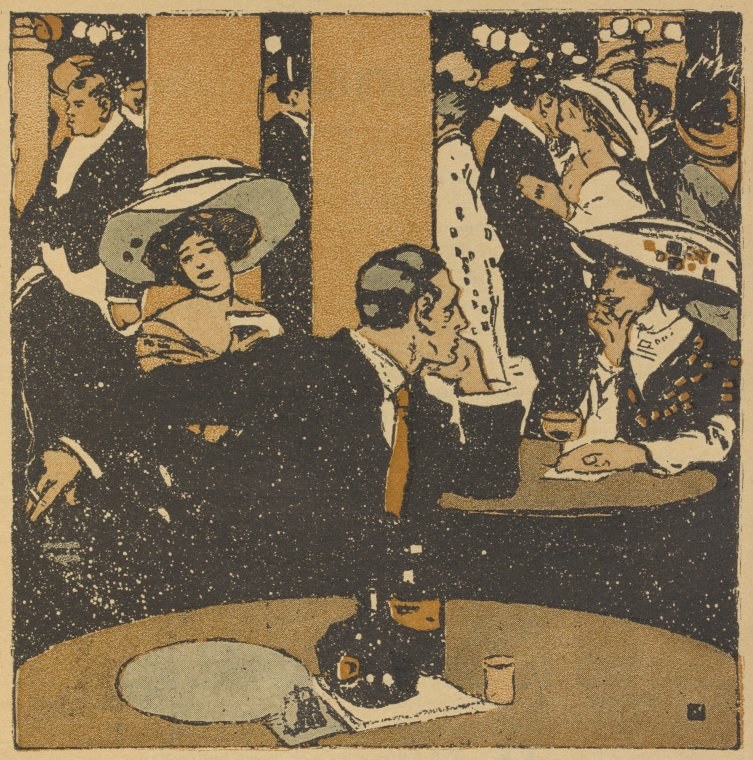
This work captures a pivotal moment in the social and artistic role of dance: the emergence of commercialized, mixed-gender, urban ballroom and cabaret culture as a modern phenomenon worthy of artistic representation. The print demonstrates how dance halls became spaces of contested social value—sites of liberation and desire for some, moral anxiety for others—and how visual artists engaged with that complexity. The composition and style suggest the work was made during or shortly after a period of intense innovation in both dance and printmaking, when the formal possibilities of both media were being radically reimagined.
What you are looking at
A crowded indoor scene of social dancing, rendered in a woodcut or linocut style with bold black lines and warm tan and cream tones. The composition is vertically divided by two tall rectangular panels of cream or light wood, suggesting pillars or architectural divisions in a dance hall or ballroom. On the left, a woman in a large feathered hat leans back in a relaxed posture, while on the right a group of five or six figures cluster together—men in dark suits and fedoras, women in fashionable dress and hats. In the foreground, an empty place setting with plate and glass sits on a tan surface, suggesting this is a supper room or cabaret where dancing and dining occur. The figures' poses are animated and informal; some lean, gesture, and turn toward one another in the loose, social manner of couples meeting and interacting rather than executing choreography. The background densely packed with faces and figures, the foreground quiet and staged, creates the effect of an intimate moment within a larger revelry.
The dancing
The bodies show no formal dance frame or hold. Instead, figures stand, lean, and gesture in the conversational postures of social mingling. The woman on the left reclines with her weight shifted, head tilted, one arm extended in an inviting or dismissive gesture—a pose of leisure and flirtation rather than dance technique. The cluster on the right stands upright, some with hands on hips or arms at their sides, engaged in what appears to be animated talk or observation. No couple is shown in a closed dance position; the grouping is ad-hoc and social.
The dance depicted
This is a scene of social dance or cabaret culture, most likely from the early twentieth century, depicting the leisure and courtship rituals of urban ballroom or supper-club life rather than a specific dance form. The 'lure' in the title suggests the seductive or magnetic pull of the dance hall itself—the promise of music, movement, romance, and escape from everyday constraint. The setting and dress indicate this is commercial dance entertainment or social dancing among the middle or upper-middle classes, the kind of venue where ragtime, jazz, or ballroom dances would have been performed. No specific style or technique is evident; this is a scene about the culture of dancing, not a demonstration of dance itself.
How it was made
This is a print—most likely a woodcut or linocut, or possibly a lithograph. The characteristic bold outlines, high contrast between black and cream, and the textural speckle throughout suggest relief printing rather than engraving or etching. The medium was well-suited to rapid reproduction and popular circulation; such prints were common in early twentieth-century art and commercial illustration, often published in journals, posters, or as standalone gallery prints. The technique allowed the artist to create strong graphic impact and a sense of movement through simplified form and dynamic composition, effects that would have resonated with modern art audiences of the period.
About this work
This is a print depicting the social world of early twentieth-century dance halls and cabarets. The title *The Lure of the Dance* invokes not a specific choreography but the magnetic appeal of dance culture itself—the glamour, sexuality, and social transgression promised by a night of music and movement in a modern urban venue. The composition frames an intimate moment of flirtation and encounter within a crowded public space, using the formal device of architectural panels to focus attention on individual figures while keeping the larger revelry visible. The work belongs in a gallery of dance in art as a document of how dance functioned as a site of social desire and modern leisure, and as a formal subject that could command serious artistic attention in the early twentieth century.
How to look at it
Attend to the contrast between the formal architectural structure of the room (the two vertical panels that frame and divide the composition) and the informal, chaotic energy of the figures within it. The artist has chosen not a moment of dancing itself but a moment of social encounter and display—the 'lure' exists in the promise and the flirtation, not in executed movement. Notice how the foreground place setting, untouched and empty, suggests that eating, drinking, talking, and dancing were interwoven experiences in the modern dance hall, and that the real action is social interaction rather than choreography.
The period
This work was created during the early twentieth century, when ballroom and cabaret culture were reshaping urban social life and provoking intense cultural debate. Ragtime and jazz were beginning to influence ballroom dancing; the tango craze of the 1910s had scandalized conservative society; and dance halls were simultaneously celebrated as spaces of modern freedom and condemned as sites of moral decay. In the visual arts, Expressionism and other modernist movements were exploring distortion, bold outline, and psychological intensity as means to capture modern experience. Printmaking—particularly woodcut and linocut—was undergoing a revival, both as a fine art medium (especially in German Expressionism) and as a tool for social commentary and popular dissemination.
Where it lives
This work is held by the New York Public Library. It is catalogued as a print of unknown date, artist, and collection; the NYPL record provides minimal information beyond the title.
Dance in this work
Questions about this work
What dance are they doing?
No specific dance is being performed in this image. The print depicts a moment of social mingling and flirtation in a dance hall or cabaret—the environment and culture of dancing, rather than choreography itself. The title 'The Lure of the Dance' refers to the magnetic appeal of the dance hall as a modern social space, not to any particular step or style.
When was this made?
The style, dress, and print technique suggest the early twentieth century, probably the 1910s or 1920s. The catalogue record provides no definitive date. The fashion, the informal mixed-gender socializing, and the modernist printmaking technique all point to the period when urban ballroom and cabaret culture was at its height in Europe and America.
Why is the place setting in the foreground?
It signals that this is a supper room, cabaret, or restaurant-dance hall—a venue where dining, drinking, and dancing were concurrent activities. The empty, untouched plate in the foreground contrasts with the animated social life in the background, suggesting that for the patrons, the real hunger was social and erotic, not culinary.
What does the woodcut style contribute?
The bold outlines, high contrast, and graphic simplification create a sense of urgency and modernity. The technique was popular among early twentieth-century artists who wanted to capture the energy and psychological intensity of modern life. The rough, almost crude texture also gives the scene an immediacy and social realism—this is not a refined salon scene but a vital, crowded, morally ambiguous public space.
More dance artwork