49 works in this view — arrow keys or swipe to move between them.
Dance in Art · 1978
Birth of a Ballet "Béjart Style".
Unknown artist
- Source:
- Library of Congress
- Rights:
- Public domain — free to use, share and adapt.
- Recorded as:
- Public Domain
Béjart was one of the most influential choreographers of the late 20th century, and this image preserves evidence of how he staged emotional intensity through unexpected uses of the body and space. For historians of contemporary dance, the photograph documents the vocabulary and aesthetic of 1970s dance theatre—the rejection of purely technical display in favor of theatrical presence and emotional authenticity.
What you are looking at
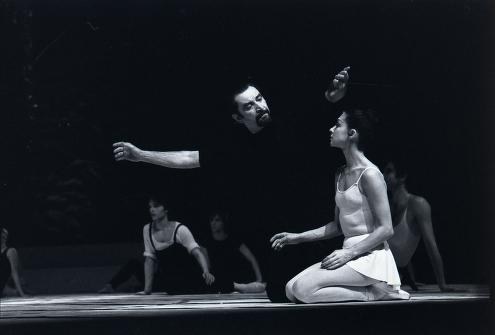
A black and white photograph captures an intense moment of theatrical dance, shot against a dark background that isolates the figures. In the foreground, a male dancer in glasses sits upright on the stage floor, shirtless, his body held in a controlled posture. His right arm extends toward a standing female dancer positioned to his right, who wears a simple white sleeveless top and matching white pants. Her body leans slightly forward in response, her arms open and gestural. Behind them, several other dancers in similar minimal dress are visible but out of focus, suggesting a larger ensemble. The lighting is stark and sculptural, falling across the lead male dancer's torso and face, creating strong shadows that emphasize the geometry of the bodies and the emotional intensity of the moment. The composition suggests a narrative climax or moment of physical and emotional connection.
The dancing
The primary male figure sits with weight grounded through his hips and legs, his torso upright and engaged, arms active and reaching. The female dancer stands with a slight forward inclination, her body responsive to his gesture, her arms open in an attitude of receiving or engagement. Their spatial relationship is intimate and charged—close enough to suggest connection but not touching. The other ensemble members visible in soft focus suggest this is a group work with hierarchical focus on the lead couple. The level change from sitting to standing creates dynamic visual contrast.
The dance depicted
This appears to be a work in the contemporary ballet or modern dance idiom, specifically evocative of the Béjart choreographic style mentioned in the title. Maurice Béjart was known for integrating contemporary movement vocabulary with dramatic intensity, often using unusual spatial relationships, floor work, and emotional directness. The seated male figure and standing female figure, the minimal costume, the stark theatrical lighting, and the apparent narrative or emotional content all align with Béjart's signature approach to dance theatre. The 1978 date places this in the mature phase of Béjart's career. The title "Birth of a Ballet 'Béjart Style'" suggests this may document the creation or rehearsal process of a new work, though the polished staging and lighting indicate a performance or promotional photograph rather than a candid studio image.
How it was made
This is a black and white photograph, likely a professional press or documentary image from a theatrical performance or dress rehearsal. The controlled lighting, clean focus on the lead dancers, and soft focus on the ensemble suggest studio photography or stage documentation using professional equipment. The aesthetic—the deep blacks, the sculptural quality of the light, the stark composition—was characteristic of 1970s dance photography, which often sought to isolate dancers and emphasize form and emotion over narrative context. This type of image would have circulated through dance publications, press releases, and archives, making it accessible to dance historians and enthusiasts rather than existing as a unique art object.
About this work
This is a documentary photograph of a theatrical dance performance or creation process from 1978, capturing a moment in a work created in or inspired by the style of Maurice Béjart. The image records a highly theatrical tableau: a male dancer seated and gesturing toward a standing female dancer, surrounded by an ensemble, all lit with the sculptural intensity characteristic of Béjart's approach to dance theatre. The photograph documents not just the movement itself but the dramatic and emotional intensity that Béjart brought to contemporary ballet—his willingness to seat dancers, to use proximity and eye contact, to create moments of psychological and physical directness that departed from classical ballet convention. The image belongs in a dance archive both as a record of Béjart's work and as an example of how dance photography itself functioned as a tool for capturing and circulating the new choreographic vocabularies of the 1970s.
How to look at it
Look at the spatial relationship between the two lead dancers: the seated position creates an unusual power dynamic and level relationship that makes the connection between them feel psychologically loaded rather than formally beautiful. Notice how the female dancer's body leans into the space the male dancer has opened, suggesting responsiveness. The photograph captures not a moment of technical display but a moment of mutual attention and emotional charge. The stark lighting and dark background force the viewer to attend to the bodies themselves rather than scenography, which is exactly what Béjart intended: the human form and its emotional presence as the primary content.
The artist
The artist of this photograph is not recorded in the catalogue. However, the image's professional quality, framing, and circulation as a press or documentary image suggest it was made by a dance photographer working in the 1970s, possibly for a theatre company, dance publication, or press office. The style is consistent with the work of photographers who regularly documented avant-garde dance of the period.
The period
In 1978, contemporary ballet and modern dance were undergoing rapid transformation. Béjart, along with choreographers like Forsythe and Limón-influenced artists, were dismantling the boundaries between ballet and modern dance, integrating floor work, pedestrian movement, and emotional directness into formally trained dancers' vocabularies. Simultaneously, dance photography was becoming increasingly sophisticated as a medium for both documentation and artistic expression, with photographers learning to capture the three-dimensionality and temporal flow of movement through still images. The 1970s were a moment when dance was becoming more democratic—less hierarchical, more willing to stage vulnerability and humanity alongside virtuosity.
Where it lives
The image comes from the Library of Congress collections (source: loc). It is catalogued as a documentary photograph from 1978, likely created as a press or archival record of a theatrical performance or creation process.
Dance in this work
Questions about this work
What does 'Béjart style' mean?
Maurice Béjart was a revolutionary choreographer who blended ballet training with contemporary movement, emotional intensity, and theatrical innovation. His style emphasizes the human presence and psychological content of dance over pure technical display. Works 'in the Béjart style' typically use non-classical positions (like floor work or seated figures), direct emotional engagement, dramatic lighting, and the bodies of trained dancers to create theatre rather than abstract beauty.
Why is the male dancer sitting?
In classical ballet, dancers stand unless the choreography specifically requires otherwise. Béjart frequently used levels, floor work, and non-traditional positions to create emotional impact and to break with ballet convention. A seated dancer can convey vulnerability, contemplation, or a different kind of physical presence than a standing figure. Here, it creates an intimate, psychologically charged moment.
Is this a performance or a rehearsal?
The professional lighting, clear focus, and stage setting suggest this is either a performance or a formal dress rehearsal documented by a professional photographer. The title's reference to 'birth' might suggest the creation process, but the polished production values indicate this is a finished work being performed or presented, not a candid studio moment.
More dance artwork





