49 works in this view — arrow keys or swipe to move between them.
Dance in Art
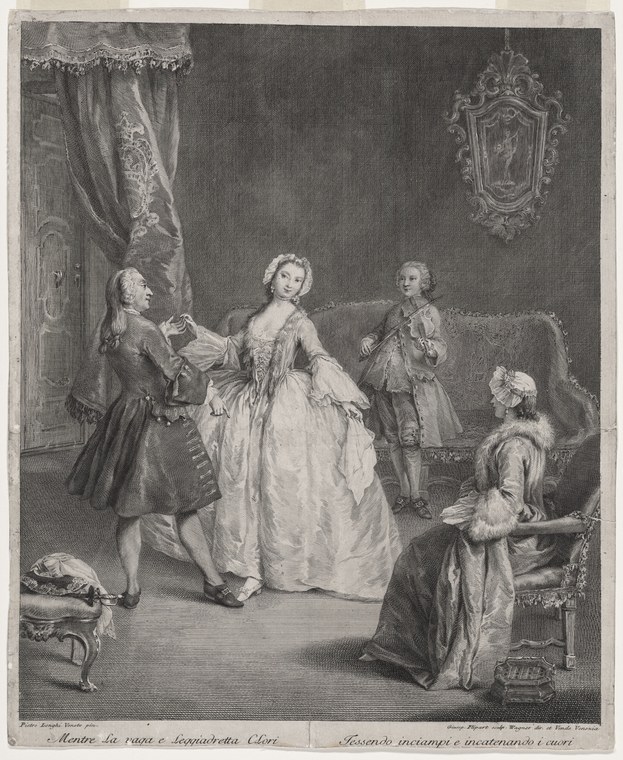
The dancing lesson
Unknown artist
- Medium:
- Source:
- New York Public Library
- Rights:
- Public domain — free to use, share and adapt.
- Recorded as:
- public_domain
The work documents the historical relationship between dance, instruction, and social courtship in the eighteenth century, when training in graceful movement and bearing was a marker of status and marriageability. It shows dance instruction not as a stage performance but as a domestic, social, and pedagogical practice central to the lives of the elite. The prominence of the female figure and the attention of multiple male viewers reflects contemporary assumptions about the role of accomplished movement in female attractiveness and social success.
What you are looking at
An elegant interior scene in which a young woman in a pale silk gown is the focus of a group of four figures arranged around her in a parlor. She stands in a relaxed pose, one arm extended, looking toward a gentleman in a dark coat and breeches on her left; a second man in similar dress stands to her right; a young person in darker clothing sits or reclines on a sofa in the background right; and a small figure in a pale gown kneels or sits on the floor in the foreground. A small dog occupies the lower left corner. The room is appointed with draped curtains, a framed mirror or heraldic shield on the wall above, and furniture suggesting mid-eighteenth-century taste. The light is theatrical, with strong contrast between the figures and the dark background, typical of reproductive engravings.
The dancing
The central woman's posture is upright but relaxed, with her weight evenly distributed and one arm extended in a graceful gesture toward the gentleman on her left. Her body is in three-quarter view, her frame open. The two male figures flank her in attitudes of attention and conversation. The figure on the floor in the foreground appears to be in a position of deference or supplication. No closed holds or formalized ballroom positions are evident; the arrangement is conversational and intimate rather than a structured dance hold.
The dance depicted
This scene does not depict an active dance in progress. Rather, it appears to document a dancing lesson or social choreography instruction in a domestic setting. The central woman's pose—poised, graceful, with extended arm—suggests she is being instructed or admired, or demonstrating a movement or deportment. The title reinforces this: a lesson scene in which instruction in movement, bearing, or courtship ritual is being conducted. The informality of the grouping, the domestic interior, and the attentive postures of the onlookers suggest an aristocratic or upper-middle-class context in which such instruction would have been a normal part of education.
How it was made
This is an engraving or etching, a reproductive print technique that allowed wide circulation of the image. The fine parallel lines used to build tone and shadow, the careful cross-hatching in the background, and the contrast between delicate detail in the figures and the dark void behind them are characteristic of mid-eighteenth-century reproductive engraving. The technique allowed the artist to capture subtle nuances of posture and expression. The inscription in Italian at the foot of the print suggests this was either produced for or circulated in an Italian-speaking market.
About this work
This is a narrative genre scene from the eighteenth century depicting a moment of aristocratic instruction or social performance in a domestic interior. The work belongs to a broader tradition of prints that documented the manners, customs, and rituals of polite society, particularly those surrounding courtship, courtship, deportment, and the acquisition of graceful movement. The focus on a single young woman as the object of attention and instruction, surrounded by attendants and admirers, is typical of such scenes. The work offers evidence of how dancing and movement instruction functioned not only as formal lessons but as social performance and ritual within the elite household.
How to look at it
Note the woman's stance and arm position: poised but not rigid, open but not theatrical. This pose was understood to embody grace and accomplishment. Observe the disposition of the other figures around her—the gentlemen flanking her, the attendant figure on the floor, the observer on the sofa—each positioned to frame and admire her. The artist has chosen a moment of stillness or pause rather than active movement, emphasizing the visual display of the body rather than the body in motion. The formal arrangement of the figures and the domestic setting recall the conventions of conversation pieces, a genre that used arranged figures to document social ideals.
The period
This print dates from the mid-eighteenth century, a period in which printed genre scenes of aristocratic life were enormously popular across Europe. Such scenes documented the manners of polite society—dancing, courtship, social games, and domestic entertainments—for a literate and socially ambitious audience. Prints of this kind were often made in series or as single sheets for framing and display. The Italian inscription suggests circulation in Italian-speaking regions, where such scenes of refined behavior held particular appeal. Dancing and movement instruction were central to aristocratic education and social life during this period, and prints depicting such scenes both reflected and reinforced contemporary ideals of grace, propriety, and social standing.
Where it lives
This print is held in the New York Public Library collection. The inscription at the foot—which appears to be in Italian—suggests it was produced for or collected in an Italian-speaking market, though the style and subject are consistent with mid-eighteenth-century European print production. The technique and composition indicate it was a reproductive print, likely produced for a broad audience rather than a single patron.
Dance in this work
Questions about this work
Is this a depiction of an actual dance, or something else?
This is not a depiction of an active dance. Rather, it shows a moment of instruction or demonstration in a domestic setting. The title indicates this is a 'dancing lesson,' and the arrangement suggests a scene of courtship or social education in which movement, posture, and bearing are being taught or admired. It documents dance as a social practice and pedagogical activity rather than a performance.
What is the significance of the woman being the center of attention?
In eighteenth-century aristocratic culture, graceful movement and accomplished deportment were markers of female status and attractiveness. The arrangement of the other figures around the woman—attending, observing, admiring—reflects the importance of the female body as an object of cultivated beauty and social accomplishment. The print documents how movement instruction was bound up with courtship, marriage prospects, and the performance of social status.
What does the Italian inscription tell us?
The Italian text at the foot of the print suggests this work was produced for or circulated in Italian-speaking regions, likely Italy or Italian-speaking Switzerland. This indicates a broader European market for prints depicting aristocratic manners and social rituals. The circulation of such prints across linguistic and political boundaries reflects the shared culture of the European elite.
More dance artwork