49 works in this view — arrow keys or swipe to move between them.
Dance in Art · 2008
Dancing Balanchine's Geometry.
Unknown artist
- Source:
- Library of Congress
- Rights:
- Public domain — free to use, share and adapt.
- Recorded as:
- Public Domain
Balanchine fundamentally reshaped how classical ballet could look and be understood in the 20th century, moving away from narrative and spectacle toward pure movement and visual geometry. This photograph is a direct record of that innovation, showing the dancer's body as line and form rather than as a vehicle for character or story—a shift that has defined ballet ever since.
What you are looking at
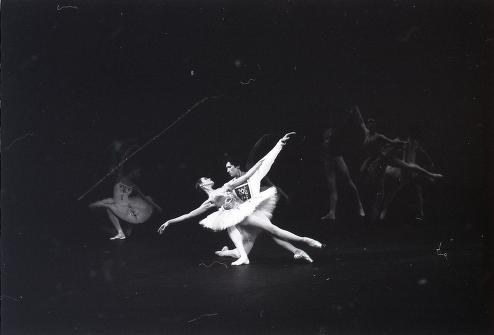
A black and white photograph captures a moment of classical ballet in performance, shot against a dark background that throws the dancers into sharp relief. The composition is intimate despite the theatrical setting: a female dancer in a light, geometrically simple tutu is supported by a male partner in dark tights and shirt, her body extended in an arabesque or similar elongated line. A second male dancer in similar dress is visible to the left, and a third figure appears dimly in the background to the right. The lighting is stark and directional, creating strong shadows that emphasize the linear quality of the extended limbs and the architectural precision of the poses. The photograph appears to be taken during a live performance, capturing the dancers mid-movement with the technical clarity and formal composition typical of mid-20th-century dance photography.
The dancing
The central female dancer is held aloft in a supported extension by her male partner, her body forming a nearly horizontal line from her supporting arm through her extended leg. Her posture exhibits the pulled-up, elongated quality characteristic of classical ballet technique—shoulders back, spine extended, the supporting leg turned out. The male dancer maintains a strong, stable base while supporting her weight, demonstrating the partnership conventions of classical ballet. The secondary male figure to the left and the dimly lit dancer upstage suggest this may be a group choreography rather than a solo-and-partner piece, though the composition emphasizes the central couple.
The dance depicted
This is classical ballet, almost certainly from the mid-20th century based on the photographic style and the geometric abstraction of the movement. The title 'Dancing Balanchine's Geometry' strongly suggests this is a work from the Balanchine repertory—likely either a photograph of the New York City Ballet or a work directly influenced by Balanchine's choreographic principles. Balanchine's aesthetic emphasized clean lines, speed, musicality, and the geometric relationships between bodies in space; this image exemplifies those values, with the extended line of the supported dancer's body creating a visual geometry. The stark lighting and dark background are typical of theatrical photography of Balanchine-era ballet, where the body's line could be read with utmost clarity against neutral surroundings.
How it was made
This is a black and white photograph, likely taken during a live performance under stage lighting. The technical quality suggests professional theatrical photography, with careful attention to exposure to capture both the lit dancers and the dark surround. The photograph preserves a moment that would last only seconds on stage—a snapshot of movement frozen in time. This medium was crucial to documenting Balanchine's work, which was choreographed to be ephemeral and existed primarily in performance; photographs became the primary record of pieces that were rarely notated and often lost or radically revised over time.
About this work
This photograph documents a moment from classical ballet in the Balanchine tradition, showing the hallmarks of his geometric, lineal approach to choreography: the extended, precisely articulated bodies of the dancers, the emphasis on the clarity of line, and the partnership between male and female dancers as a vehicle for displaying movement rather than narrative. The photograph is itself part of the work's preservation—Balanchine created for the moment of performance, and photographs like this became the visual record. The image sits at the intersection of dance history, theatrical photography, and mid-20th-century modernism, showing how abstraction and geometric precision came to define American classical ballet.
How to look at it
Watch the line of the supported dancer's body—the way her extension creates a nearly unbroken line from her supporting arm through her extended leg. This is the kind of visual clarity that Balanchine prized and orchestrated. Notice also how the photographer has composed the image to make that line the primary subject: the dark background eliminates visual clutter, the lighting is arranged to define the body's contours, and the framing centers the extended figure. This is not accidental; it reflects a collaborative relationship between choreographer and photographer in making the work's essential geometry visible. The geometric precision is the point.
The artist
The photographer is not recorded in the catalogue. However, the image is consistent with the work of theatrical photographers who documented New York City Ballet in the 1950s–1980s, a period when ballet photography became a sophisticated art in its own right. The technical quality and the aesthetic choices suggest someone with both technical command of exposure and lighting and an understanding of dance composition.
The period
This photograph was taken in 2008 according to the catalogue record, but it is a photograph of a performance of a work by George Balanchine, the Russian-American choreographer who founded New York City Ballet in 1948 and fundamentally changed the trajectory of 20th-century ballet. By the mid-20th century, Balanchine had established a new vocabulary of classical ballet that emphasized musicality, speed, and geometric abstraction. This was a radical departure from the Romantic and Classical ballet traditions; it reflected the influence of modernism and abstraction in the visual arts. The 2008 date likely reflects the digitization or archival documentation of an earlier photograph, rather than the date of the original performance.
Where it lives
The source is listed as 'loc' (Library of Congress). The catalogue record does not specify collection, accession number, or whether this is an original photograph or a digital reproduction. The record date of 2008 likely reflects archival processing or digitization rather than the original performance date.
Dance in this work
Questions about this work
Who is 'Balanchine' and what is his 'geometry'?
George Balanchine (1904–1983) was a Russian-American choreographer who revolutionized classical ballet by treating it as abstract movement rather than narrative spectacle. He emphasized fast footwork, clean lines, unexpected positions, and the mathematical relationships between bodies in space. His 'geometry' refers to this obsession with the visual clarity and precision of the body's line in motion—treating dancers as living architecture rather than storytellers.
What kind of ballet step is being shown here?
The central figure appears to be in a supported extension, most likely an arabesque or allongé, where the dancer's body is extended horizontally while being supported by a partner. This is a classical ballet vocabulary element, but Balanchine often held such positions longer and at more extreme angles than earlier traditions allowed, to emphasize their geometric perfection.
Why is the photograph so dark?
The dark background is deliberate: it isolates the dancers' bodies so their lines can be read with absolute clarity. This was a standard practice in theatrical photography of the Balanchine era, reflecting the choreographer's insistence that the viewer's eye be directed to the pure form of the movement, free from distraction.
Is this a famous ballet?
The title 'Dancing Balanchine's Geometry' is a descriptive label rather than the name of a specific ballet. Many Balanchine works explore this principle—among them 'Symphony in Three Movements,' 'Jewels,' and 'Four Temperaments.' Without more specific information, it is difficult to identify the exact ballet or performance documented here.
More dance artwork





