49 works in this view — arrow keys or swipe to move between them.
Dance in Art · 2015
Dancing Couple
Unknown artist
- Medium:
- Source:
- New York Public Library
- Rights:
- Public domain — free to use, share and adapt.
- Recorded as:
- public_domain
This print is important as evidence of how Renaissance and early modern artists used the image of the dancing or embracing couple as a vehicle for moral and satirical argument. It shows that images of bodily proximity and movement were understood as carriers of meaning beyond mere entertainment, and that dance and dance-like poses were central to how early modern art communicated about desire, virtue, and human folly.
What you are looking at
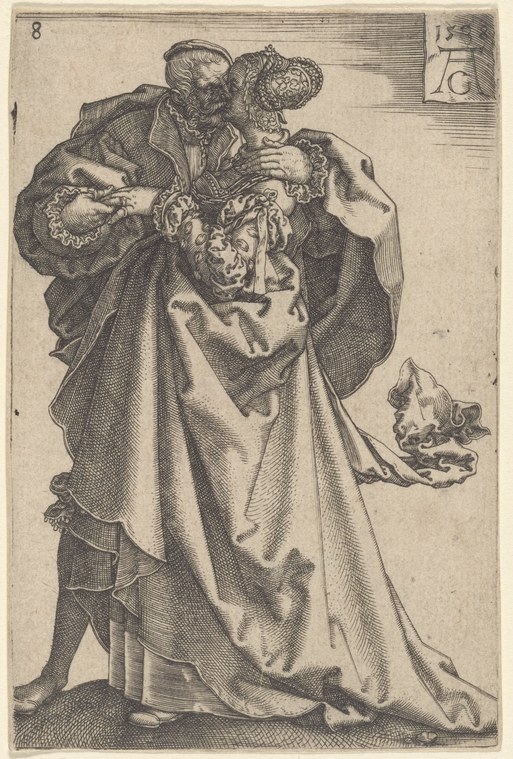
A richly dressed couple dominates the composition in this engraving. The man, positioned behind and to the left, wears a long coat with elaborate patterning and a feathered hat; his face is rendered in profile with exaggerated, mask-like features. The woman, in the foreground, wears a voluminous gown with heavy drapery and a distinctive headdress. Both figures are depicted in an embrace or close contact, the man's arms encircling the woman from behind. The woman's head tilts back toward the man's face, which looms large above hers. The composition is crowded and theatrical: a swaddled infant or cherub sits prominently on the woman's torso, and additional grotesque or demonic faces—possibly representing jealousy, lust, or other allegorical vices—appear at the edges, particularly in the lower right. The background is spare, rendered with fine hatching lines typical of engraving technique. The overall effect is one of moral or satirical commentary rather than a straightforward dance representation.
The dancing
The two figures are not in a conventional dance hold. The man's posture is rigid and angular, his arms wrapped around the woman in a grip that reads more as control or possession than partnership. The woman's body is passive, her spine arched backward, her face tilted upward in an exaggerated, almost ecstatic expression. There is no visible footwork or weight transfer suggestive of ballroom technique. The static quality of their limbs and the frontality of their pose suggest a moment of frozen drama or allegory rather than the mobile, coordinated movement that characterizes social dance.
The dance depicted
This is not a straightforward depiction of a known dance style. The composition appears to be a moralizing or satirical print in the Northern European tradition—possibly German or Netherlandish—using the image of a couple in intimate contact as a vehicle for commentary on lust, folly, or the disorder caused by desire. The grotesque faces and chaotic framing suggest this is allegory rather than documentary record. If movement is intended, it would be theatrical or pantomimic rather than ballroom or folk dance.
How it was made
This is a finely executed engraving on paper, created using the burin (an engraving tool) to incise lines directly into a metal plate, typically copper. The fine, dense hatching used to build tone and shadow, and the crisp linear definition of forms, are characteristic of Northern European Renaissance and early modern engraving. The numbering visible in the upper left corner (8) and upper right (marked with what appears to a collector's mark or catalogue reference) suggests this is part of a series or collection. Engravings were the primary medium for circulating imagery across Europe in the 16th and 17th centuries, allowing relatively inexpensive reproduction and wide distribution.
About this work
This engraving depicts a couple in a highly stylized, allegorical embrace that uses the visual language of intimate contact to communicate moral or satirical meaning rather than to document an actual dance practice. The grotesque surrounding figures and the theatrical intensity of the pose mark this as a work of Northern European printmaking, likely from the Renaissance or early modern period, engaging with themes of desire, folly, and human weakness. While not a representation of a social or theatrical dance in the conventional sense, the work uses the body language and compositional conventions of intimacy and movement to create its meaning.
How to look at it
Pay attention to the grotesque faces that surround the central couple—these are not incidental decoration but the interpretive key to the image. They suggest that what appears to be romantic intimacy is, from the artist's moral perspective, a form of enslavement to base impulses. Notice how the woman's passivity and backward-arching posture contrast with the man's aggressive forward lean; the composition is not symmetrical or harmonious but charged with tension and imbalance. The fine, intricate hatching creates a sense of both beauty and claustrophobia. This is an image meant to be read as much as looked at: the pose tells a story about human weakness.
The period
This work belongs to the Northern European tradition of satirical and moralizing prints that flourished from the 15th through 17th centuries. Artists like Albrecht Dürer, Lucas Cranach, and Hendrik Goltzius created elaborate allegorical compositions that used the human body and dramatic poses to communicate complex moral and philosophical ideas. The engraving technique itself was perfected in the 15th century and became the dominant medium for the dissemination of images throughout the Renaissance. Dances and intimate gestures were stock motifs in this tradition, often used to represent the folly of youth, the power of lust, or the disorder caused by passion. The style and execution of this print are consistent with 16th-century Netherlandish or German practice.
Where it lives
The work is held in the New York Public Library collection and is catalogued as a print, though further details of acquisition and holding are not recorded. The catalogue notation suggests it was part of a numbered series or collection at the time of cataloguing.
Dance in this work
Questions about this work
Is this a record of an actual dance?
Probably not. The composition and the grotesque surrounding figures suggest this is an allegorical or moralizing image using the pose of an intimate couple to communicate ideas about desire and folly, rather than a documentary record of a social or theatrical dance practice.
What do the demonic faces mean?
They likely represent vices or moral dangers associated with lust and desire—jealousy, avarice, or other consequences of the passion depicted in the central embrace. This is a standard device in Northern European moralizing art.
Why does the woman look so passive?
The artist has deliberately contrasted the woman's limp, arched body with the man's aggressive posture to suggest her lack of agency and his dominance. This reinforces the moralistic message about the dangers of desire and the vulnerability of the body to passion.
What period is this from?
The style, technique, and iconography are consistent with Northern European (likely German or Netherlandish) printmaking of the 16th or early 17th century. The fine engraving technique and the allegorical content place it in the Renaissance tradition.
More dance artwork