49 works in this view — arrow keys or swipe to move between them.
Dance in Art · 1920
Dance me around
Unknown artist
- Source:
- Library of Congress
- Rights:
- Public domain — free to use, share and adapt.
- Recorded as:
- Public Domain
This work documents the visual and cultural packaging of theatrical dance in the 1920s, revealing what kind of movement and body image were considered marketable and entertaining to urban American audiences. For historians of theatrical dance, fashion, and popular culture, it is a direct artifact of how the musical theater industry presented dance to the public and what aesthetic values it promoted.
What you are looking at
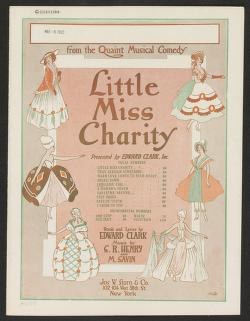
This is a color illustration for a theatrical musical comedy, likely a poster or program cover. The composition centers on the title "Little Miss Charity" in large decorative lettering, surrounded by six stylized female figures in various poses of movement and gesture. The women wear 1920s-era costume pieces: short pleated skirts in pastel colors (pink, yellow, white), Mary Jane shoes, and cloche-style hats or headpieces. The palette is dominated by soft pinks, yellows, greens, and whites on a cream background. The figures are arranged asymmetrically around the central text, some leaning, some with arms extended or raised, creating a sense of sprightly movement without depicting any single organized dance form. The drawing style is Art Deco–influenced with clean lines and simplified forms characteristic of commercial theatrical illustration of the 1920s. At the bottom are credits for the composer (Edward Clark) and other production details in smaller type.
The dancing
The six female figures vary in pose and body position. Several lean forward or to the side with a relaxed, informal stance. Arms are positioned variously—some raised, some at the sides—but never in a formal ballroom hold or classical ballet frame. The women's weight appears distributed casually, with bent knees and tilted torsos suggesting a light, playful energy rather than trained technique. The style is that of generic theatrical chorus or revue dancers: energetic but not balletically disciplined. No partner holds or couple formations are evident; these are individual or loose group poses arranged for visual variety rather than coherent ensemble choreography.
The dance depicted
This is a musical comedy cover, and the figures represent the cast or the spirit of the show rather than any specific historical dance form. The loose, exuberant postures and the 1920s theatrical costume are consistent with jazz-age revue dancing or generic theatrical movement of that era—the kind of buoyant, non-codified movement that would have accompanied comedic musical theater in the early twentieth century. The image does not depict ballroom dance, classical ballet, or any recognizable folk or social dance style; it is promotional illustration of the theatrical mode, capturing the mood and fashion of the period rather than documenting actual dance technique.
How it was made
This appears to be a color lithograph or color printing on paper, characteristic of theatrical posters and program covers of the 1920s. The flat color areas, the clean outlines, and the commercial lettering are consistent with lithographic production, which allowed for economical mass reproduction and bright, eye-catching color. The technique was suited to large poster distribution and smaller program printing alike, making the work accessible to a broad urban theater audience. The style and production method confirm this as an industrial theatrical product rather than fine art.
About this work
"Dance Me Around" (here titled as cover art for "Little Miss Charity") is a commercial theatrical illustration from 1920, likely a poster or program cover for an American musical comedy. It captures the aesthetic of Jazz Age revue theater through six stylized female figures in 1920s costume, arranged in casual, playful poses around the show's title. The work is a window into how dance was marketed and imagined in early twentieth-century popular theater: not as virtuosic ballet or strict ballroom form, but as buoyant, energetic, informal movement suited to comedic entertainment and the fashions of the flapper era.
The piece belongs in a dance history collection not as documentation of a specific dance practice, but as evidence of theatrical culture and the visual language used to sell dance entertainment to the public. It shows us what Broadway and commercial theater considered "dance" in this period—a mode of movement associated with youth, fashion, music, and play rather than formalized technique.
How to look at it
Look at the variety of poses: no two figures are in the same stance or arm position. This reflects the theatrical revue convention of presenting a chorus as a collection of individual personalities and bodies rather than a unified, synchronized ensemble (that would come later). Observe the costume details—the short skirts, the Mary Jane shoes, the hats—which date the work precisely and signal the deliberate fashionability of the production. Notice how the figures are arranged around the text in a decorative, almost heraldic composition: they are illustrative and ornamental, not narrative. This is commercial theater advertising, not documentary, so it tells us more about 1920s taste and marketing than about how dancers actually moved.
The artist
The artist is not recorded. The work was produced as commercial theatrical printing, likely designed in-house at a theatrical printing firm or by an illustrator under contract to a producer. The credited composer Edward Clark appears on the cover, along with other production details, but the visual designer remains anonymous—a common situation for commercial theatrical and promotional work of this era.
The period
In 1920, American musical theater was at the height of the Jazz Age. Theatrical dance in this period was dominated by revue and musical comedy forms that drew on vernacular jazz movement, vaudeville tradition, and European ballroom and ballet influences, but synthesized them into a distinctly American commercial style. Female dancers in musical theater were associated with youth, modernity, and social liberation; the flapper silhouette and short skirt were markers of contemporary fashion and cultural change. Ballroom dance was a social craze, but theatrical dance was something different—a looser, more playful idiom suited to comedy and spectacle. The visual style of this illustration—the Art Deco–influenced line, the bright flat colors, the stylized figures—was at the forefront of modern commercial design in 1920.
Where it lives
The work is held by the Library of Congress. It is a printed theatrical poster or program cover, part of the Library's collections of American popular culture and theatrical ephemera from the early twentieth century.
Dance in this work
Questions about this work
What dance form is shown here?
No specific dance form is depicted. This is promotional illustration for a musical comedy, capturing the spirit and fashion of 1920s theatrical revue dance rather than documenting any single technique or style. The figures show the loose, playful movement aesthetic of Jazz Age musical theater.
Is this a ballet?
No. The figures are not in ballet positions, wear no pointe shoes, and lack the formal frame and alignment that would mark classical ballet. This is popular commercial theater, not concert ballet.
Who designed this?
The artist is not recorded. It was created for commercial theatrical production as an anonymous work, a common situation in early twentieth-century printing and promotional design.
Why were women shown in such short skirts in 1920?
The short hemline was the height of modern fashion in 1920—a symbol of social change, youth, and liberation after World War I. It also freed the legs for the energetic movement that jazz-age revue dancing demanded. Theatrical costuming both reflected and amplified fashion trends of the moment.
More dance artwork





