49 works in this view — arrow keys or swipe to move between them.
Dance in Art · 1904
Fairy dance : Valse lente
Unknown artist
- Source:
- Library of Congress
- Rights:
- Public domain — free to use, share and adapt.
- Recorded as:
- Public Domain
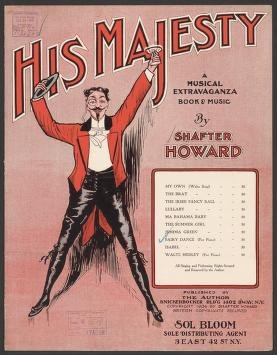
This image documents how dance was marketed and consumed in early 20th-century popular theatre, showing the integration of balletic technique into comic theatrical entertainment. It reveals the visual language of theatrical publicity of the period and the conventions through which male dancers were presented to the public—not as classical artists but as comedic characters and entertainers.
What you are looking at
This is the cover of a theatrical programme or poster for a musical entertainment titled "His Majesty," with the subtitle identifying it as "A Comic Extravaganza." The central figure is a male dancer dressed in a striking red military-style jacket with ornate black braiding, black knee breeches, and black boots, striking a triumphant pose with one arm raised high and the other gesturing expansively. He wears a formal white shirt front and appears to be mid-leap or in an exuberant balletic pose. The figure fills most of the composition against a pale pink background. At the top, "HIS MAJESTY" appears in large bold red letters, with publication details in smaller type below, including the note "Book & Music by Chappel Howard," indicating this was a complete theatrical work. The lower portion contains performance information and credits, identifying this as a Drury Lane Theatre production with Sol Bloom as the author/producer and noting the performance was at the Heart Theatre. The aesthetic is characteristic of early 20th-century theatrical publicity.
The dancing
The dancer is depicted in an exuberant, airborne pose suggesting vigorous elevation and balletic training. His body is twisted slightly, with weight clearly transferred upward through the supporting leg, while the free leg extends dynamically. His raised arm reaches skyward in a triumphant gesture, and his posture conveys comedic exultation rather than the controlled refinement of classical ballet—his body is expressive and theatrical, with an emphasis on energy and personality over precision. The pose suggests a male dancer trained in theatrical and balletic idioms, capable of both elevation and dramatic gesture.
The dance depicted
The work is identified as a 'Comic Extravaganza,' a theatrical genre of the Edwardian era that blended music, dance, comedy, and spectacle. This is not a depiction of a specific dance form, but rather a promotional image of a character from a theatrical entertainment. The pose is drawn from a theatrical vocabulary that included balletic and music-hall elements. The costume—military-style jacket and breeches—and the triumphal pose suggest a comedic hero in a farcical scenario, rather than a concert dance performance. The emphasis on theatrical character and dynamic gesture, combined with the reference to 'extravaganza,' places this in the world of early 20th-century popular theatre rather than classical ballet or social dance.
How it was made
This is a colour lithograph, a process that allowed cheap mass production of theatrical posters and programmes. The printing technique is evident in the flat, bold colors and the characteristic line quality, with hand-drawn lettering for the title and credits. Lithography's accessibility and speed made it the dominant technology for theatrical publicity in this period. The image was created to circulate widely—as a poster, programme cover, and souvenir—reaching both the theatre-going public and potential audiences in the streets. The medium's association with popular theatre and commercial publicity is central to its meaning and distribution.
About this work
This is a colour lithograph cover or poster for 'His Majesty,' a comic extravaganza of the early 20th century, featuring a male dancer in theatrical dress captured in a moment of exuberant elevation and triumph. The work documents both the aesthetics of Edwardian theatre and the conventions of theatrical publicity, showing how dance in comic drama drew on balletic technique while maintaining an emphasis on character and personality. As a printed theatrical artefact, it represents the world of music-hall entertainment and commercial popular theatre rather than concert dance, but it captures an important moment in the history of dance's role in entertainment and the visual language used to sell it to the public.
How to look at it
Attend to the pose itself: the dancer is captured mid-leap or in full extension, a moment of maximum elevation and expansiveness. The gesture—the raised arm and the twisted torso—is comedic rather than classical, suggesting character and personality. The costume is part of the spectacle, not a ballet costume; the military jacket and breeches are part of a theatrical character. Notice how the artist has chosen a moment of triumph and joy, not a moment of control or refinement. This is how early 20th-century theatre presented its dancers to the public: as vivid, energetic performers rather than as classical artists.
The artist
The artist is not identified in the catalogue record. The lithographic technique and style are consistent with early 20th-century commercial theatre printing in London. The work was produced as part of the publication and marketing apparatus of Drury Lane Theatre, one of London's leading theatrical venues.
The period
Comic extravaganzas were a dominant form of musical theatre in Britain in the 1900s, blending music, dance, comedy, and elaborate costume and staging. This period saw the rise of theatrical publicity through printed posters and programme covers, with lithography as the standard medium. Male dancers in popular theatre of this era often combined music-hall training, acrobatic skill, and balletic technique, performing in comedic roles rather than as concert artists. The aesthetic of exuberant, character-driven performance was central to this entertainment.
Where it lives
This is a colour lithograph printed for theatrical distribution, likely serving as both a poster and a programme cover for a production at Drury Lane Theatre. The source is the Library of Congress.
Dance in this work
Questions about this work
What is a comic extravaganza?
A comic extravaganza was a form of theatrical entertainment popular in Britain and America in the 19th and early 20th centuries, combining comic plots, music, dance, and elaborate costumes and staging. These works were not serious drama or classical ballet, but rather popular entertainment designed for commercial theatre, emphasizing spectacle, comedy, and accessible pleasure. They often featured topical jokes and satirical elements alongside musical and dance numbers.
What kind of dancer would have performed this role?
A male theatrical dancer of this period would have been trained in multiple forms—balletic technique, acrobatics, music-hall movement, and character acting. The pose shown here demonstrates both balletic elevation and comedic expressiveness. Such dancers were entertainers and performers rather than concert artists, and they typically worked in commercial theatre venues like Drury Lane rather than in ballet companies.
Why is this a lithograph rather than a photograph or drawing?
Lithography was the dominant process for theatrical publicity in this period because it combined the visual impact of color printing with relatively low cost and fast production. A poster or programme cover needed to be produced in large quantities and distributed widely, and lithography was the technology that made this possible and economical.
More dance artwork





