49 works in this view — arrow keys or swipe to move between them.
Dance in Art · 2015
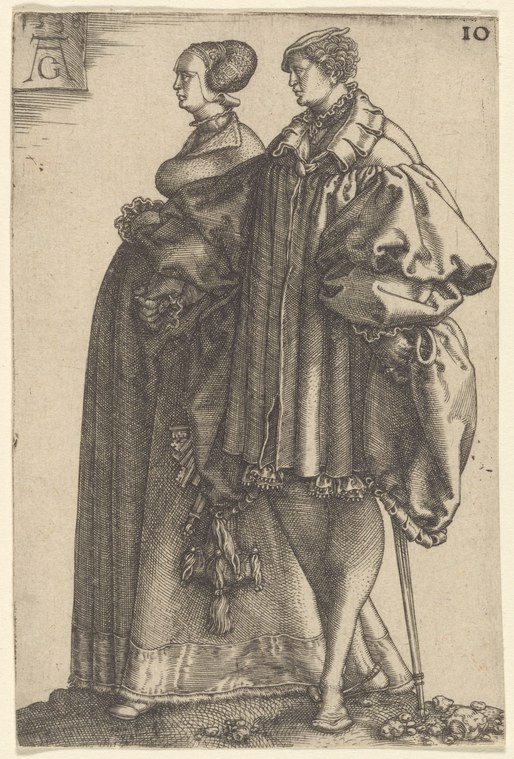
Dancing Couple
Unknown artist
- Source:
- New York Public Library
- Rights:
- Public domain — free to use, share and adapt.
- Recorded as:
- public_domain
Renaissance court dances such as the pavan and galliard were defined as much by costume, pacing, and social performance as by footwork. This engraving shows how contemporary viewers understood the dancing couple as a visual type—fashionably dressed, formally paired, and worthy of reproduction and circulation. For historians of dance and dress, it provides rare documentary evidence of the aesthetic presentation and gender dynamics of early 16th-century courtly dance.
What you are looking at
Two fashionably dressed women stand together against a plain background in this engraving. The woman on the left wears a long gown with a fitted bodice and a voluminous skirt decorated with embroidered or patterned detail; her hair is bound up in a coif or snood. The woman on the right wears a similarly long dress and an ornate cloak or cape with puffed sleeves, lined with fur, which she holds or adjusts with one hand. Both figures stand in a composed, upright manner characteristic of early 16th-century court portraiture. The setting is minimal—a ground line with scattered stones or pebbles suggests an outdoor space, but the focus is entirely on the figures' dress, posture, and the intricate rendering of fabric textures through fine engraved lines. The numbered plate mark "10" visible in the upper right indicates this is part of a series.
The dancing
Both figures stand in a relaxed but dignified stance, their bodies turned slightly toward one another in a companionable arrangement. Neither figure is in active motion; they are posed for presentation rather than in the middle of movement. The woman on the left stands with arms at her sides; the woman on the right holds her cloak or mantle with one hand. Their posture is vertical and controlled, and the arrangement suggests social standing and courtly formality rather than dance in motion.
The dance depicted
Despite the title "Dancing Couple," this image does not depict dance in progress. The figures are stationary and posed; there is no visible embrace, partnered hold, or bodily position suggesting movement. The clothing and style indicate an early 16th-century court setting, and the pairing of fashionably dressed figures of different genders may reference the social dances of the Renaissance court—such as the pavan or galliard—in which couples were central. However, the engraving shows the dancers at rest or in formal presentation, not in the act of dancing. The work may document court dress and the visual culture of dance partnership rather than choreographic content.
How it was made
This is a fine engraving on paper, executed with the careful parallel line work (hatching) and precise detail characteristic of Northern European printmaking of the early 16th century. The technique allows for the intricate rendering of fabric pattern, embroidery, and texture that dominates the composition. As an engraving, this work was reproducible and portable, making it a vehicle for circulating knowledge of courtly dress and fashion across Europe. The small scale and plate mark suggest this is one sheet from a larger series, likely a suit of prints documenting court costume, social types, or courtly pastimes.
About this work
This engraving documents the fashionable dress and social presentation of a Renaissance court couple, likely from the early 16th century on the basis of silhouette and ornament. The title "Dancing Couple" signals that these figures belong to the world of courtly dance and social partnership, yet the image captures them in a moment of composed, stationary presentation rather than active choreography. The work is a valuable record of how dance was visually associated with court dress, gender pairing, and social status during a period when dancing was central to aristocratic life. It belongs in a gallery of dance in art not because it shows dance in motion, but because it documents the visual culture, costume, and courtly context in which Renaissance dances were performed.
How to look at it
Attend to the elaborate detail of the clothing: the embroidery, patterning, and construction visible in the woman's skirt and the fur lining of the mantle on the right. These details tell us what fashionable court dress looked like and how much visual status and wealth were invested in the dancer's appearance. Notice the formal symmetry of the composition and the neutral, documentary tone: this is not a narrative scene of courtship or flirtation, but a presentation of the social type—the fashionable, courtly dancing pair. The absence of narrative action is itself significant: the power of the couple lies in their dress and formal bearing.
The artist
The artist is not recorded in the catalogue. The style and technique place the work within Northern European printmaking of the early 16th century, likely German or Flemish. The composition and subject matter are consistent with the fashion-print tradition and costume-documentation prints that were produced in substantial numbers during this period, often as series or suites. Such prints were commercial products, circulated among the upper classes and used as references for dress, deportment, and courtly behavior.
The period
The early 16th century was the height of the court dance's importance in Renaissance Europe. Dances such as the pavan (a slow, processional dance) and the galliard (a faster, more acrobatic dance with leaps) were central to courtly entertainment and social ritual. Dance masters were employed by courts and wrote the first notation systems for dance. At the same time, the medium of the engraving was developing rapidly and being used to circulate knowledge of fashion, courtly life, and social types across Europe. Prints documenting costume, dance, and courtly behavior were popular and commercially successful.
Where it lives
The work is held by the New York Public Library and accessed through their collection. The plate mark and numbering (10) indicate it is one sheet from a larger print series, likely a Renaissance costume or court-life suite. It was obtained or catalogued in a way that separated it from its original series context, which is typical for prints in general collections.
Dance in this work
Questions about this work
Why is this called a dancing couple if they are not dancing?
In Renaissance printmaking, "dancing couple" was a recognized type in costume and courtly-life prints. The term identified the social role and context of the figures—they are courtiers for whom dance is part of their status and daily life—rather than a description of an action captured in mid-performance. The engraving documents the appearance and dress of people who dance, not the dance itself.
What dances would these people have performed?
In the early 16th century, Renaissance court couples typically danced the pavan (a slow, dignified processional) and the galliard (a more energetic dance with leaps and turns). Both dances were done in couples and were central to courtly entertainment. The formal dress and deportment visible in this engraving would have been standard for both.
Why is the woman on the right holding her cloak?
The cloak or mantle was a high-status garment worn over the gown and was often held or adjusted by the wearer to display its rich fabric and lining. In courtly presentation and some dances, the management of such garments was part of the visual performance. The gesture shows both the garment itself and the refinement of the figure's bearing.
More dance artwork