49 works in this view — arrow keys or swipe to move between them.
Dance in Art · 1965
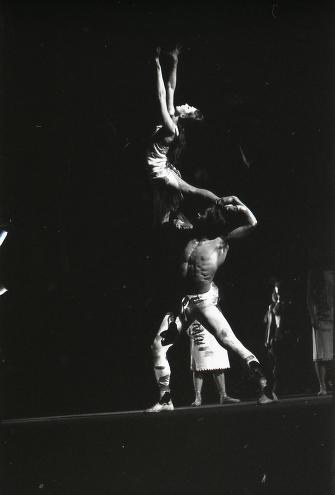
Like a Shot from a Bow. Nina Sorokina and Yuri Vladimirov Dancing.
Unknown artist
- Source:
- Library of Congress
- Rights:
- Public domain — free to use, share and adapt.
- Recorded as:
- Public Domain
This image exemplifies the adagio vocabulary that became foundational to ballet and ballroom technique worldwide. The photograph preserves a specific moment of Soviet dance artistry during a period when Soviet training methods were gaining international influence, and shows how acrobatic and balletic disciplines were integrated in that tradition. For dancers and historians, it documents the technical and aesthetic standards of partnership dancing in the 1960s.
What you are looking at
A dramatic black-and-white photograph captures two dancers in a spectacular overhead lift against a dark background, likely a stage. The male dancer (Yuri Vladimirov) stands with legs apart, arms raised to shoulder height, supporting the female dancer (Nina Sorokina) who is inverted above him in a dramatic arch. She extends one leg vertically upward while the other bends, her torso curved backward in a deep extension. Her arms reach overhead and to the sides, creating an open, expansive line. The strong backlighting picks out the contours of their bodies and limbs, throwing them into sharp relief against the darkness. The composition emphasizes the vertiginous height and the partnership required—this is a moment of sustained tension and control, frozen mid-performance. The minimal costume (likely Soviet-era practice or performance wear) and the theatrical lighting suggest a concert or competition setting.
The dancing
The lift is executed from a wide standing base, with the male dancer's core and upper body engaged to hold the woman aloft. The woman's body is fully extended and arched, creating a long diagonal line from her feet through her fingertips. Her leg position suggests significant flexibility and control; her weight is entirely dependent on the male dancer's strength and positioning. The open arms and arched back convey both vulnerability and grace. This is a true adagio lift—a display of technical mastery requiring absolute trust and precision from both partners.
The dance depicted
This is partner acrobatics or adagio dancing in the Soviet academic tradition. The title 'Like a Shot from a Bow' and the nature of the lift suggest a moment from a theatrical ballet or concert work, likely from the 1960s Soviet dance repertoire. Adagio was a central element of Soviet ballet training and performance, emphasizing sustained control, flexibility, and the aesthetic of effortless elevation. The lift itself—one dancer held aloft in an extended position—was a signature move in this vocabulary, designed to showcase both dancers' technical abilities and their partnership. The photograph documents a specific moment that would have been rehearsed extensively to achieve this level of control and visual impact.
How it was made
This is a black-and-white stage photograph, likely taken during a performance or dress rehearsal under theatrical lighting. The strong chiaroscuro effect—bright bodies against deep shadow—is a product of both the lighting design and the photographic technique. The clarity and detail suggest professional documentation, possibly for archival or publicity purposes. Such photographs were an important record of Soviet dance performance, especially given the difficulty of preserving film or video from this era. The technical quality indicates a skilled photographer working with available stage light, using contrast to emphasize form and movement.
About this work
This photograph documents a moment of Soviet partnership dancing at a moment of technical and aesthetic achievement. It captures Nina Sorokina and Yuri Vladimirov in what appears to be a grand adagio lift—a staple of Soviet ballet and acrobatic dance training and performance. The lift, with its dramatic inversion and extended line, demonstrates the vocabulary of partner work that dominated Soviet dance pedagogy in the mid-twentieth century. The photograph is valuable as both a technical record and as a window into how Soviet dancers understood beauty, strength, and the partnership between male and female dancers. It shows a tradition in which the male dancer's role was to provide a stable, invisible base for the female dancer's extension and display—a convention that shaped concert dance globally.
How to look at it
Look first at the woman's body: note the arch of her spine, the extension of her raised leg, the reach of her arms—this is the moment of maximum extension, when the lift has been achieved and held. The photograph has frozen the moment just after the lift has stabilized, before the descent. Observe the male dancer's positioning: his legs are wide and grounded, his arms are positioned to support without appearing to strain. This is the aesthetic of Soviet adagio—the male dancer disappears into his function, allowing the female dancer to be displayed. The lighting emphasizes this: she is bright and visible; he is partly in shadow. This is not accidental but a convention of the form.
The period
In 1965, Soviet dance occupied a unique position: the Kirov and Bolshoi ballets were at the height of their international prestige, and Soviet pedagogical methods—especially the Vaganova technique—were becoming the gold standard for ballet training worldwide. The photograph dates to the height of the Cold War cultural competition, when dance was a significant arena for demonstrating Soviet artistic achievement. Adagio and partner work were central to Soviet ballet and to the emerging discipline of sport acrobatics, which the Soviet state was developing as both an art form and a competitive practice. The emphasis on technical mastery, control, and the aesthetic of effortless strength visible in this photograph reflects Soviet values: the triumph of training, discipline, and the subordination of the individual to the collective ideal (here, the partnership).
Where it lives
This photograph is held in the Library of Congress collections (source: loc), suggesting it was part of an official documentation or archival project. The identification of the dancers and the title suggests it may have been captioned or documented at the time of performance or shortly after.
Dance in this work
Questions about this work
What is an adagio lift?
An adagio lift is a staple of partner dance in which one dancer (typically male) supports another (typically female) in an extended, often inverted position. The lift emphasizes the supported dancer's line, flexibility, and extension while requiring the supporting dancer to provide stable, seemingly effortless control. Adagio is found in ballet, ballroom dance, and acrobatic dance traditions.
Why is this dance position so difficult?
The difficulty lies in the sustained control required by the male dancer—holding a human body in an unstable, inverted position requires significant strength, body awareness, and core stability. For the female dancer, the challenge is to extend and relax fully while maintaining awareness of her weight distribution and the position of her partner's base. Both dancers must have trained extensively together to achieve the precision and trust needed.
What does 'Like a Shot from a Bow' mean?
The title suggests speed, directness, and a moment of release or flight—apt metaphors for the moment captured in the photograph. The image of an arrow leaving a bow, swift and true, captures the aesthetic of the lift: the female dancer appears to be lifted high and held suspended, as if launched upward. The title may reference a specific moment in a choreographic work or may be metaphorical.
More dance artwork





