49 works in this view — arrow keys or swipe to move between them.
Dance in Art · 2015
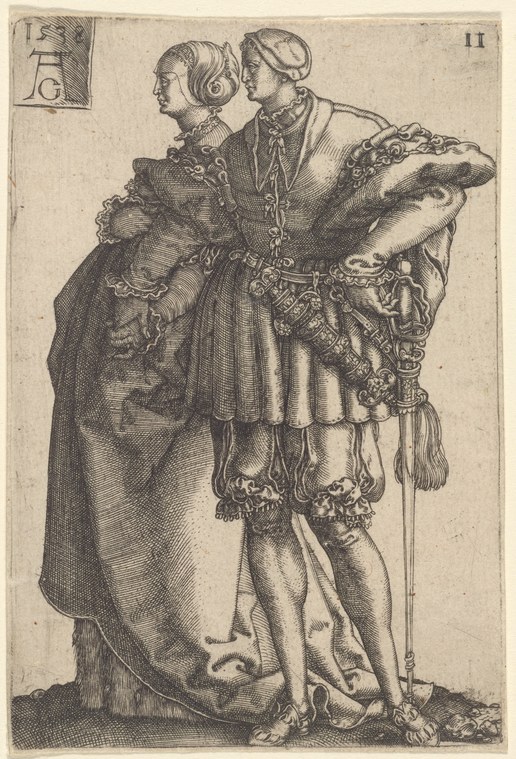
Dancing Couple
Unknown artist
- Source:
- New York Public Library
- Rights:
- Public domain — free to use, share and adapt.
- Recorded as:
- public_domain
This engraving is one of few surviving visual documents of how Renaissance court dances were actually performed and presented—the hold, the spacing, the costume, and the social choreography of aristocratic courtship. It shows that Renaissance dance was fundamentally a social and political act, embedded in strict codes of dress, posture, and decorum. For anyone studying Renaissance court culture, fashion history, or the roots of Western ballroom dance, this image is primary visual evidence.
What you are looking at
A man and woman stand together in an engraving, positioned as if mid-dance or in formal courtly attendance. The woman, on the left, wears an elaborate gown with a high collar, jeweled necklace, and a flowing train that sweeps behind her; her hair is bound up in an ornate coif. The man stands slightly behind and to her right, dressed in fitted hose, a short pleated tunic or doublet, and an ornate feathered hat; one arm appears to rest near the woman's back or waist, while the other hand holds a sword or similar implement. Both figures are rendered with meticulous attention to textile pattern and jewelry. The composition is vertical and formal, set against a plain background, and the fine parallel hatching typical of Renaissance engraving creates volume and shadow throughout the figures' garments. The style and detail suggest this captures a moment of courtly interaction or the opening gesture of a formal dance.
The dancing
The two figures occupy a tight, intimate spatial relationship without a clear partnered dance hold as understood in later ballroom traditions. The woman stands upright with her body angled slightly toward the viewer, her hands not clearly engaged with the man's. The man's positioning suggests deference or courtly attention—his body angles toward hers, and his arm placement suggests either a preparatory gesture or a moment of social contact. Neither figure displays the weight shift or leg extension typical of active movement; instead they present themselves as formal, composed, and posed for display. The arrangement suggests the opening or closing moment of a courtly greeting dance rather than a moment of vigorous motion.
The dance depicted
This appears to depict a Renaissance courtly dance or court ceremony, most likely a formal court dance such as the pavane or basse danse that structured aristocratic social interaction in the 15th and 16th centuries. The dress—especially the woman's jeweled collar and formal gown, and the man's feathered hat and fitted doublet—places this in a Northern European Renaissance court. The composition emphasizes social position and decorum over kinetic display; the dance here is an act of courtship, social negotiation, and dynastic display rather than virtuosic footwork. The engraving may document an actual dance tradition or may illustrate a fashionable couple in a stylized courtly moment meant to convey elegance and propriety.
How it was made
This is a copper engraving, executed in the fine linear technique characteristic of Northern Renaissance printmaking. The artist has used closely spaced parallel lines (hatching and cross-hatching) to model the volumes of cloth, flesh, and ornament, creating a tonally sophisticated image from line alone. The precision and density of line work suggests this was produced for a affluent, educated audience—likely nobles, collectors, or scholars—since engravings of this fineness required skilled execution and expensive materials. The medium's capacity for fine detail made it ideal for capturing the intricate embroidery, jewels, and tailoring that signaled rank and wealth, and the print's formal composition and careful finish suggest it functioned as both a document of fashion and an exemplar of courtly behavior.
About this work
This is a Renaissance engraving depicting two figures in formal courtly dress engaged in what appears to be a court dance or ceremonial courtship gesture. The work demonstrates the Northern European Renaissance fascination with elaborate costume, social ritual, and the visual documentation of aristocratic life. The engraving's formal composition and meticulous technique suggest it served as a model or record of courtly fashion and behavior—a guide to elegance and decorum for an elite audience. The work sits at the intersection of dance history, costume history, and social history, showing how Renaissance courts used choreographed movement and formal presentation as instruments of political and social power. For dance historians, it offers evidence of how court dances were structured as formal, composed interactions between partners rather than as displays of individual virtuosity.
How to look at it
Attend to the precise positioning of the two figures: the woman's formal, upright stance and the man's slight lean toward her convey social protocol and deference rather than kinetic momentum. Notice how the artist has frozen the moment at the threshold of contact—hands are positioned but not actively clasping, bodies are oriented toward each other but not in dynamic partnership. The extraordinary detail lavished on costume (the woman's jeweled collar, the man's feathered hat, the intricate patterning of both garments) tells you that this image is about social display and status as much as about movement. The engraving technique itself—the precise, measured line work—reinforces a sense of formal order and control, mirroring the courtly values the dance itself embodied.
The period
This engraving dates to the Northern European Renaissance, likely the 15th or 16th century, when printmaking became a primary means of disseminating images of courtly life and fashion. During this period, court dances such as the pavane, basse danse, and galliard were the primary social dances of European nobility, structured by elaborate rules of deportment and partnering. Renaissance courts used dance as a visible enactment of social hierarchy, courtship, and political alliance; the ability to dance well and with proper decorum was a mark of noble status. Engravings like this one served to circulate images of courtly elegance and correct behavior across Europe, making them didactic tools as much as documents. The formal, composed quality of the figures here—their emphasis on stillness and presentation rather than motion—reflects Renaissance aesthetic values of proportion, dignity, and classical restraint.
Where it lives
The work is held in the New York Public Library collection and is catalogued as a historical print (likely from a broader collection of Renaissance engravings documenting courtly life and fashion). The catalogue record provides minimal descriptive information, suggesting it may be part of a larger series or reference collection rather than a singularly important documented work.
Dance in this work
Questions about this work
What dance is this?
The exact dance cannot be determined from the image alone. The formal dress, the composed posture, and the moment of courtly greeting suggest a Renaissance court dance such as the pavane or basse danse, but the engraving appears to prioritize fashion and social decorum over the documentation of specific footwork or choreography. The work may be a generalized image of courtly dancing rather than a record of a particular dance form.
Why are they not moving?
Renaissance court dances were highly structured, formal affairs, and the artist has chosen to freeze a moment of presentation and courtship ritual rather than vigorous motion. The still, composed quality reflects both the aesthetic values of the Renaissance (proportion, dignity, control) and the actual nature of these dances, which emphasized precise, measured steps and correct deportment over energetic display.
What does the costume tell us?
The elaborate jewels, fine fabrics, and fashionable details of both figures' dress mark them as aristocratic. The engraving itself is partly an image of fashion and status—the intricacy of the textile patterning and the precision of the technique allowed wealthy patrons to admire and emulate courtly elegance. For dancers, the stiff, structured garments (particularly the woman's high collar and rigid bodice) indicate the physical constraints within which court dances were performed.
More dance artwork