49 works in this view — arrow keys or swipe to move between them.
Dance in Art · 1961
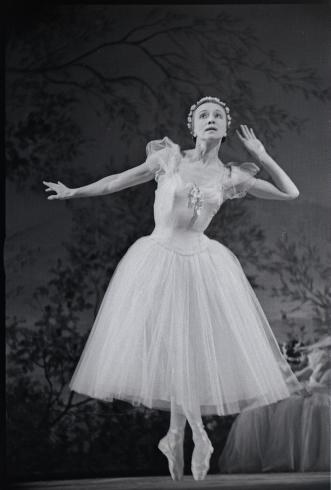
The Goddess of Dance. Galina Ulanova.
Unknown artist
- Source:
- Library of Congress
- Rights:
- Public domain — free to use, share and adapt.
- Recorded as:
- Public Domain
This photograph is a document of classical ballet in the twentieth century and an example of how photography elevated dance to the status of a fine art subject worthy of careful composition and theatrical lighting. It preserves a particular style of performance and embodiment that defines the romantic ballet tradition and the technique required to perform it.
What you are looking at
A female dancer in a classical ballet costume stands alone against a dark, atmospheric backdrop suggesting a forest or natural setting with bare branches visible. She wears a white tulle tutu of mid-calf length, a fitted bodice, and pointe shoes. Her pose is one of classical elegance: she stands in a lifted, upright position with her left arm extended to the side at shoulder height and her right arm raised toward her head. Her gaze is directed upward and to the side, conveying a sense of yearning or spiritual transcendence. The lighting is theatrical, concentrating on her pale costume and figure while the background recedes into darkness. The composition emphasizes her isolation and the ethereal quality of the moment—a single figure suspended between the earthly and divine.
The dancing
The dancer appears to hold a near-vertical alignment through her supporting leg, with the lifted leg extended in a controlled position (likely arabesque or attitude). Both arms frame the upper body in a classical line: one arm opens to the side in a smooth épaulement, while the other rises and curves near the head in a gesture suggesting supplication or reverie. The posture conveys weightlessness and control characteristic of trained classical technique. Her head position—tilted back slightly with the gaze lifted—completes a long, unbroken line from the supporting foot through the crown, a hallmark of romantic and classical ballet vocabulary.
The dance depicted
This is classical ballet, almost certainly from the romantic tradition. The costume, pointe work, the arabesque-like extension, and the ethereal, emotionally charged pose all point to romantic-era ballet or a theatrical work in that style. The title 'The Goddess of Dance' and the upward gaze suggest a transcendent or allegorical subject common to nineteenth-century romantic ballets. The image may document a specific moment from a classical ballet performance or a study of the form itself—the figure could be representing a sylph, a muse, or an idealized vision of dance itself. Without additional context, we cannot determine the specific ballet or choreography, but the visual language is unmistakably classical ballet of the romantic tradition.
How it was made
This is a black and white photograph, likely taken in a professional theatrical context. The lighting and composition suggest studio or stage photography, possibly a promotional or documentary photograph of a performance. The photographic medium captures detail in the dancer's musculature and the texture of the tulle tutu, while the tonal range of the print emphasizes sculptural form and the dramatic interplay of light and shadow typical of theatrical photography. The image appears to be from a professional source and was likely distributed as a publicity photograph or archival documentation of a dance performance.
About this work
This photograph documents a moment of classical ballet as performed at the height of the mid-twentieth century. It is a study in the vocabulary of romantic and classical ballet: the posed extension, the lifted carriage, the ethereal costume, and the transcendent emotional register conveyed through upward gaze and open arms. The work exemplifies the role of photography in preserving and celebrating the ephemeral art of dance performance, allowing a single moment of movement and presence to become a lasting image. The photograph belongs in a gallery of dance art because it demonstrates how dancers and photographers collaborate to communicate the emotional and physical content of ballet to an audience that cannot witness the live performance.
How to look at it
Focus on the verticality and control in the dancer's posture: the alignment of the supporting leg, the arc of the lifted leg, and the unbroken line from foot to crown. Observe how the arms frame the face and body, opening the torso and directing the viewer's eye upward. The tilt of the head and the direction of the gaze are crucial to the emotional content—they communicate longing, transcendence, or spiritual aspiration rather than technical display. The costume and the darkness surrounding the figure were both deliberate choices: they isolate the dancer and emphasize her otherworldliness.
The artist
The photographer is not recorded in the catalogue. However, the professional quality, theatrical lighting, and composition suggest a studio or company photographer working in the mid-twentieth century, likely documenting performances for promotional or archival purposes. The subject's identification in the title (Galina Ulanova) indicates this may be an official company photograph.
The period
This photograph dates to 1961, a period when ballet photography was an established art form and dance companies used professional photographers to document and promote their artists. The Soviet ballet tradition, with which Galina Ulanova was associated, was at a peak of international prominence in the Cold War era, and photographs like this one served as ambassadors for Soviet cultural achievement. The romantic ballet tradition—though originating in the nineteenth century—remained the dominant vocabulary of classical ballet training and performance well into the twentieth century.
Where it lives
This photograph is held by the Library of Congress. It is catalogued as a historical photograph of a dance performance, likely acquired as part of documentary or archival photography related to the history of ballet and dance in the twentieth century.
Dance in this work
Questions about this work
Who is Galina Ulanova?
Galina Ulanova (1910–1998) was a Soviet prima ballerina, widely regarded as one of the greatest classical dancers of the twentieth century. She was a leading dancer of the Bolshoi Ballet and became an international cultural ambassador for Soviet ballet during the Cold War. She was known for her dramatic intensity, technical precision, and emotional depth in romantic roles.
What is 'The Goddess of Dance'?
The title likely refers to the subject or concept of the photograph rather than a specific named ballet. It is a romantic and allegorical way of describing the image: a single dancer posed as if embodying the divine or transcendent nature of dance itself. Without additional documentation, we cannot determine whether this image documents a specific ballet or is a studio study created for publicity or artistic purposes.
What ballet technique is the dancer using?
The dancer is using classical ballet vocabulary, with pointe work, a turned-out supporting leg, and an extended lifted leg (likely in arabesque or attitude derrière). The carriage of the arms and the upright alignment of the torso are characteristic of the Vaganova method, the dominant Soviet ballet training system, which Ulanova would have been trained in.
Why is the background so dark?
The dark background is a theatrical and artistic choice that isolates the dancer and emphasizes her figure and costume. It creates a sense of timelessness and removes any distraction, allowing the viewer to focus entirely on the body, the line, and the emotional content of the pose. This is a common approach in theatrical and promotional dance photography.
More dance artwork





