49 works in this view — arrow keys or swipe to move between them.
Dance in Art · 1910
Spook dance
Unknown artist
- Source:
- Library of Congress
- Rights:
- Public domain — free to use, share and adapt.
- Recorded as:
- Public Domain
This poster is a primary document of early 20th-century theatrical dance as a commercial and visual spectacle. It shows how dance was advertised to the public, what themes and imagery sold tickets, and how the female dancing body was positioned within broader visual and theatrical culture of the period. For researchers tracking the history of theatrical dance in America, the iconography and style conventions of such posters are crucial evidence of what 'dance' meant to the public imagination at a specific historical moment.
What you are looking at
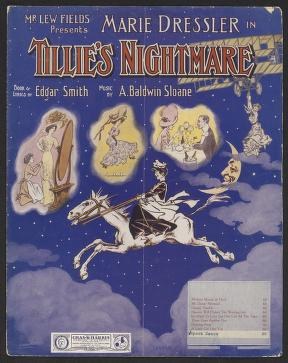
This is a theatrical poster for a 1910s stage production, rendered in the Art Nouveau style typical of the era. The composition is dominated by a rearing white horse in the center-lower portion of the frame, captured mid-leap against a deep blue night sky scattered with stars and wispy clouds. Above and around the horse float four luminous female figures in gossamer drapery, their bodies arranged in attitudes suggesting weightlessness and supernatural movement. The figures appear to be wearing flowing Greco-Roman or classical revival costumes rendered in pale gold and white, with their bodies posed in various attitudes of abandon—arched backs, extended limbs, and swirling fabrics that suggest rapid motion. The overall effect is dreamlike and ethereal, with the horse functioning as an anchor point for the composition while the human figures seem to dematerialize into the nocturnal atmosphere. The design uses the characteristic palette of early 20th-century theatrical printing: deep blues and purples for the sky, warm golds and whites for the figures and horse, with decorative typography at top and bottom identifying the production.
The dancing
The four female dancers are positioned in a scattered, asymmetrical arrangement rather than in any formal dance hold or line. Their bodies display high extensions, arched spines, and dramatic arm placements suggestive of classical ballet vocabulary, but the floating, unsupported quality of their poses—with limbs extended in multiple directions and bodies suspended in mid-air—indicates theatrical staging and costume artifice rather than technical dance positions captured mid-movement. The drapery of their costumes flows and billows, creating lines that echo and amplify the body's gesture. Their relationship to one another is spatial rather than partnered; each figure occupies its own zone of the composition. The horse, rearing with front legs extended and head thrown back, becomes a sixth moving body in the design, its musculature and tension offering a stark counterpoint to the ethereal human figures.
The dance depicted
This is promotional art for a theatrical spectacle rather than a documentation of a specific dance form. The title 'Spook Dance' and the ethereal, ghostly presentation suggest this is stage dance in the early 20th-century 'interpretive' or 'classical' idiom—what was sometimes called 'classical ballet' or 'aesthetic dance' of the period, performed by actresses or theatrical dancers rather than trained ballet technicians. The supernatural theme and the emphasis on flowing, unbounded movement in diaphanous costume point to the Romantic ballet tradition (spectral maidens, nocturnal enchantment) that remained a staple of theatrical dance through the 1910s. The presence of the horse suggests this may have been a narrative ballet or a pictorial spectacle with equestrian elements, not uncommon in theatrical dance of the period. Without access to the production records, the specific choreography cannot be identified, but the movement vocabulary is unmistakably theatrical and staged rather than social or vernacular dance.
How it was made
This is a color lithographic poster, a printing technique that allowed for bold, graphic color work and wide circulation. The technique is characteristic of theatrical advertising in the early 20th century, particularly for stage productions seeking a broad audience. Lithography's capacity for subtle gradations and fluid drawing, visible here in the treatment of drapery and the horse's musculature, made it ideal for this kind of atmospheric, romantic imagery. The poster format and the presence of printed text at top and bottom (identifying the production and principals) confirm its function as public advertising material, intended for street display and shop windows. This suggests the production had commercial ambitions and drew audiences beyond the theater elite.
About this work
This is a lithographic theatrical poster for a stage production titled 'Spook Dance,' dating to the 1910s. The image advertises a supernatural-themed dance spectacle in the classical or interpretive tradition, featuring costumed performers in ethereal attitudes against a night sky, accompanied by a prominently featured horse. The poster demonstrates the visual conventions and production values of early 20th-century theatrical dance, marketed to popular audiences through color lithography. It belongs to a body of evidence about how theatrical dance was promoted, styled, and imagined in the Edwardian era—an era when classical ballet and 'aesthetic' dance coexisted with more experimental and spectacle-driven forms, and when equestrian elements could feature in stage dance without incongruity.
The work is significant as a document of theatrical taste and visual culture at the moment when dance was establishing itself as a commercial theatrical medium in the United States and Europe. The poster's visual language—the Romantic imagery, the ethereal female form, the exotic animal, the mystical atmosphere—reflects the period's fascination with escapism, the supernatural, and the female body as an object of visual spectacle. For historians of dance in theater, this poster documents not the dance itself but the marketing apparatus and visual imagination that surrounded it, revealing what producers and audiences believed dance should look like, even if we cannot see the actual choreography.
How to look at it
Attend to the composition's central focus on the rearing horse and the way the human figures are distributed around and above it, rather than forming a unified ensemble. This tells us something about the production's priorities: spectacle and pictorial effect rather than coordinated group choreography. Notice how the lithographic technique renders the drapery and the horse's musculature—the lines are fluid and expressive, which means the printer (and the poster's designer) understood how to translate movement and physicality into a static image. The nocturnal setting and the floating, weightless quality of the figures' poses suggest a moment of supernatural suspension, not a naturalistic dance moment. The costume and the classical poses of the figures position this within the Romantic ballet tradition, even as the title 'Spook Dance' and the theatrical presentation suggest a more populist, commercial approach to that tradition than a classical ballet company would have used.
The artist
The poster credits 'A Baldwin Sloane' in the theatrical credits (visible in the printed text), though it is not clear whether Sloane is the designer, composer, or producer. The artist who created the lithographic design is not identified in the available record. The style is consistent with the commercial theatrical poster aesthetic of the 1910s, particularly the Art Nouveau-influenced design language that persisted in American theatrical printing into the second decade of the 20th century. The work reflects the visual standards of mass theatrical production: professional graphic design, skilled lithographic execution, and an understanding of how to market spectacle to a broad urban audience.
The period
In the 1910s, theatrical dance in America was experiencing a period of rapid professionalization and commercialization. The legacy of 19th-century Romantic ballet (with its emphasis on ethereal female figures, supernatural themes, and spectacle) remained dominant in popular theatrical production, even as avant-garde artists and dancers were beginning to challenge these conventions. The rise of commercial theater and the popularity of stage spectacles meant that dance was increasingly performed for paying urban audiences rather than court or elite audiences. This was the era before the widespread impact of modernist dance pioneers like Martha Graham and Doris Humphrey; classical ballet, 'interpretive' dance, and theatrical spectacle dominated the commercial stage. The poster's aesthetic—the emphasis on beauty, ethereality, and romantic atmosphere—reflects the conservative visual vocabulary that still dominated mainstream theatrical dance at this moment.
Where it lives
This poster is held in the Library of Congress, as indicated by the source notation 'loc' in the catalogue record. It is a commercial theatrical poster, created for public distribution and display, and thus represents the materials of popular visual culture rather than a work created for a fine art audience or collectors.
Dance in this work
Questions about this work
Is this a real ballet, or was 'Spook Dance' just a spectacle?
It was almost certainly a theatrical spectacle rather than a formal ballet in the classical sense. The term 'ballet' was used loosely in early 20th-century theater to describe any large-scale dance production with scenery, costumes, and narrative or pictorial themes. 'Spook Dance' appears to have been a commercial stage production designed to appeal to a broad popular audience, using classical dance vocabulary and Romantic imagery (ethereal maidens, supernatural atmosphere) but not necessarily representing the work of a trained ballet company or a named choreographer.
Why is there a horse in a dance production?
Equestrian elements were not uncommon in theatrical spectacles of this period, particularly in productions that aimed at pictorial grandeur and visual variety. The horse may have been central to the narrative or simply a striking element of stage design. Early 20th-century theatrical dance often borrowed from pantomime, circus, and historical pageantry, all of which could include horses. The prominence of the horse in this poster suggests it was a major draw for audiences.
Who was Marie Dressler, and what was her role in this production?
Marie Dressler's name appears prominently on the poster, indicating she was the star of the production. Dressler was a major theatrical personality of the early 20th century, known for both dramatic and musical theater roles. Her presence in the credits suggests that 'Spook Dance' was a star vehicle—a production built around a famous performer rather than choreography or ensemble work. This was typical of early 20th-century commercial theater.
What does the Art Nouveau style tell us about when this was made?
The flowing lines, organic forms, and palette of the poster design are characteristic of Art Nouveau, a design movement that was dominant in the 1890s and early 1900s but continued to influence theatrical and commercial art into the 1910s and beyond. This poster's style confirms its early 20th-century date and its place within a specific visual and cultural moment—a moment when such flowing, theatrical design was considered modern and appealing.
More dance artwork





