49 works in this view — arrow keys or swipe to move between them.
Dance in Art · 1906
Oriental dance
Unknown artist
- Source:
- Library of Congress
- Rights:
- Public domain — free to use, share and adapt.
- Recorded as:
- Public Domain
This work documents the visual grammar of early Broadway marketing and the aesthetic of musical-theatre dance as a commodity. It reveals what producers and designers chose to emphasize—chorus precision, female beauty rendered in art-nouveau style, and spectacle—and thus tells us about the taste, values, and commercial logic of popular entertainment around 1906.
What you are looking at
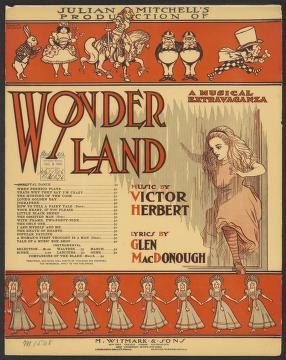
This is a color lithograph—a theatrical poster for the musical *Wonder Land*, with music by Victor Herbert and lyrics by Glen MacDonough. The design is divided into three horizontal registers. The top frieze shows a chorus line of stylized characters in various grotesque or whimsical costumes: a figure in a tall hat, musicians, and dancers in exaggerated poses. The central and largest section features the title *WONDER LAND* in bold gold lettering above an illustration of a woman in a diaphanous, shell-like or art-nouveau gown, reclining in a languid pose with her head tilted back and one arm raised. The composition uses warm oranges, golds, and flesh tones against a neutral background. The bottom register repeats the chorus-line motif, showing eight identical or near-identical female figures in matching light-colored dresses with their arms raised or positioned symmetrically, suggesting a precision line or corps de ballet. The overall design is characteristic of early 1900s theatrical poster art, with strong graphic composition and bold typography.
The dancing
The central figure exhibits a reclining, languid posture typical of art-nouveau sensuality: her torso is arched, her head thrown back, and her arm extended in an arabesque-like lift. This is not an active dancer but an idealized, static form. The chorus figures in the top and bottom registers are shown with raised arms and forward-facing orientation, suggesting a synchronized ensemble or kick line. Their postures are upright and uniform rather than expressive of individual movement quality. The overall impression is of theatrical spectacle and visual symmetry rather than naturalistic dance technique.
The dance depicted
This is a musical-theatre poster, not documentation of actual dance. The title *Wonder Land* (1906) was a musical-comedy production, and the imagery reflects turn-of-the-century Broadway and musical-theatre conventions rather than a specific dance form. The chorus line at top and bottom—a hallmark of musical theatre and vaudeville of the era—suggests ensemble numbers and precision work. The central reclining figure and the theatrical presentation indicate this is commercial entertainment dance, positioned between theatrical spectacle and emerging Broadway chorus traditions. The word "Oriental" in the catalogue record does not appear to be supported by the image itself, which shows no clearly oriental costume, setting, or dance iconography.
How it was made
This is a color lithograph, a process well suited to theatrical poster production in the early 1900s. Lithography allowed bold, graphic color separation and dramatic visual impact suitable for street advertising and lobby display. The print would have been produced from multiple stones or plates, one for each color. The technique enabled rapid reproduction and wide circulation of theatrical imagery, making it an effective medium for promoting Broadway productions to a broad urban audience.
About this work
This is a commercial theatrical poster for the 1906 musical *Wonder Land*, designed to advertise a Broadway production. It is an artifact of early 20th-century musical-theatre promotion and visual culture, capturing the conventions of theatrical spectacle in the transition from vaudeville to the modern Broadway era. The image reflects how dance and performers were marketed to the public: through idealized, stylized imagery that emphasized ensemble effect, visual symmetry, and theatrical glamour rather than technical or choreographic substance.
How to look at it
Attend to the division of the image into three registers: the static, idealized central figure versus the repeated, synchronized chorus at top and bottom. The central woman is presented as an object of aesthetic contemplation—reclining, passive, decorative—while the chorus figures suggest coordinated movement and ensemble discipline. Note the contrast between romantic arabesque-like arm positioning (which evokes ballet) and the frank commercial purpose (theatrical advertisement). The symmetry and repetition of the chorus line reflect early modern values of efficiency and visual order applied to the human body.
The period
In 1906, Broadway musical comedy was in a period of rapid expansion and professionalization. The chorus girl and the precision ensemble had become central to theatrical marketing and audience appeal. Art nouveau remained a dominant visual language in poster design, though its influence would wane within a decade. Victor Herbert was one of the most successful composers of American operetta and musical comedy during this era, and his works were known for elaborate staging and large ensemble numbers. The poster reflects the intersection of European aesthetic modernism (art nouveau) with American commercial theatrical culture.
Where it lives
The work is held at the Library of Congress and identified as a color lithograph from 1906. It is a theatrical poster, a form of commercial ephemera now collected as a primary source for the history of American entertainment and visual design.
Dance in this work
Questions about this work
Why does the catalogue call this 'Oriental dance' when there is no obvious oriental content?
The catalogue record may be inaccurate or based on incomplete information. The image itself shows no clear oriental costume, setting, or dance iconography. The title *Wonder Land* suggests a fantastical rather than geographically specific setting. This is a discrepancy between the record label and the visual evidence.
Is this a record of actual choreography or movement?
No. This is a theatrical poster—a promotional artifact designed to advertise the show to potential audiences. The poses are stylized and static, chosen for visual appeal and graphic impact rather than to document how dancers actually moved. The central figure is not executing a dance step but adopting an idealized, decorative posture.
What do the chorus lines tell us about dance in early Broadway musicals?
The repeated, synchronized figures at top and bottom suggest that ensemble precision, visual uniformity, and spectacle were key values in musical-theatre marketing. The chorus was sold as a visual commodity—interchangeable, ornamental, and disciplined—rather than as vehicles for individual artistry.
More dance artwork





