49 works in this view — arrow keys or swipe to move between them.
Dance in Art · 2019
Sarumawashi dance
Unknown artist
- Medium:
- Source:
- New York Public Library
- Rights:
- Public domain — free to use, share and adapt.
- Recorded as:
- public_domain
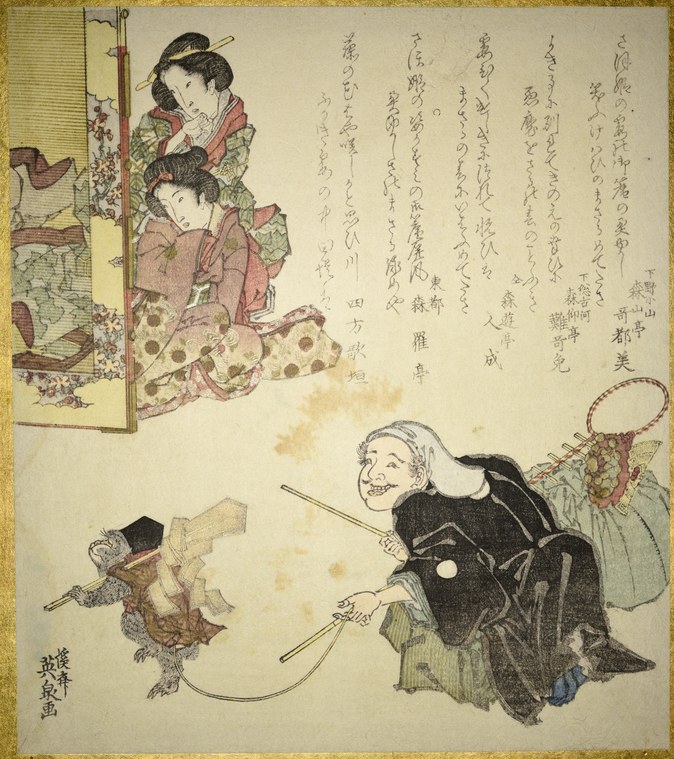
Sarumawashi is a vanished performance tradition that reveals how humans choreographed nonhuman bodies and how movement operated as entertainment across class lines in early modern Japan. This print is one of few surviving visual documents of the form, showing not just the monkey but the entire social and gestural grammar of the performance—how trainers directed, how animals responded, and how audiences received the spectacle. For dance historians, it demonstrates that 'dance' in cultural context encompasses human-animal partnerships and that improvisation with living, unpredictable performers was a valued art form.
What you are looking at
A Japanese woodblock print depicting sarumawashi (monkey dance), a traditional performance art where a trainer presents a trained monkey to an audience. The composition is divided into two registers: the upper portion shows two elegantly dressed women in richly patterned silk robes seated indoors, observing the performance through an open screen or window decorated with flowering plum branches. The lower register depicts an elderly male trainer in dark robes, grinning widely and gesturing with a stick or baton toward a small monkey wearing formal dress. The monkey appears animated, captured mid-movement in a playful pose. The scene is framed by decorative borders and accompanied by Japanese calligraphic text on the right side, suggesting this is a narrative or documentary woodblock from Japan's Edo period. The color palette is muted—soft greens, reds, and earth tones—typical of nishiki-e (brocade pictures) or hand-colored woodblock prints.
The dancing
The monkey is rendered in a lively, forward-leaning stance with limbs extended in an exaggerated, comedic posture suggesting active, uncontrolled movement. The trainer stands opposite, bent slightly forward with arm raised, maintaining eye contact and gestural control of the animal through a stick or training implement. The two female observers sit in a composed, formal seiza position (kneeling), their bodies held upright and still—a stark contrast to the kinetic energy of the monkey. The dynamic tension between the controlled, dignified posture of the women and the chaotic liveliness of the monkey is central to the composition.
The dance depicted
Sarumawashi (monkey dance) was a popular street performance in medieval and early modern Japan, typically performed by traveling entertainers who trained monkeys to mimic human behavior and perform acrobatic tricks. The trainer used verbal commands, gestures, and sometimes physical cues (the stick visible here) to direct the monkey's movements into sequences that resembled human dance or martial arts postures. This was entertainment for common people and nobility alike; the presence of the two well-dressed women suggests performance for an elite household. The monkey's exaggerated gestures and the trainer's gestural direction are the choreographic core: sarumawashi was improvisational, responsive, and relied on the animal's unpredictability making each performance unique.
How it was made
This is a woodblock print, likely hand-colored (possibly nishiki-e or a hand-tinted print). The technique is evident from the bold line work, the application of flat color fields, and the characteristic registration marks or edges visible in the composition. Woodblock allowed for mass reproduction and distribution of images documenting popular entertainments, making sarumawashi—a folk performance—accessible as a visual record for viewers across Japan. The print likely dates to the Edo period (17th–19th century) based on style and subject, when such documentary prints of street life and performance became a major genre.
About this work
This woodblock print documents sarumawashi, a centuries-old Japanese performance tradition in which a trained monkey, directed by a handler, performed acrobatic and dance-like movements for paying audiences. The composition captures a private performance for two elite patrons, showing the fundamental dynamics of the form: the trainer's gestural control, the monkey's animated responsiveness, and the audience's composed, formal observation. The work preserves a practice that was once widespread but has largely disappeared, making it a valuable historical record of how movement, control, and improvisation functioned in Japanese folk performance.
How to look at it
Attend to the arrested moment the artist chose: the monkey mid-gesture, caught in a pose of exaggerated motion, while the trainer leans toward it with stick raised and the women sit motionless. This captures the essential asymmetry of sarumawashi—pure, wild movement contained and directed by human will. Notice the trainer's expression and posture: he is not passive but actively performing through gesture and expression, suggesting that sarumawashi was as much about the handler's showmanship as the monkey's antics. The formal frame of the watching women's silhouette against the screen emphasizes that this performance was a deliberate social act, not mere animal chaos.
The artist
The artist is not recorded. The print is housed in the New York Public Library and carries the institutional mark of a collection formed to document Japanese prints and popular arts. The style and execution suggest a skilled printmaker working in the mid-to-late Edo period, when documentary prints of street performers, actors, and entertainers became a recognized genre (kyōka-e, mononoke-e, and similar types).
The period
Sarumawashi thrived during Japan's Edo period (1603–1868), when urban popular entertainments proliferated and were widely documented in ukiyo-e (pictures of the floating world). Performance traditions involving animals—including horse dancing, dog acrobatics, and trained monkeys—were common street attractions. Woodblock prints of such performances served as both entertainment themselves and as records of ephemeral live art. By the Meiji period (1868 onward), Western theatrical forms and modernization led to the decline of sarumawashi; it survives today only in a few communities and as a historical curiosity.
Where it lives
The work is held in the New York Public Library collection, one of the premier institutions for Japanese woodblock prints and visual culture. It is catalogued as a print (medium confirmed from the object itself), dating to the era of its production in Japan, approximately mid-to-late Edo period. The work entered a Western collection where it has been preserved and documented as a historical artifact of Japanese popular performance.
Dance in this work
Questions about this work
What was sarumawashi?
Sarumawashi (lit. 'monkey turning') was a form of street and court entertainment in medieval and early modern Japan in which a trainer presented a trained monkey performing acrobatic tricks and dance-like movements. Monkeys were taught to mimic human gestures, perform martial arts poses, and respond to the trainer's vocal and gestural commands. The performance was improvisational and relied on the animal's unpredictable behavior for its appeal. It was popular among both common people and the nobility, though it gradually disappeared during the Meiji period.
How did the trainer control the monkey?
The trainer used a combination of vocal commands, hand gestures, and a stick or baton (visible in this print) to direct the monkey's movements. The relationship was one of learned responsiveness rather than mechanical obedience; the trainer guided and suggested, and the monkey performed. The trainer's own expressive energy—his posture, facial expression, and gesture—was also part of the show, creating a dynamic duet between handler and animal.
Why is this print historically important?
Few visual records of sarumawashi survive, making this woodblock print a rare documentary of a vanished performance tradition. It captures not only the monkey but the entire social context—how trainers worked, how audiences watched, how movement functioned as entertainment. For historians of performance and animal-human interaction, it is invaluable evidence of how Japanese culture choreographed live, unpredictable bodies.
Is sarumawashi still performed?
Sarumawashi largely disappeared by the early 20th century as Western theatrical forms became dominant and attitudes toward animal performance changed. A small number of practitioners continue the tradition in Japan as a cultural heritage practice, but it is no longer a widespread popular entertainment. This print documents a form of performance that was once common but is now nearly extinct.
More dance artwork