49 works in this view — arrow keys or swipe to move between them.
Dance in Art · 2019
Sarumawashi dance
Unknown artist
- Medium:
- Source:
- New York Public Library
- Rights:
- Public domain — free to use, share and adapt.
- Recorded as:
- public_domain
Sarumawashi represents a now-extinct form of trained animal performance that occupied a distinct space in pre-modern Japanese entertainment culture, distinct from both theatrical dance and folk celebration. The print is valuable evidence of how movement, spectacle, and training intersected in popular culture, and how artists documented ephemeral street performance for commercial circulation.
What you are looking at
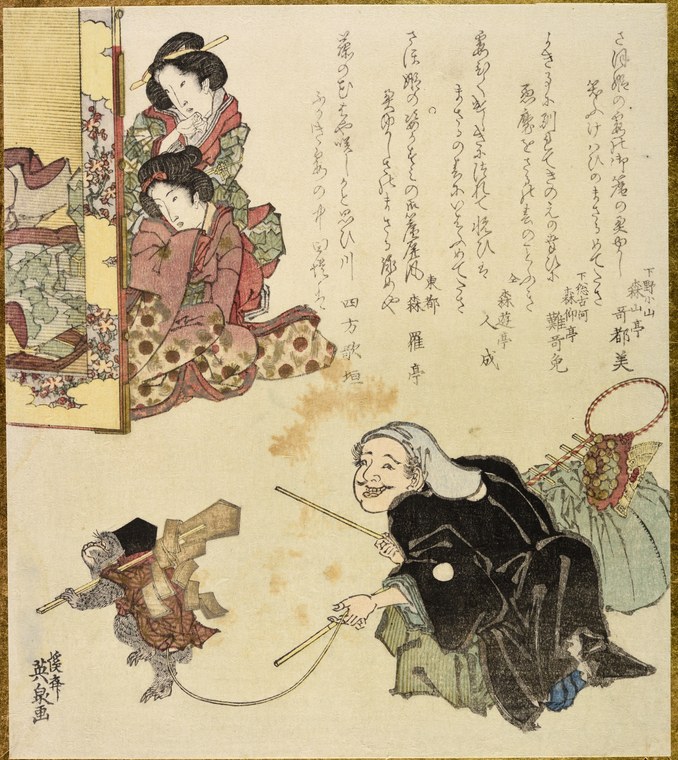
This Japanese woodblock print depicts a sarumawashi (monkey dance) performance, a traditional entertainment form where trained monkeys danced for street audiences. The composition divides into two registers: the upper portion shows two elegantly dressed women in layered robes—one in red with patterned sleeves, the other in green—observing from what appears to be an interior space with a decorative pole or support visible. Below them, a grinning figure in dark robes and a white face mask operates a monkey on a rope or lead, the small animal dressed in ornamental costume and captured mid-gesture. The figures occupy a shallow, compressed space typical of Edo-period prints, with Japanese calligraphy—likely poetry or commentary—filling the right side of the composition. The print employs the characteristic palette of hand-coloured woodblock work: bold reds and greens in the women's garments, delicate line work defining the grotesque expression of the handler, and detailed pattern work in textiles.
The dancing
The two women sit in a relaxed, observational posture, their bodies arranged in the formal composure expected of their social standing, with hands held near their laps or bodies in a contained manner. The monkey handler crouches or bends forward with exaggerated energy, his body angled toward the small animal, which is captured mid-leap or mid-gesture on its rope—the monkey's posture is animated and loose-limbed, suggesting trained movement responding to the handler's direction. The physical relationship between handler and animal is one of control and choreography: the rope acts as both tether and conducting tool, and the handler's body language reads as directorial rather than passive.
The dance depicted
Sarumawashi was a form of street performance, primarily Edo period (17th–19th centuries), in which handlers trained macaques to execute learned movements and gestures to entertain crowds. The dance was not a formalised theatrical genre but rather a feat of animal training adapted to rhythmic music and audience expectation. The monkey performed through conditioning and reward, executing bows, spins, and mimetic gestures that observers found both amusing and marvellous—the performance played on the audience's recognition of human-like behaviour in an animal body. This print captures the essential elements: the decorated monkey as performer, the handler as orchestrator, and the watching figures as consumers of a commercialised street spectacle.
How it was made
This is a hand-coloured woodblock print (likely nishiki-e, a full-colour print technique). The image combines multiple woodblocks—separate blocks for line-work and for each colour layer—allowing the parallel registration of text and image. The delicate rendering of facial expression and costume detail in the women demonstrates the precision possible in this medium, while the looser, more energetic line-work around the monkey and handler conveys movement and informality. The survival of the print with colour largely intact suggests it circulated as a finished commodity among urban, literate audiences in Japan.
About this work
This woodblock print documents sarumawashi, a popular Edo-period street performance in which trained monkeys danced for urban audiences. The work captures both the spectacle itself—the costumed monkey in motion under the handler's direction—and the social context of viewing: the elegant women observing from a privileged vantage point, the energetic handler mediating between animal and audience, the framing of entertainment as a commercial exchange. The accompanying calligraphy suggests the print functioned as both record and commentary, offering urban audiences a keepsake of a live performance they might have witnessed in the street or marketplace.
How to look at it
Attend to the handler's posture and the rope: this is the apparatus of control and choreography, and the handler's bent, forward-leaning body reads as actively conducting the monkey's movement rather than simply restraining it. Notice the monkey's costume—the decorative jacket and adornments—which marks it as a trained performer, not a wild animal; the artifice of the costume is itself part of the spectacle. The contrast between the composed, formal bearing of the watching women and the exuberant, grotesque energy of the handler is deliberate: the print registers the social distance between spectators and performers, and between human dignity and the transgressive comedy of animal performance.
The period
This print dates to Japan's Edo period (1603–1868), when urban centres like Edo and Osaka generated strong demand for images of contemporary entertainment and street life. Woodblock prints depicting actors, courtesans, and performers were among the most popular genres, and sarumawashi—already declining by the late Edo period—would have held nostalgic or documentary interest for audiences. The format of the print, with space devoted to poetry or commentary alongside the image, reflects a broader Edo aesthetic in which visual art and literary text were conceived as complementary.
Where it lives
The work is held in the New York Public Library collection and was digitised as part of their public-domain materials. It is a single-leaf print, circulated as a commodity in the Japanese marketplace.
Dance in this work
Questions about this work
What is sarumawashi and why did it die out?
Sarumawashi was street entertainment in which handlers trained macaques to perform learned gestures and movements for paying audiences. The practice declined in the modern period as urbanisation, animal welfare concerns, and changing entertainment forms made trained monkey performances obsolete. By the 20th century it had largely disappeared, though the cultural memory persisted in prints and literary references.
How were the monkeys trained to dance?
Training involved reward-based conditioning, with handlers using food, gestures, and rhythm to teach the animals to associate specific movements with positive feedback. The 'dance' was not instinctive but learned behaviour, adapted from human movement through patient repetition. Handlers often performed with music—drums or pipes—to give the routine rhythmic structure.
Who watched sarumawashi performances?
Sarumawashi was popular street entertainment that drew mixed urban audiences: children, servants, merchants, and the curious. The print's depiction of elegantly dressed women watching suggests that even higher-status audiences might attend, either as part of street spectating or as a novelty. The commercial nature of the performance—handlers needed paying crowds—shaped both the marketing and the form of the entertainment.
More dance artwork