49 works in this view — arrow keys or swipe to move between them.
Dance in Art · 1914
While we danced
Unknown artist
- Source:
- Library of Congress
- Rights:
- Public domain — free to use, share and adapt.
- Recorded as:
- Public Domain
This image reveals the vocabulary and aesthetic of musical-theater dance in the 1910s—a world of slapstick, pantomime, and character-based movement that coexisted with and often outshone classical and concert dance in terms of public attendance and cultural reach. For historians of American dance, it documents the forms and attitudes that would eventually feed into jazz dance, tap, and Broadway choreography.
What you are looking at
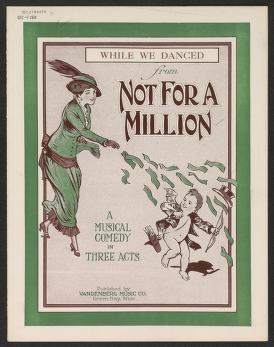
This is a cover design for a musical comedy in three acts titled "Not for a Million." The composition is divided into two registers. In the upper portion, a figure in green Pierrot costume—identifiable by the characteristic loose tunic, pointed hat, and slippers—leans forward in an exaggerated pose of theatrical distress or comic pleading, one arm extended downward. Below, a chaotic tumble of figures in various states of collapse and entanglement fills the lower half of the page, their bodies overlapping in a jumbled heap suggesting slapstick comedy or farcical mayhem. The green border frame and art nouveau styling indicate this is a theatrical poster or program cover from the early 20th century. The composition emphasizes comedic physical business rather than virtuosic dance technique.
The dancing
The upper figure moves in the loose, exaggerated manner of pantomime or commedia dell'arte, with bent knees and an off-balance lean suggesting comic desperation. The lower figures are arranged without formal partnering or frame—no closed holds, no ballroom posture—instead piled together in attitudes of tumbling or collapse. The bodies are articulated to show strain and physical comedy rather than trained dance alignment. This is the vocabulary of slapstick and musical-theater physicality, not ballroom or concert dance.
The dance depicted
This appears to document a musical comedy staged in the early 1910s, likely a burlesque or vaudeville-inflected show rather than a concert dance work. The Pierrot character and the farcical tangle of bodies below suggest that the 'dance' content consists of theatrical movement, comic pantomime, and knockabout physical comedy—the kind of choreography typical of musical-theater production numbers and slapstick interludes. The work celebrates comic business and comedic ensemble physicality rather than any specific ballroom or classical dance form.
How it was made
This is a color lithograph, a technique ideal for theatrical promotion in the 1910s. Lithography allowed inexpensive mass production of posters for distribution to theaters, hotels, and street advertisements. The bold outlines, flat color fields, and caricatural exaggeration are characteristic of the medium. The design is credited as from the Strobridge Lithographing Co. (visible in the lower margin), one of the major American theatrical poster houses of the period. The work was intended as an advertisement and program cover for a wide urban audience.
About this work
This is a theatrical poster for a 1914 musical comedy, reproduced as a color lithograph by a major American theater publisher. It captures the physical vocabulary of early 20th-century musical-theater dance: commedia dell'arte costuming, pantomimic gesture, and farcical ensemble tumbling. The work documents what 'dance' meant in commercial musical theater of the moment—not concert performance but comedic physical action integrated into narrative and character. It is an artifact of the everyday theatrical culture that shaped American dance practice outside the concert hall.
How to look at it
Note the two-part composition: the solitary figure above and the tangled ensemble below. This structure mirrors the dramatic structure of musical comedy—a character's reaction to chaos. The exaggerated lean and extended arm of the Pierrot character are frozen in a moment of maximum expression rather than technical accomplishment; the artist valued legibility of emotion and comic timing over anatomical precision. The lithographic technique allows the designer to use bold outline and flat color to make the composition readable from a distance, as a street advertisement would need to be.
The artist
The poster was produced by the Strobridge Lithographing Co. of Cincinnati and New York, one of the dominant theatrical lithography firms in America from the 1880s into the 1920s. The company specialized in promotional materials for theatrical productions and was known for bold, colorful designs aimed at street advertising. The artist/designer is not recorded in the catalogue.
The period
In 1914, American musical theater was at the height of its commercial power. The dominance of European ballet and concert dance was being challenged by native forms—musical comedy, vaudeville, and revue—in which dance was integrated into comedy, song, and narrative. Pierrot and commedia dell'arte characters had undergone a romantic revival in the 1890s and persisted as stock figures in popular theater. At the same moment, early modern dance pioneers like Ruth St. Denis and Ted Shawn were beginning to establish concert dance as a serious American art form; this poster documents the popular theatrical mainstream that existed in parallel.
Where it lives
The work is held in the Library of Congress as part of its theatrical poster collection. It is a color lithograph credited to Strobridge Lithographing Co., published in 1914 as promotional material for the musical comedy "Not for a Million."
Dance in this work
Questions about this work
Is this a dance work or a theater work?
It is theatrical dance—dance as an element of musical comedy narrative and entertainment, not concert dance or ballroom competition. The movement vocabulary is slapstick and pantomime rather than virtuosic technique. For the history of American dance, it is important because it shows what most people actually saw on a stage in 1914, as opposed to what concert-dance historians have chosen to emphasize.
What does the Pierrot costume tell us?
Pierrot was a stock character in commedia dell'arte and had been recycled through European Romantic ballet and pantomime. By 1914, the costume was instantly recognizable to American audiences as a marker of whimsy, comedy, and sentimentality. Its use here signals that the musical is drawing on established theatrical traditions of comic character performance.
Who actually danced in 'Not for a Million'?
The catalogue record does not identify the performers or the choreographer. The poster credits the musical as 'a musical comedy in three acts' and credits the publisher, but not the production team or cast.
More dance artwork





