49 works in this view — arrow keys or swipe to move between them.
Dance in Art · 1928
Ballets Russes, 1928
Unknown artist
- Source:
- Library of Congress
- Rights:
- Public domain — free to use, share and adapt.
- Recorded as:
- Public Domain
This image documents a pivotal moment in ballet history when the male dancer was being intellectually and physically rehabilitated as a serious artist. The formal apparatus of the drawing—the geometric framing, the academic technique—signals that ballet itself was being repositioned as a subject worthy of fine-art attention, not mere entertainment. For choreographers and historians, it shows what the classical male body was trained to achieve in 1928.
What you are looking at
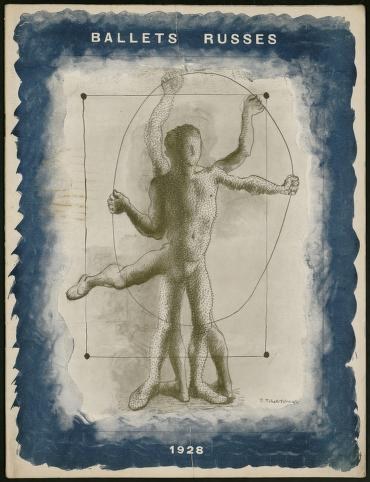
A pen-and-ink figure study rendered in sepia tones within a blue-gray border, showing a single male dancer posed in a classical contrapposto stance. The figure is nude or seminude, drawn with anatomical precision in the manner of Renaissance life studies. His body is inscribed within a geometric framework—a circle and rectangle—that suggests the proportional systems used in classical art instruction. His weight rests on one leg while the other extends in a balletic attitude; one arm lifts overhead while the other extends outward, framing the body in an open, expansive line. The pose reads as a study in classical form rather than a frozen moment from performance: it is an ideal type, not a snapshot. The title "Ballets Russes" appears centered at the top in capitals; the date "1928" is placed at the bottom center.
The dancing
The single figure demonstrates a classical ballet vocabulary: the standing leg is turned out and straight, the supporting hip is lifted, and the free leg is drawn up into a clean ligne. The upper body is held upright with the sternum elevated and the shoulders level despite the asymmetrical arm frame. The overhead arm reaches fully extended with the elbow softly bent; the lower arm presents the palm outward in a controlled, intentional gesture. The anatomical study suggests the artist understood balletic line and the precision of the classical male dancer's port de bras. The body is rendered without tension, suggesting ease in an advanced position.
The dance depicted
This is unmistakably a classical ballet study, specifically in the romantic or neoclassical idiom of male technique. The Ballets Russes (1909–1929) under Sergei Diaghilev revolutionized European ballet by synthesizing classical technique with modernist visual design; this figure study may document or celebrate that fusion. The pose—a variation on an attitude derrière or écarté—belongs to the vocabulary codified by the Cecchetti method and the Imperial Russian school, both central to the Ballets Russes repertoire. The male dancer's role in the company was elevated through works like Nijinsky's choreography and the revival of classical pedagogy; this image situates the male body as the subject of serious study rather than ornament to the ballerina.
How it was made
The work is executed in a mixed medium: pen and ink with ink wash or watercolor, rendered in warm sepia tones on paper. The geometric framework is lightly drawn in graphite or fine pen; the figure itself is built with fine hatching and tonal modeling to suggest musculature and volume. The blue-gray watercolor border frames the composition as a finished work. The technique is consistent with academic figure-study pedagogy and with the arts-and-crafts lineage of art instruction books. The precision of line and the systematic anatomical approach suggest this was either a study for publication or a teaching tool, likely printed or reproduced for circulation among dance professionals and students.
About this work
This is a classical ballet figure study from 1928, the final years of the Ballets Russes. The artist has rendered a male dancer in a canonical classical position, using both the vocabulary of ballet technique and the methods of Renaissance-derived anatomical study. The geometric framework inscribing the body—the circle and rectangle—echo systems of proportion taught in art schools and ballet academies, suggesting that the work sits at the intersection of visual art and dance pedagogy. The title associates the image with Diaghilev's company at a moment when the male dancer was being restored to prominence as a serious virtuoso figure.
The work belongs to a body of visual documentation around the Ballets Russes, a company that collaborated intensively with modern painters, sculptors, and designers. Images like this served multiple functions: as pedagogical tools for dancers, as promotional or documentary images for the company, and as artworks in their own right. The study format—isolating a single figure against a neutral ground—is consistent with both anatomy texts and the company's printed materials.
How to look at it
Note the geometric framing: the circle and rectangle are not mere decoration but a claim about the body's perfection and measurability. Observe how the dancer's line flows within and against these boundaries—the weight is grounded, the torso is erect, but the limbs reach outward, suggesting both control and expression. The artist has chosen a moment of readiness rather than propulsion: this is the dancer as embodied idea, not as narrative agent. The slight asymmetry of the pose—one leg working, one arm high, one arm extended—is the classical ballet vocabulary in its essential form.
The period
The Ballets Russes (1909–1929) was the most innovative dance company of its era, introducing works by Fokine, Nijinsky, and Massine while establishing collaborations with visual artists including Picasso, Matisse, and Goncharova. By 1928, the company was in its final season but remained influential. The figure study format reflects the broader modernist interest in abstraction and geometry—the golden section, Cubism's use of structural frameworks, and the Bauhaus movement's fusion of craft and design. In ballet pedagogy, this period saw the systematization of technique through Cecchetti notation and the increasing prestige of the Russian Imperial school. The male dancer's role was being theorized and elevated in tandem with modernist dance reform.
Where it lives
The work is recorded in the Library of Congress collection. It appears to be a finished study or print, likely part of a series of documentation around the Ballets Russes or a pedagogical publication.
Dance in this work
Questions about this work
Is this a drawing of a real dancer or an idealized type?
It is a type study rather than a portrait. The use of geometric framing and anatomical precision suggests the artist was interested in the ideal classical form rather than in depicting a particular performer. However, the specificity of the balletic vocabulary—the exact positioning of the feet, the port de bras, the distribution of weight—indicates observation of how trained dancers actually moved in 1928.
Why does the geometric framework matter?
The circle and rectangle are a visual claim: that the human body can be measured, proportioned, and understood as a perfect form. This reflects Renaissance humanist ideas about the body that ballet technique itself inherited. For modernist audiences in 1928, these frameworks would also have evoked Cubism and the Constructivist interest in structure and abstraction.
What does 'Ballets Russes' mean in this context?
The title connects this work to Sergei Diaghilev's company, which transformed ballet in the 1910s and 1920s. By 1928, the company was documenting and promoting itself through collaborations with fine artists. This study may have been made for the company, by a company-associated artist, or in homage to its innovations.
Why is the male body the subject here?
Before the Ballets Russes, male dancers in European ballet were often secondary to the prima ballerina. Nijinsky and subsequent male stars restored the male dancer to prominence as a virtuoso and artist. This study of a male body in a canonical classical position reflects that historical shift.
More dance artwork





