44 works in this view — arrow keys or swipe to move between them.
Dance in Art · 2010
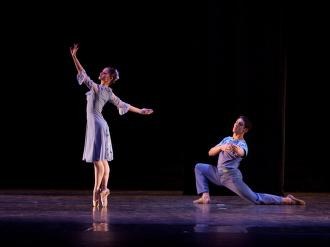
Montgomery Ballet performs "A New Ballet by Paul Gilliam" at the Davis Theatre in downtown Montgomery, Alabama
Unknown artist
- Source:
- Library of Congress
- Rights:
- Public domain — free to use, share and adapt.
- Recorded as:
- Public Domain
This image documents the work of a contemporary choreographer in a regional American context, showing how classical ballet technique and vocabulary are being actively reimagined and expanded by working artists outside major dance centers. The juxtaposition of the two figures—one in classical ballet form, one in modern vocabulary—visually demonstrates a real choreographic conversation about what ballet can be, making it a valuable record of 21st-century ballet practice.
What you are looking at
Two dancers are captured mid-performance on a dark stage lit by theatrical spotlighting. The dancer on the left, wearing a pale lavender or mauve tutu with a fitted bodice, stands on pointe with one arm raised overhead in an elegant port de bras and the other extended to the side. Her body is arched with classical extension. The dancer on the right, dressed in a darker costume that appears to be a tunic or contemporary dress, is on the floor in a lunging or kneeling position with arms reaching forward and upward in a contrasting, more grounded gesture. The floor appears to be polished and reflects the stage lights. The composition contrasts the vertical lift of the left figure with the earthbound, vulnerable position of the right figure, creating dramatic visual tension. A vertical pole or set piece is visible at the right edge. The lighting is theatrical and dramatically side-lit, creating strong shadows and silhouettes against the dark background.
The dancing
The left dancer demonstrates full classical ballet form: standing en pointe in an upright frame with proper turned-out legs and a lifted, extended port de bras. The right dancer uses a modern, floor-based vocabulary—kneeling or in a deep lunge with arms extended upward in a contemporary reaching gesture rather than a classical ballet line. Their bodies relate to each other across space but do not make contact; the contrast between one figure's vertical line and the other's horizontal/grounded orientation is compositional and thematic. The two figures appear to be the same dancer captured in different roles or states, or two dancers in dialogue.
The dance depicted
This appears to be a contemporary ballet or ballet-influenced work that blends classical technique with modern movement vocabulary. The classical pointe work and tutu on the left figure signal traditional ballet training and aesthetic, while the kneeling floor work and unconventional arm positions on the right suggest a Neoclassical or Contemporary Ballet approach that deliberately juxtaposes classical elegance with earthier, more emotionally direct physicality. The catalogue identifies this as a work by Paul Gilliam (a contemporary choreographer active in Alabama) performed by Montgomery Ballet. Without access to the specific choreography, the image suggests a narrative work exploring contrasts—perhaps between aspiration and grounding, control and release, or classical and modern sensibilities.
How it was made
This is a stage photograph, likely taken from the house during a live performance at the Davis Theatre in downtown Montgomery. The theatrical lighting—side-lit and focused—and the depth of field suggest professional performance photography taken during an actual performance rather than a rehearsal or posed session. The photographic medium captures the dancers in motion at a precise moment, freezing the choreography for analysis and documentation. Such photographs serve as historical records of regional dance productions and are valuable documentation of local dance communities.
About this work
This is a production photograph from a performance of 'A New Ballet by Paul Gilliam' by Montgomery Ballet, circa 2010. The image documents a contemporary work that blends classical ballet vocabulary with modern movement, as evidenced by the coexistence of pointe work and tutu alongside floor-based kneeling positions and contemporary arm gestures. The photograph captures the moment of performance, preserving a snapshot of a specific artistic statement. It belongs in a gallery of dance in art as documentation of regional American ballet practice and as evidence of how choreographers working outside major urban centers engage with both classical and contemporary movement languages.
How to look at it
Attend to the two contrasting body positions and what they suggest about the work's values: the left figure's lifted, extended verticality is the classical ballet ideal, but it is balanced—perhaps even put in question—by the right figure's grounded, reaching position. The photographer chose to capture both figures in a single frame, inviting comparison. Notice also how the theatrical lighting sculpts the bodies differently: the pointe dancer is caught in a moment of suspended elegance, while the kneeling figure is more earthbound and direct. This compositional choice tells us something about what the choreography is trying to say.
The artist
Paul Gilliam is a contemporary choreographer based in Alabama. The photograph documents his work with Montgomery Ballet, a regional ballet company. Beyond the title and this single photograph, little information about Gilliam's broader practice or training is accessible from the record, but the work itself suggests a choreographer engaged with both classical ballet tradition and contemporary movement exploration.
The period
The photograph dates to 2010, a period when American ballet was actively debating the relationship between classical technique and contemporary movement vocabulary. Neoclassical and Contemporary Ballet approaches—established by figures like George Balanchine, William Forsythe, and Martha Graham—had by this time become widely integrated into regional ballet training and performance. Regional ballet companies like Montgomery Ballet were increasingly commissioning new work and exploring contemporary choreography, not merely performing classical repertory. This reflects a broader democratization and decentralization of dance making in the early 21st century, with artistic innovation occurring in smaller cities and regional companies rather than solely in New York City and other major metropolitan centers.
Where it lives
This is a production photograph from the Davis Theatre in downtown Montgomery, Alabama, held in the Library of Congress as part of a broader collection documenting American dance. It documents a single performance moment and serves as historical evidence of regional dance activity.
Dance in this work
Questions about this work
Who is Paul Gilliam?
Paul Gilliam is a contemporary choreographer associated with Montgomery Ballet in Alabama. Beyond this photograph and title, detailed biographical information is not available in this record. The work itself suggests a choreographer engaged with blending classical ballet technique with contemporary movement vocabulary.
What is Montgomery Ballet?
Montgomery Ballet is a regional ballet company based in Montgomery, Alabama. Like many regional ballet companies in the United States, it trains dancers in classical ballet technique while also commissioning and performing contemporary works by choreographers like Paul Gilliam.
Why are the two dancers in such different positions?
The contrast between the classical pointe position and the contemporary kneeling/floor position appears to be deliberate choreographic choice, possibly exploring themes of aspiration versus grounding, control versus release, or the relationship between classical and modern dance vocabularies. Without seeing the full work, we can say the photographer captured a moment emphasizing this compositional dialogue.
Is this contemporary ballet or modern dance?
It appears to be contemporary ballet—a work that maintains classical ballet training and some of its vocabulary (pointe shoes, tutu, lifted frame) while incorporating modern dance movement (floor work, different arm positions, different weight-sharing). This blend is common in 21st-century ballet.
More dance artwork





