27 works in this view — arrow keys or swipe to move between them.
Dance in Art · 1919
Oh you dancing widow
Unknown artist
- Source:
- Library of Congress
- Rights:
- Public domain — free to use, share and adapt.
- Recorded as:
- Public Domain
This work documents the visual language of 1920s social dance at a pivotal moment—the transition from Victorian ballroom formality to Jazz Age informality. It shows how a female dancer (rather than a couple) was used to sell modern dance to the public, reflecting genuine changes in who danced, how they danced, and what values—freedom, energy, modernity—those dances embodied. For historians of dance, fashion, graphic design, and gender, this single object encapsulates the cultural upheaval of the post-war period.
What you are looking at
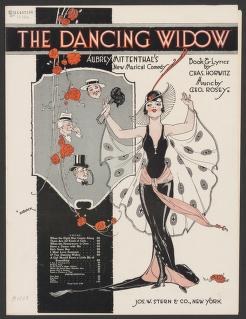
This is a sheet music cover from 1919 for a popular song titled *Oh, You Dancing Widow*. The design is rendered in an Art Deco style typical of early 20th-century theatrical promotion. The composition is split between two halves: on the left, a stylized geometric interior with a small inset scene of dancers at what appears to be a social gathering or nightclub, rendered in muted tones; on the right, a life-size figure of a woman in a sleek black evening gown dominates the image. She is posed in profile and three-quarter view, her body angled in a dynamic, forward-leaning stance suggestive of motion. Her dress is dramatically simplified—a long, straight sheath with minimal ornamentation, typical of 1919 fashion. Her hair is bobbed in the modern style of the era, and her posture conveys the liberated, energetic movement associated with Jazz Age dancing. The overall palette is restrained—black, white, cream, and warm ochres—with bold graphic lines defining form rather than naturalistic detail.
The dancing
The principal figure is a single woman, posed not in a dance hold but in a solo stance suggesting forward momentum and ease of movement. Her weight appears shifted onto one leg, her upper body angled forward, and her arms positioned freely at her sides or slightly extended, conveying the ungoverned, athletic quality of 1920s social dance. The small scene in the background suggests couples or multiple dancers in enclosed space, but these are too small and schematic to read specific holds or frames. The graphic style emphasizes silhouette and profile over anatomical detail, which limits what can be said about footwork or the mechanics of specific steps.
The dance depicted
This is a commercial artifact promoting social dance during the Jazz Age. The title *Oh, You Dancing Widow* and the 1919 date place this squarely in the era of the Charleston, the Lindy Hop's precursor dances, and the general culture of nightclub dancing that emerged after World War I. The figure's loose, forward-leaning posture, bobbed hair, and modern dress all signal the new dances of the period—likely a form of one-step, two-step, or foxtrot as danced socially in urban venues. The composition's emphasis on the isolated, confident female dancer (rather than a couple in formal position) reflects the era's fascination with the modern, independent woman and suggests an audience that would have recognized contemporary ballroom and social dance styles.
How it was made
This is a lithographic sheet music cover, a medium that allowed rapid, economical production and mass distribution of theatrical and popular music promotion. The bold, flattened forms and graphic simplicity are characteristic of lithography's strengths—strong line, flat color fields, and the ability to reproduce text alongside image. As a sheet music cover, the object was designed for visibility and appeal in music stores, at theatrical box offices, and in consumers' homes; it represents the visual culture of commercial entertainment and the music industry of 1919. The Art Deco styling—geometric forms, streamlined silhouettes, and modernist sensibility—marks this as a high-style commercial product aimed at urban, fashion-conscious buyers.
About this work
This sheet music cover is a window into the social and visual culture of Jazz Age dance in 1919 America. It documents the emergence of new, liberated forms of social dancing—the Charleston and its contemporary styles—and the modern female dancer who embodied them. The graphic design itself is a primary historical artifact: the bobbed hair, the straight-line dress, the forward-leaning posture, and the absence of a male partner all signal a radical shift in how dance, gender, and modernity were understood and marketed. The cover bridges commercial music, theatrical promotion, and visual art, recording how dancers and their audiences saw themselves during a transformative moment in dance history.
How to look at it
Attend to the figure's posture and how it differs from formal ballroom deportment: her forward lean, her free arms, her lack of a partner, and her simplified, un-corseted silhouette all convey a new kind of movement freedom. Notice too the graphic language—the flat color, the bold outlines, the reduction of the body to simplified curves and angles—which is itself part of the modernist style of the 1920s. The small, schematic figures in the background are less important than the monumental foreground figure, which suggests that the appeal of this dance was personal liberation and visual spectacle rather than partnered formality. The composition treats the dancer as a commodity and a style icon, not merely as a figure demonstrating steps.
The artist
The artist is not recorded in the catalogue, which is common for commercial sheet music covers of this period. Such designs were often produced by in-house design studios at music publishing houses or by freelance commercial artists working quickly to tight deadlines. The Art Deco style and the professional execution suggest a trained graphic designer working within established conventions of theatrical and music promotion, but without a signature or documented attribution, the individual creator remains anonymous.
The period
In 1919, social dance in America was undergoing rapid transformation. The post-World War I years saw the rise of jazz music, syncopated rhythms, and the dances that accompanied them—the foxtrot, the Charleston (which would debut publicly in 1923 but was being danced privately earlier), and various one-steps and two-steps. These dances were associated with youth, urbanism, and a rejection of Victorian formality. Simultaneously, the visual arts were embracing modernism and Art Deco, a style that prized geometric simplification, streamlined forms, and the visual language of speed and modernity. The cover's design reflects both trends: it presents dancing as modern, graphic, and energized. This was also the era of women's suffrage (ratified in 1920) and the emergence of the modern woman—independent, employed, and leisure-seeking. The solo female dancer on this cover embodies that figure.
Where it lives
This sheet music cover is held by the Library of Congress. The source record identifies it as a 1919 publication but does not record the publisher, composer, or lyricist. As a commercial artifact, it represents the mass-produced visual culture of the American music industry during the Jazz Age.
Dance in this work
Questions about this work
What dances is this cover depicting?
The image does not clearly depict a specific named dance, but the figure's posture, the 1919 date, and the title all point to social dances of the Jazz Age—likely a foxtrot, one-step, or two-step as danced in urban venues. The lack of a male partner and the emphasis on the woman's solo movement suggest a shift away from the formal ballroom tradition toward the more individualistic, energetic dancing of the 1920s.
Why is the woman alone, without a dance partner?
In formal ballroom tradition, dancers were shown in couples. The solo female figure here reflects both the era's fascination with the modern, independent woman and the rise of novelty and jazz dances where partners danced near each other but with less rigid contact and holds. It also made for a more eye-catching commercial design: a single, striking figure is more memorable and more suitable for advertising than a coupled pair.
What does the Art Deco style tell us about this dance?
Art Deco's emphasis on geometric form, streamlined silhouettes, and modernist simplification visually reinforced the idea that these new dances were modern, urban, and forward-looking. The style made dance look contemporary and fashionable, appealing to young, urban audiences who were eager to embrace new music, new fashions, and new social freedoms after World War I.
Is this a high-art object or a commercial one?
It is unambiguously commercial—a sheet music cover designed to sell both the song and the cultural fantasy it advertised. However, the professional execution, the sophisticated graphic design, and the historical significance make it valuable to art historians, designers, and cultural historians. The boundary between commercial and fine art was already blurred in 1919; this cover shows how seriously the music industry took visual design.
More dance artwork





