35 works in this view — arrow keys or swipe to move between them.
Dance in Art · 2019
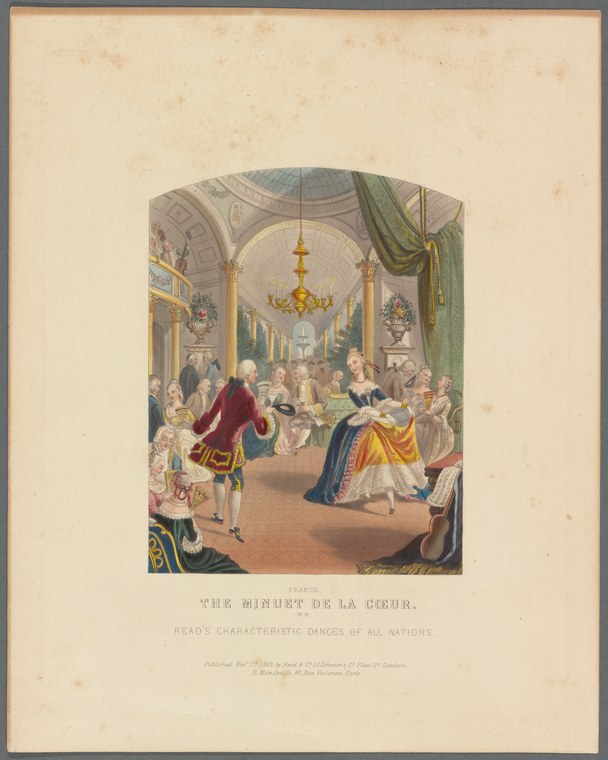
France. The minuet de la cœur
Unknown artist
- Medium:
- Engraving
- Dance:
- Minuet
- Era:
- 1700s (Enlightenment/Minuet Era)
- Source:
- New York Public Library
- Rights:
- Public domain — free to use, share and adapt.
- Recorded as:
- public_domain
The minuet dominated European court culture for nearly a century and established conventions of partnered ballroom dance still taught today. This engraving is direct visual evidence of how the minuet was actually performed—the frame, the carriage, the dress, the spatial relationships—rather than a written description or a later artist's interpretation. For dancers and dance historians, it is primary source material for understanding a foundational style.
What you are looking at
A formal court ballroom scene rendered as a colored engraving, showing a grand interior with a barrel-vaulted ceiling, ornamental urns on pedestals, and a green damask curtain swag at the right. In the center foreground, a well-dressed gentleman in wine-red coat with gold trim and knee breeches leads a woman in an elaborate gown of yellow and blue silk, her skirts gathered voluminously around her in mid-movement. A small child watches from the left. Along the walls and receding into the background, numerous couples in 18th-century court dress stand in conversation or prepare to dance. The lighting is cool and even, the figures rendered with careful attention to fabric texture and fashion detail. A chandelier with multiple flames hangs from the vault above the dancing pair. The composition is framed as though viewed through an architectural opening, with the barrel vault creating theatrical depth.
The dancing
The central couple is in what appears to be a closed or semi-closed position characteristic of 18th-century court dance, with the gentleman's body angled slightly forward and the woman's frame held upright. Her arm position suggests the formal carriage typical of minuet posture—shoulders back, arm extended but not rigid. The gentleman's free arm is held gracefully. Both figures are caught mid-step, their legs extended in a controlled manner consistent with minuet footwork. Surrounding couples show similar restrained, upright carriage. The bodies throughout convey formality and precise control rather than energy or exuberance.
The dance depicted
This is almost certainly a minuet, the preeminent dance of 18th-century European courts. The title itself—'The Minuet de la Cœur' (Minuet of the Heart)—confirms this as the primary subject. The formal court setting, the style and cut of the costumes (place this firmly in the 1700s), the upright frame, the measured step of the central couple, and the social composition all align with the minuet as a formal, choreographed court dance performed by aristocrats in specified dress. The minuet was danced in pairs, often as part of a formal sequence, and this image captures the essential visual signature: elegance, restraint, and social ritual performed in a richly appointed interior.
How it was made
This is a hand-colored engraving, a reproductive print technique that allowed wide distribution of images of fashionable court life. The fine parallel hatching lines visible especially in shadow areas and architectural detail are characteristic of engraving. The color has been applied by hand after printing, which accounts for slight variations and the warmth of the pigments. Engraving was the standard reproductive medium for images of dance, manners, and court ceremony in the 18th century, and such prints circulated among educated audiences across Europe to document fashion, social custom, and artistic composition. The technique allowed this image to reach far beyond the court itself.
About this work
This colored engraving documents the minuet as it was performed in aristocratic European courts during the Enlightenment. The work captures not just the dance itself but the entire ritual context—the architectural grandeur of the ballroom, the meticulous costume, the social hierarchy of courtly gathering, and the precise formality of carriage and movement. It is a record of how the body was displayed and controlled in one of history's most influential dances, one that shaped ballroom dancing for centuries. The image is valuable equally as art history, dance history, and social documentation: it shows us what the minuet looked like in practice, how it was integrated into aristocratic life, and how that life was represented to contemporary audiences.
How to look at it
Observe the posture and frame of the central couple, which represents the ideal minuet position: upright, controlled, with weight held over the balls of the feet. Notice the precise angle of the woman's extended leg and the gentleman's matching step—this is not natural walking but a learned, stylized movement. Look at the contrast between the central dancing pair and the standing figures around them: even in conversation, the courtiers maintain the same upright carriage and formal bearing. The engraving technique allows the artist to render fine detail in costume and ornament, which was as much part of the minuet as the movement itself—the full skirts, the silk stockings, the heeled shoes were all essential to the visual presentation of the dance. The architectural framing—the barrel vault, the grand scale—presents the minuet as a ceremonial act worthy of a grand interior.
The period
The minuet reached the height of its prestige and formality in the 18th century, particularly in France and the courts that imitated French manners. By the 1700s, the minuet had become so codified that it served as a marker of aristocratic education and breeding; the ability to execute it correctly was essential social knowledge. At the same time, the minuet was already being satirized and challenged by faster, more energetic dances—the contredanse, the cotillion—that offered greater freedom and complexity. Dance manuals of the period, particularly those by Raoul-Auger Feuillet and Pierre Rameau, provided detailed notation and description of minuet technique. Engraved images like this one were used to circulate these ideals of courtly grace and to document contemporary fashion and social practice for audiences who might never attend court.
Where it lives
This engraving is held in the New York Public Library collection. It is a color engraving (hand-colored after printing), a common format for the commercial distribution of images of fashionable life and court ceremony in the 18th century.
Dance in this work
Questions about this work
What is a minuet and why was it important?
The minuet was the dominant social dance of European courts from the late 17th through the 18th century. It was slow, formal, and required training. To dance the minuet well was a sign of aristocratic status and refinement. It later became the basis for the structure of the classical symphony and remained part of ballroom dancing into the modern era.
How can you tell this is a minuet?
The title states it explicitly, but the image also shows several tell-tale signs: the formal court setting, the couple dancing in an upright position with precise carriage, the ornate costume of the 1700s, and the social context of aristocrats gathered in a grand interior. The restrained, measured quality of the movement—visible in the controlled step and arm position—is characteristic of the minuet's style.
Who danced the minuet?
In its heyday, the minuet was danced exclusively by aristocrats and the wealthy educated classes. A gentleman might open a ball by dancing a minuet with his partner as part of a formal ritual. By the late 18th century, middle-class dancers and professionals also performed it, often as part of public assembly rooms or theatrical contexts.
Why is this an engraving rather than a painting?
Engraving was the printmaking medium of choice in the 18th century for images meant to circulate widely. A single engraved plate could produce dozens or hundreds of prints, making images of fashion, manners, and dance accessible to educated audiences across Europe. This was far more economical and practical than commissioning original paintings.
More Minuet artwork