26 works in this view — arrow keys or swipe to move between them.
Dance in Art
The Dance
Henri Matisse
- Medium:
- oil on canvas
- Era:
- 1900-1920 (Ragtime/Early Jazz)
- Source:
- Wikimedia Commons
- Rights:
- Public domain — free to use, share and adapt.
- Recorded as:
- public_domain
For dance historians and practitioners, the painting is essential not as evidence of any actual dance practice, but as proof of how modernist painting invented an imaginary 'dance' to escape European aesthetic conventions. It shows the moment when dance became an abstract idea—movement, rhythm, collective joy—rather than a specific social or technical form. Understanding the work means grappling with the uncomfortable fact that European modernism often appropriated non-Western cultures as raw material for formal innovation, and this painting is among the most celebrated examples of that appropriation.
What you are looking at
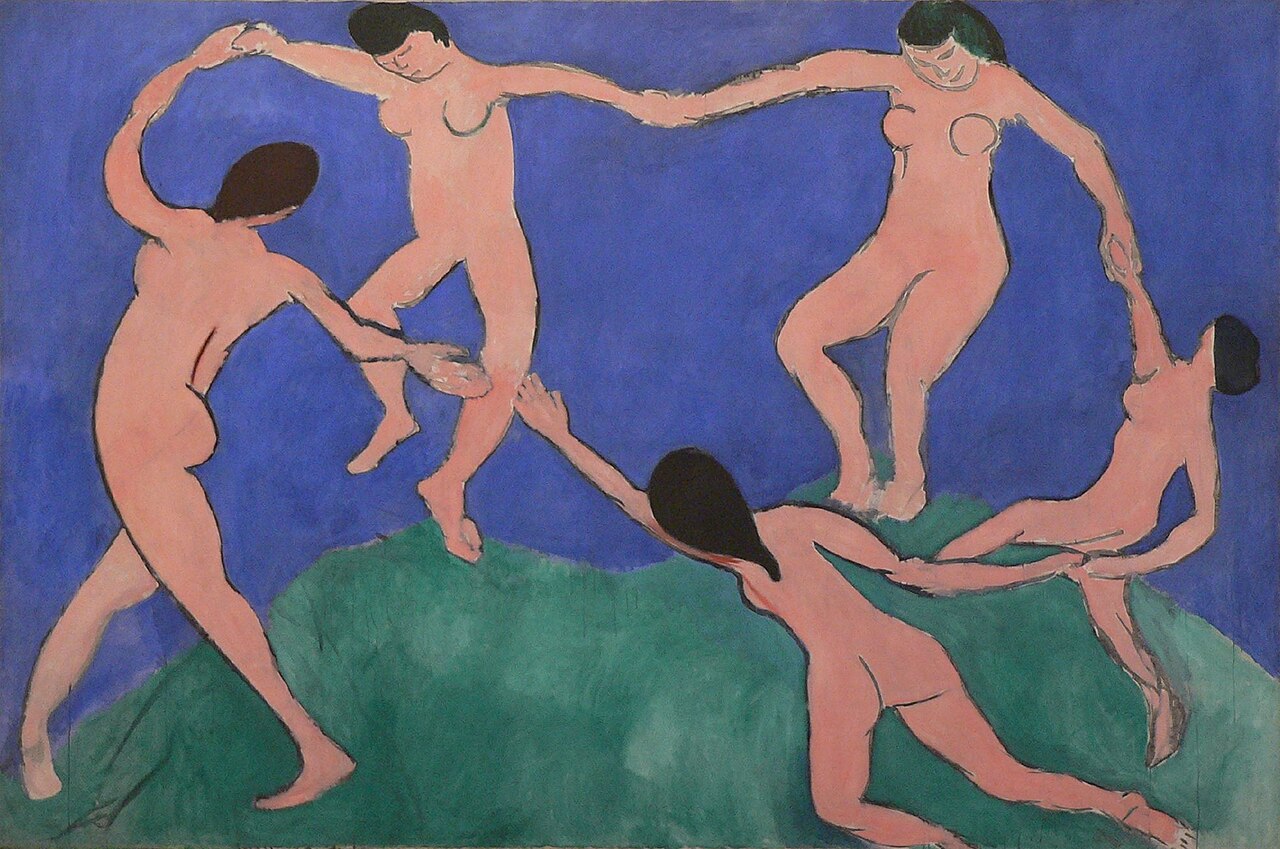
Five nude or near-nude figures dance against a vivid blue background, their bodies rendered in warm terracotta and flesh tones. The composition is roughly circular, with figures at different scales and orientations creating a sense of rhythmic movement across the canvas. The dancers occupy a simple green ground that anchors the lower portion of the composition. Their hair is rendered in dark, almost black tones that stand out sharply against the warm skin. The bodies are simplified into essential forms—elongated limbs, fluid curves—with minimal anatomical detail. There is no setting, no props, no narrative context: only the bodies and their motion against colour. The paint is applied flatly, with minimal shading or modeling, emphasizing pattern and silhouette over sculptural form.
The dancing
The five figures are at varying scales and in different stages of an energetic, swinging movement. Their arms are extended outward and upward, legs bent and splayed as if caught mid-leap or mid-sway. The bodies are articulated loosely at shoulders, elbows, knees, and hips, with weight shifting dynamically from one leg to the other. No formal hold connects the figures; instead, they appear to touch or move near one another in a kind of chain or circle. The postures suggest a folk or social dance rather than a codified technique—the movement is exuberant and unschooled, with bodies collapsing into curves rather than holding rigid lines. The artist has compressed the figures into a compressed pictorial space where bodies overlap and scale shifts freely, prioritizing the visual rhythm of the group over anatomical consistency.
The dance depicted
This appears to represent an ecstatic, non-Western or 'primitive' (in the early modernist vocabulary) form of communal dance—the kind that interested Matisse and his contemporaries as an expression of authentic human movement freed from European academic constraint. The circular grouping, the uninhibited arm-raising, the sense of collective rather than paired movement, and the deliberate simplification of bodies all point away from ballet or ballroom dance and toward ethnographic or imagined 'primal' movement. The painting does not depict a specific dance tradition but rather a modernist fantasy of dance as pure bodily joy and formal pattern-making. Whether any actual dance—whether African, Oceanic, or simply human—stands behind it is not evident from the image alone.
How it was made
Oil paint on canvas, applied in flat areas of colour with minimal internal modulation. The simplified forms and bold colour contrasts are characteristic of Matisse's Fauvist practice, where colour is liberated from its descriptive function and deployed for emotional and compositional effect. The flatness and the primacy of line (seen in the dark outlines defining the bodies) suggest the influence of non-Western art—African sculpture, Islamic pattern, Japanese prints—that Matisse had encountered and studied. The technique allows for a directness of expression and a rejection of illusionistic depth that was itself a modernist revolt against academic painting. This approach was disseminated through exhibitions, reproductions, and Matisse's own teaching, making it one of the most influential artistic strategies of the twentieth century.
About this work
Henri Matisse's *The Dance* (1910) is a canonical modernist image in which five figures move in collective exuberance against fields of saturated colour. The work is remarkable not as a document of any actual dance tradition, but as a statement about what painting could do: reduce the human body to essential forms, harness colour as pure expression, and render joy and movement through abstraction rather than imitation. The painting was made at the moment when European artists were turning to non-Western cultures—African masks, Oceanic sculpture, ethnographic photography—as sources of liberation from academic restraint. *The Dance* participates in that turn, though it is not ethnographically responsible; rather, it uses the idea of 'primitive' dance as permission to paint the body as flat colour and moving line. The work has become the definitive image of modernist optimism about art and the body.
How to look at it
Attend first to the colour and how it produces the sensation of movement without depicting actual space or ground. The warm bodies against the cool blue create optical vibration; the green ground sits ambiguously—neither deep nor flat—and the figures float or press against it. Notice how Matisse has used scale, overlap, and the tilt of bodies to suggest a rotating or swirling motion, even though no single figure is shown mid-movement in a photographic sense. The dark outlines around each body (a technique borrowed from medieval manuscripts and non-Western art) ensure that the painting reads as a pattern of flat shapes in motion rather than a scene of bodies in space. The moment chosen is not a climax but a condition: this is what joy looks like when painted as pure colour and form.
The artist
Henri Matisse (1869–1954) was the leading figure of Fauvism and one of the most influential painters of the twentieth century. By 1910, when he painted *The Dance*, he had already abandoned representation and academic training in favour of colour as the primary language of painting. He was deeply engaged with non-European art—African masks, Islamic tilework, Japanese prints—which he studied in museums and private collections. He also travelled to North Africa and the South Pacific, experiences that fed his exploration of colour, pattern, and simplified form. *The Dance* was commissioned by the Russian collector Sergei Shchukin and exists in multiple versions; it represents the apex of Matisse's early radical period before his practice became more lyrical and intimate in later decades.
The period
In 1910, European modernism was in ferment over the question of how art could be made new. The Fauves and Expressionists had liberated colour from description; Cubism was fragmenting form; and artists across Europe were mining non-Western cultures—ethnographic museums, colonial exhibitions, anthropological photographs—for aesthetic alternatives to the exhausted academic tradition. In dance, this same period saw the rise of Ballets Russes (founded 1909), which also drew on 'exotic' sources and sought to reinvent dance as a total art form. *The Dance*, made in the same moment, is both a parallel development and a critique: where Diaghilev's company staged narrative ballet with oriental and primitivist themes, Matisse distilled dance to its essence—colour, rhythm, and the moving body. The painting thus sits at the intersection of two modernist revolutions, in visual art and choreography, both claiming access to a more 'authentic' or 'primitive' human expression.
Where it lives
The record does not specify the holding collection; the image is sourced from Wikimedia Commons. Multiple versions of *The Dance* exist, including works in major international museums. This reproduction enters the public domain through digital archives, making it accessible for research and educational purposes.
Questions about this work
Is this painting based on a real dance or tradition?
Not a specific one. Matisse was inspired by the idea of 'primitive' or non-Western dance as an expression of pure bodily joy and freedom, and by non-Western art more broadly. But *The Dance* is a modernist invention—an abstract vision of what dance could represent in painting—rather than a documentation of any actual dance tradition. It reflects the early twentieth-century European fascination with non-Western cultures, though that fascination was often based on stereotypes and colonial fantasy rather than ethnographic knowledge.
Why are the figures all the same colour if they are meant to be different people?
Matisse was not interested in depicting individual characters or a narrative scene. By rendering all the bodies in the same warm terracotta, he unified them as a single chorus or collective body in motion. This was a radical formal choice that prioritized colour and pattern over representational clarity. The sameness of the bodies emphasizes their shared rhythm and energy.
What does the green ground mean?
It is ambiguous—neither clearly a ground beneath the dancers nor a flat decorative shape. This ambiguity is intentional. Matisse was exploring how to suggest space and movement without using perspective or illusionistic depth. The green stabilizes the composition and suggests an outdoor setting (grass, earth), but it refuses to recede convincingly into space, keeping the viewer's attention on the pattern and colour of the whole painting.
How did this painting influence dance itself?
Indirectly but profoundly. *The Dance* became an icon of modernism and of the idea that the body in motion could be a subject for high art. It inspired choreographers and dancers who wanted to liberate dance from classical technique and narrative, and it reinforced the notion that 'primitive' or non-European movement could be a source of authenticity and freedom. However, the painting also perpetuated the problematic fantasy of the 'primitive,' which has been critically examined by scholars of postcolonial dance history.
More dance artwork