49 works in this view — arrow keys or swipe to move between them.
Dance in Art · 2015
Dancing Couple
Unknown artist
- Medium:
- Source:
- New York Public Library
- Rights:
- Public domain — free to use, share and adapt.
- Recorded as:
- public_domain
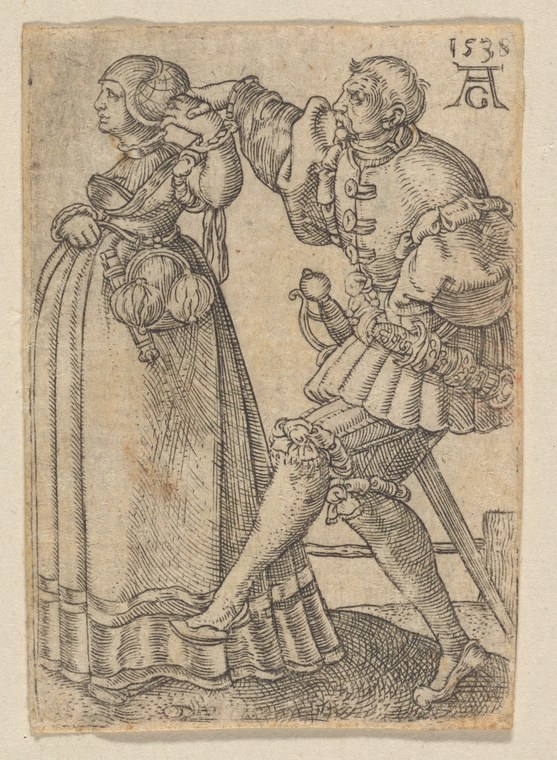
This engraving is one of the few visual records of how sixteenth-century social dance was actually performed—the positioning, the gesture, the use of space, the integration of dress into the movement. For historians and dancers seeking to reconstruct Renaissance practice, such images are invaluable evidence of the open frame, the emphasis on courtship display, and the integration of music and social hierarchy that defined the period.
What you are looking at
A woodcut or engraving from the sixteenth century shows a couple in the midst of a lively dance, positioned in profile against a plain background. The woman wears a long, full gown with a fitted bodice and a high collar typical of Northern Renaissance fashion; her hair is bound up and covered. The man wears a doublet with ornate fasteners down the front, hose, and a feathered hat, gesturing expressively with one arm raised. Between them stands a small child or dwarf figure, also dressed in period costume. The woman's body leans back slightly, her skirts swinging outward, while the man's posture is dynamic and forward-leaning, suggesting rapid movement. The engraving technique captures fine detail in the fabric textures and the intricate patterns of their clothing, and the date mark "1539" appears in the upper right corner, establishing this as a precise historical document of courtly dance practice.
The dancing
Two primary dancers are shown in an open or semi-open position—not in the closed partnered hold of later ballroom dance. The man's right arm is raised and extended, his body twisting dynamically; the woman's arms hang at her sides, her frame upright but her lower body swinging. The small figure between them appears to be a musician or attendant rather than a dancer. The woman's weight appears to shift into her left hip, creating the characteristic sway of Renaissance social dance, while the man's forward lean and arm gesture suggest a moment of courtship or flirtation.
The dance depicted
This depicts a Renaissance social dance, most likely a German or Low Countries coupling dance of the 1530s–1540s. The open positioning, the prominence of arm gesture, the woman's swinging skirts, and the man's theatrical pose are consistent with dances documented in sixteenth-century dance manuals such as those by Paulus Heufelder or Pierre Attaignant. The small figure between the dancers may represent a child joining the dance or a musician providing accompaniment. The image captures the social and flirtatious character of courtly recreation, where dance was an act of display and courtship.
How it was made
This is a woodcut or fine engraving on paper, executed with the precision typical of Northern European printmaking in the early sixteenth century. The medium allowed for wide circulation of the image—such prints were affordable, portable, and could be reproduced in quantity, making them vehicles for disseminating knowledge of fashionable dance styles across courts and merchant cities. The fine hatching and linear detail suggest engraving rather than woodcut, a technique that preserved subtle gradations and fine line work, allowing the artist to render the intricate folds and textures of the dancers' clothes with clarity.
About this work
This engraving documents a moment of Renaissance courtship and social pleasure: two elegantly dressed figures engaged in a lively dance, their bodies and clothing rendered with the precise detail characteristic of Northern European printmaking. The date 1539 anchors it as a historical record of how dance was performed and displayed in sixteenth-century court society. The image belongs in a gallery of dance not merely as a representation of movement, but as evidence of a specific cultural moment when dance was increasingly documented visually, and when the clothing, gesture, and staging of dance were matters of courtly refinement and artistic attention.
How to look at it
Attend to the moment the artist has chosen: the woman's body swinging outward, the man's raised arm and forward lean, the dynamic twist of his torso. This is not a static pose but a captured moment within a sequence of movement. Notice how the artist has rendered the couple not face-to-face but in profile, allowing both figures to be read clearly and showing off the profile of the woman's high headdress and the man's elaborate hat. The small figure between them breaks the bilateral symmetry and introduces a note of social reality—courtly dance was a public performance, often watched and often involving multiple participants or musicians. The precise rendering of fabric—the woman's voluminous skirt, the man's slashed sleeves, the intricate fastenings—tells us that in Renaissance courts, the clothing was as much a part of the dance as the movement itself.
The artist
The artist is not recorded. The style and date (1539) suggest a Northern European printmaker working in the tradition of fine engraving that flourished in the Low Countries and German-speaking lands in the early sixteenth century. The care taken with costume detail and the courtly subject matter suggest the work was created for a cultivated audience of merchants, nobility, or professionals interested in fashion and social manners.
The period
In the sixteenth century, the Renaissance had made dance a subject of intellectual interest and artistic representation. Dance manuals were being published and circulated; court dances were codified and taught. Simultaneously, print culture was enabling the dissemination of images of fashionable behavior to a widening audience. This engraving sits at the intersection of these developments: it records a moment of social dance while also serving as a model of courtly decorum and style for viewers across Europe. The prominence of gesture and the open positioning reflect the aesthetics of Renaissance dance as documented in surviving manuals, where arm movement, spatial dynamics, and the dialogue between partners were central to the form.
Where it lives
The work is held in the New York Public Library collection. It is a print from the sixteenth century, one of a genre of popular engravings that documented fashionable dress and social behavior for circulation among educated Europeans.
Dance in this work
Questions about this work
What is the date and where does 1539 come from?
The date 1539 appears marked in the upper right of the engraving. This establishes the work as a precise historical document of Renaissance practice, created during the reign of Henry VIII in England and the reigns of Francis I in France and Charles V in the Holy Roman Empire. Whether this date refers to the creation of the original design or the printing of this particular impression is not recorded.
Why are they not holding hands or in a closed position?
The open positioning shown here is typical of sixteenth-century social dances, which emphasized spatial dynamics, arm gesture, and display rather than sustained physical contact. Couples would move through patterns, sometimes approaching and separating, with the dance serving as a structured courtship display. This open frame allowed both dancers to be seen clearly and gave the man opportunity for expansive gesture.
Who is the small figure between them?
The small figure is most likely either a child participating in the dance (children of the nobility often danced with adults in courtly settings) or a musician providing the music. Without documentary evidence, the exact role cannot be determined, but the figure's presence underscores that Renaissance dance was a social event involving multiple participants.
What does the clothing tell us about this dance?
The elaborate dress—the woman's long gown with fitted bodice, high collar, and bound hair; the man's doublet with slashed sleeves and ornamental fastenings—indicates this is a courtly or noble dance, not a folk or popular one. The voluminous fabric of the woman's skirt would swing visibly as she moved, making the visual spectacle of the dance a key part of its appeal. Such precise rendering of fashion suggests the image itself was meant to disseminate knowledge of courtly style.
More dance artwork