49 works in this view — arrow keys or swipe to move between them.
Dance in Art · 2015
Dancing Couple
Unknown artist
- Medium:
- Source:
- New York Public Library
- Rights:
- Public domain — free to use, share and adapt.
- Recorded as:
- public_domain
For historians of Renaissance dance and fashion, this engraving is valuable as evidence of how court dances were visually represented and circulated in print culture. It documents the ceremonial and social dimensions of early modern courtship and dance, showing that the historical record of dance includes not only technical treatises but also prints aimed at a general audience. The work also demonstrates how engraving allowed the dissemination of idealized images of courtly behavior and fashion across Europe.
What you are looking at
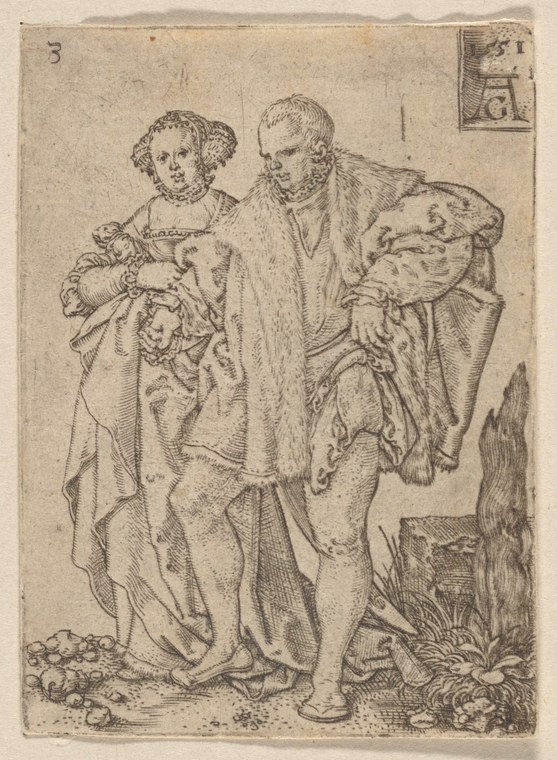
An engraved scene showing a man and woman in Renaissance dress engaged in a formal dance or courtship moment. The woman, positioned on the left, wears an elaborately patterned gown with puffy sleeves and a decorative headdress; her dress is richly ornamented with geometric and floral motifs. The man stands close beside her in a long robe or coat, his posture attentive and formal. Both figures occupy the foreground against a plain background with minimal setting details—a few rocks or landscape elements appear at the bottom right. The print is rendered in fine lines characteristic of engraving, with careful cross-hatching to suggest texture and volume in the fabrics. A small architectural or heraldic device appears in the upper right corner of the composition. The overall mood is one of measured, courtly interaction rather than vigorous movement.
The dancing
The two figures stand in close proximity without a visible ballroom hold. The woman's body faces slightly toward the viewer while the man leans inward, his head inclined toward hers in a gesture of attention or conversation. Neither figure is captured mid-step; both are relatively static, suggesting a moment of presentation or salutation rather than active locomotion. Their arms hang naturally or are positioned to display the richness of their sleeves. The formality and stiffness of their posture, combined with the absence of any suggestion of weight transfer or springing action, indicates this is not a depiction of vigorous partnered dancing but rather a formal court greeting or dance entrance.
The dance depicted
This appears to be a Renaissance or early modern courtship or dance-greeting scene rather than a depiction of ballroom dancing per se. The formal dress, the heraldic element, and the restrained postures suggest this may represent a dance of ceremony or courtship (possibly a galliard or pavane entrance) rather than a sustained partnered dance. The image captures the social and ritualistic dimension of Renaissance dance—the display of finery, the formal positioning, and the courtly decorum—more than it captures the technical content of the dance itself. Without a visible hold, footwork, or evidence of movement, the specific dance style cannot be securely identified, though the context points to Renaissance court dance.
How it was made
This is an engraving, executed in fine lines with careful cross-hatching to model form and suggest the texture of rich fabrics. The technique allows for precise delineation of ornament and pattern, and the print shows considerable skill in rendering the intricate surface detail of Renaissance costume—the geometric patterns, the puffed sleeves, the headdress. As an engraving, this work was reproducible and likely circulated in print collections or pattern books, reaching a broad audience interested in costume, courtly fashion, or social conduct. The presence of a number (3) in the upper left suggests this is part of a numbered series.
About this work
This is a Renaissance-era engraving depicting a formally dressed man and woman in a moment of courtly greeting or dance initiation. The work belongs to a tradition of prints documenting Renaissance court life, fashion, and the ritualized social dances that occupied courtly society. It is primarily a record of costume and decorum rather than a technical study of dancing—the artist's interest lies in depicting the richness of dress and the formality of courtly interaction. The image sits at the boundary between dance documentation and fashion or etiquette print, offering insight into how Renaissance dancing was understood as a social and sartorial practice, not merely a technical one.
How to look at it
Look closely at the costume details—the patterning, the construction of the sleeves, the headdress—as these are what the engraver has taken pains to render. Note the absence of any dynamic pose or suggestion of footwork; the artist has chosen a moment of stillness or formal greeting, not a moment of active movement. Observe how the print documents the social hierarchies and gender presentations of Renaissance courtly interaction: the woman's elaborate display of fabric and ornament, the man's formal attentiveness. This is a print that teaches decorum and fashion as much as it documents dance.
The period
This engraving dates to the Renaissance or early modern period, when woodcuts and engravings became a primary means of circulating images of courtly life, costume, and social conduct across Europe. The Renaissance saw a flourishing of dance treatises (such as those by Arbeau and Caroso) and an equal proliferation of visual prints documenting costume, etiquette, and courtly activities. Such prints served multiple purposes: they instructed viewers in proper decorum, displayed fashionable dress, and celebrated courtly culture. The fine detail and ornamental focus of this engraving align with the period's interest in the visual splendor of court life.
Where it lives
The work is held in the New York Public Library collection. It is catalogued as a print but without further attribution or dating. The presence of a number (3) suggests it belongs to a series, possibly a costume or dance instruction series, though the series title or publisher is not recorded.
Dance in this work
Questions about this work
Is this showing an actual dance step or move?
Not directly. The image captures a formal moment of greeting or presentation in a courtly setting, not a moment of active dancing. Both figures are relatively static, and there is no visible hold or footwork. The engraving documents the costume, decorum, and social ritual surrounding Renaissance dance more than the technique of dancing itself.
What does the costume tell us about when and where this was made?
The dress—the woman's puffed sleeves, geometric patterning, and headdress, and the man's long robe—all point to Renaissance Europe, likely the 16th century. The elaborate ornamentation reflects the period's investment in display as a form of courtly status and the importance of costume in Renaissance social life.
Why would a print of a couple standing still be included in dance history?
Because Renaissance dance was inseparable from fashion, courtship, and social ritual. Prints like this document how dancing was understood and performed in courtly society—not as isolated movement but as a total performance of identity, decorum, and status. They show us what dancing meant to the people who did it.
More dance artwork