49 works in this view — arrow keys or swipe to move between them.
Dance in Art · 2015
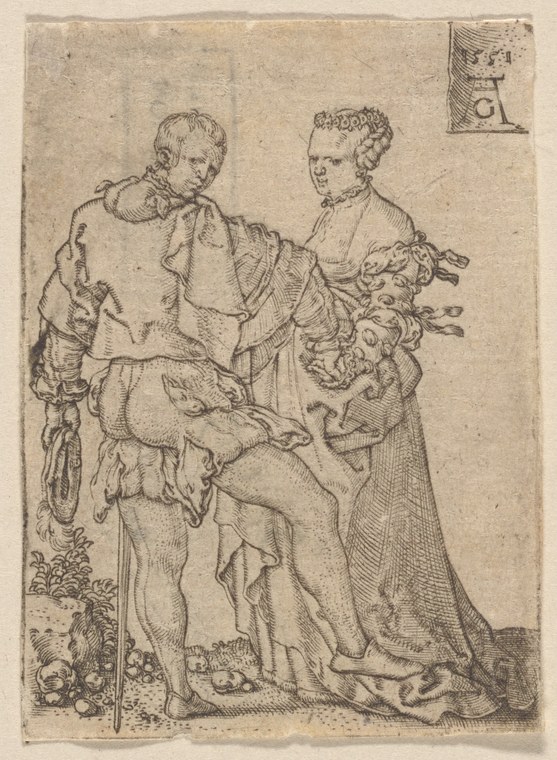
Dancing Couple
Unknown artist
- Medium:
- Source:
- New York Public Library
- Rights:
- Public domain — free to use, share and adapt.
- Recorded as:
- public_domain
For historians of Renaissance dance and courtship, this engraving documents the visual and allegorical language in which the period understood love and formal social encounter. It reveals that 'dance' in courtly contexts was often as much about symbolic meaning and social hierarchy as about bodily technique. The image offers a window into how prints circulated ideas about gender, love, and courtly behavior to a broad audience.
What you are looking at
An engraving depicting a young couple in an intimate dance or courtship moment, rendered in the Northern European Renaissance style. The man, positioned to the left, wears a short tunic or doublet and is shown in profile; the woman, to the right, wears a long flowing gown with full sleeves. Between them stands a cherub or putto, nude and winged, who appears to be orchestrating or blessing the encounter. The ground is scattered with flowers and fruits—grapes, strawberries, and other produce—suggesting abundance, fertility, and the garden setting of courtly love. The background is plain, throwing full attention onto the three figures. The line work is fine and controlled, characteristic of sixteenth-century printmaking from the Low Countries or German-speaking lands.
The dancing
The couple does not touch directly; instead, the winged figure between them mediates the space. The man leans slightly forward in a posture of approach or deference, his body angled toward the woman. The woman stands more upright, her gaze directed toward the man; her long skirts fall in vertical folds that suggest stillness rather than active movement. Their feet are planted, and there is no suggestion of footwork or traveling steps. The composition is formal and symmetrical, with the putto at the apex of a triangle formed by the three figures, emphasizing the allegorical rather than the kinetic nature of the scene.
The dance depicted
This is not a depiction of social dance in the modern sense, but rather a representation of courtly love ritual and the symbolic 'dance' of courtship conducted through gesture and proximity. The presence of the putto—Cupid or a similar figure—identifies this as an allegory of love rather than a documentation of actual dance practice. It may relate to the allegorical or court dances of the Renaissance, where the formal, slow movements of pavanes and other processional forms functioned as ritualized courtship. However, the static pose and the symbolic framing suggest this is more a meditation on the idea of courtly love than a guide to actual steps or technique.
How it was made
This is a copper engraving or possibly a finely executed woodcut, executed with precise linear hatching to create tone and volume. The delicate line work and the shallow depth of field are consistent with Northern European printmaking of the early sixteenth century, likely from the workshop tradition of Albrecht Dürer or a comparable printmaker. Engravings of this type circulated widely among the educated and merchant classes, making allegorical and moralizing imagery accessible beyond the court. The technique allowed for fine detail in the costume and the careful rendering of facial expression.
About this work
This engraving presents a Renaissance allegory of courtship, in which a young couple is united or blessed by a winged putto amid symbols of abundance and fertility. It belongs to a broad tradition of Northern European prints that represented courtly love not as physical movement but as a formal, ritualized exchange mediated by allegorical figures. The image offers insight into how Renaissance culture understood the 'dance' of courtship—as a symbolic, almost ceremonial act rather than a choreographed sequence of steps. It sits at the intersection of dance history, visual culture, and the social codes of the Renaissance court.
How to look at it
Attend to the role of the putto: he is not a bystander but the agent or arbiter of the encounter, suggesting that courtship in this worldview is orchestrated by forces beyond the couple's control. Notice the careful symmetry of the composition and the vertical emphasis created by the woman's long skirts and the formal alignment of the figures—these formal qualities suggest that the 'dance' depicted is one of ritual and rule rather than spontaneous movement. The scattered fruits and flowers are not merely decorative but carry symbolic weight, identifying this as an image of abundance and natural fertility sanctioned by divine love.
The period
This engraving dates stylistically to the early sixteenth century, a period of intense innovation in both printmaking and the formalization of court dances. The pavane, galliard, and other stately processional forms were becoming codified during this era, and they shared with this image a concern with formal, hierarchical movement and the symbolic meanings of approach and distance. Prints of allegorical scenes were a major vehicle for circulating courtly ideals and moral lessons; this work is one example of a vast output of similar engravings from German and Netherlandish workshops.
Where it lives
The work is held in the New York Public Library collection. It is catalogued as a print of unknown artist and date, though stylistic analysis suggests a Northern European origin in the early sixteenth century.
Dance in this work
Questions about this work
Is this actually a dance?
Not in the sense of choreographed steps, but yes in the sense that Renaissance court culture understood dance as a ritualized form of social engagement. The static pose and the presence of Cupid indicate this is an allegory of courtship as a 'dance' of approach, deference, and symbolic encounter. The image documents how the period visualized love and formal meeting as formal, rule-governed acts.
What do the fruits and flowers mean?
They are symbols of abundance, fertility, and the natural world brought into harmony by love. Grapes suggest wine and celebration; strawberries and other fruit suggest the Garden of Eden or a paradise restored. Together, they frame the couple's encounter as a moment of cosmic harmony and natural abundance.
Who is the winged figure?
The figure is most likely Cupid or a generic putto representing divine or supernatural love. In Renaissance allegorical imagery, such figures often mediate between mortals and the forces that govern their lives, blessing or orchestrating the encounters depicted.
More dance artwork