36 works in this view — arrow keys or swipe to move between them.
Dance in Art
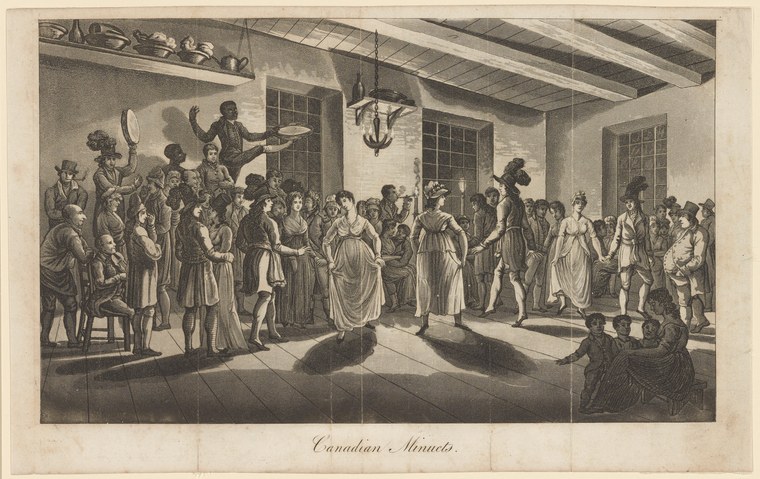
Canadian minuets
Unknown artist
- Medium:
- Engraving
- Dance:
- Minuet
- Era:
- 1700s (Enlightenment/Minuet Era)
- Source:
- New York Public Library
- Rights:
- Public domain — free to use, share and adapt.
- Recorded as:
- public_domain
This print offers rare documentation of how minuet-era dance was staged and recorded in the North American colonies or early North America. The title's specific claim about 'Canadian' minuets suggests either a regional variation or a civic celebration that adapted European court dance to local purposes—a valuable trace of how colonial and early national communities adopted and adapted European courtly practices.
What you are looking at
A formal indoor gathering in a grand hall with exposed beam ceiling, where dozens of figures in neoclassical dress participate in a stately dance. The composition is crowded and processional: figures in long white and pale-colored robes stand in loose groups across the floor, some with arms extended or gesturing, others watching from the sides. The lighting is naturalistic, casting shadows on the wooden floor. Two windows with panes pierce the back wall. A trident symbol hangs prominently above, and several figures occupy a raised area or dais to the left, suggesting this is a ceremonial or formal civic occasion rather than purely social dancing. The overall impression is of an orderly, ritualized gathering with strong emphasis on formation and decorum.
The dancing
The dancers stand predominantly upright, many with arms extended in open positions rather than closed holds. The closest figures wear long neoclassical gowns with high waistlines; some have arms raised to shoulder height or extended to the sides in broad, unhurried gestures. There is no visible evidence of turned-out positions, pointe, or the intricate footwork of theatrical dance. The grouping is loose and open, with multiple figures arranged in a kind of procession or queue rather than tight couple work. The overall carriage is formal and dignified, suggesting social dance of a ceremonial rather than recreational nature.
The dance depicted
The title identifies this as 'Canadian minuets,' a term that requires caution. The minuet was a court and ballroom dance widespread in Europe from the 17th through 18th centuries, characterized by a stately triple meter and formalized steps. The image shows the external markers of minuet-era dance—the costume, the formal indoor setting, the orderly grouping—but the loose, processional arrangement and open gesture do not clearly show the characteristic minuet frame or the precise small steps that defined the dance. This may be a civic or ceremonial adaptation of minuet form, or the artist may have chosen to show the dance in preparatory or formal-greeting poses rather than active stepping. The attribution to 'Canada' in the title is curious and requires explanation, as the minuet was a European courtly form.
How it was made
This is an engraving, a technique that uses fine lines cut into a metal plate (likely copper) to build tone and form. Engraving allowed for precise detail and fine gradations of light and dark through cross-hatching and line density, making it ideal for documentary or instructional prints. The clarity of the figures and the architectural detail suggest careful execution. Engravings of this type were commonly published as broadsheets or bound in instructional manuals and circulated among educated readers and dance practitioners, making this a form of print for circulation and instruction rather than a unique artwork.
About this work
This engraving documents a formal, ceremonial gathering centered on dance in a grand neoclassical interior. The scene is titled 'Canadian minuets' and shows the influence of 18th-century court dance in its dress, setting, and composition, though the specific choreography or regional variation is not clear from the image alone. The work sits at the intersection of dance instruction and civic ceremony, recording not a moment of pure recreational dance but a formal, ritualized event in which minuet-style movement played a part. As an engraving held in the New York Public Library collection, it is a printed document of unknown artist and date, likely originating in the 18th century and intended for a broad educated audience interested in dance, ceremony, and social conduct.
How to look at it
Attend first to the overall composition: this is not a close dance portrait but a wide gathering shot, emphasizing ceremony and order over the detail of footwork or individual technique. Notice the absence of the closed frame and precise partner contact that would characterize actual minuet dancing—instead, figures stand open and formal, many with arms extended in greeting or salute rather than in dance hold. The trident symbol above suggests a civic or naval context. The print uses line weight and hatching to create depth and hierarchy, drawing the eye first to the central raised figures, then to the crowd. This is a documentary print showing the *occasion* of formal dance rather than the *technique* of dance.
The period
The minuet dominated formal dance in Europe and courtly circles throughout the 18th century and remained present in ballroom practice well into the 19th. This print was created during or after the height of minuet culture. The neoclassical dress visible in the figures—high waistlines, simple silhouettes, classical drapery—points to the later 18th century, when both dance aesthetics and fashion were turning toward simplified, antique-inspired forms. The formal indoor setting and civic framing suggest this documents either a public ceremony, a civic ball, or an instructional demonstration of courtly dance adapted for a North American audience.
Where it lives
The work is held in the New York Public Library collection and is catalogued as an engraving of unknown date and artist. It is a printed work, likely an 18th-century broadsheet or page from a bound instructional or commemorative volume.
Dance in this work
Questions about this work
What is a minuet?
A minuet is a stately, measured dance in triple meter (three beats) that originated in France and became the dominant formal dance of European court and ballroom society from the 17th through 19th centuries. It is characterized by small, precise steps, a formalized frame between partners, and strict etiquette governing participation and dress. The dance was not only a social practice but also a marker of refinement and courtly status.
Why does this print say 'Canadian minuets'?
The title suggests either a regional variant of minuet dancing practiced in Canada during the colonial or early national period, or a civic ceremony in which minuet-style formal dance played a role. The specific reason for the 'Canadian' designation is not documented in the catalogue record and would require additional research into the print's provenance and original publication context.
How do we know this is an engraving?
The catalogue record identifies the medium as engraving. The image shows the characteristic fine lines, hatching, and precise detail consistent with the engraving technique, in which lines are cut into a metal plate and filled with ink to create a printed image. This technique allowed for both high detail and broad circulation.
Are these people actually dancing?
The print shows a formal gathering centered on dance, but the loose grouping and open gestures suggest this documents a ceremonial or social event in which dancing took place, rather than freezing a moment of active stepping. The figures appear to be in formal poses or preparatory stances rather than mid-movement.
More Minuet artwork