49 works in this view — arrow keys or swipe to move between them.
Dance in Art · 2019
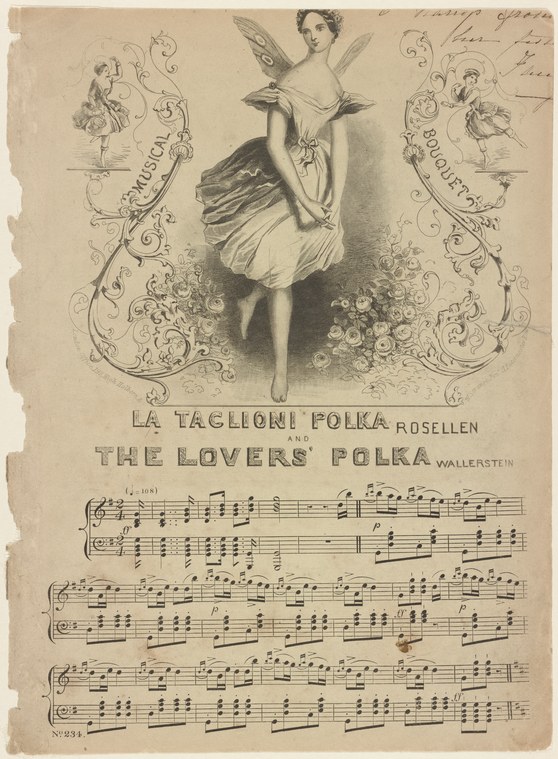
Musical bouquet. La Taglioni polka... The lovers' polka
Unknown artist
- Medium:
- Lithograph
- Dance:
- Polka
- Era:
- Late 1800s (Victorian Ballroom)
- Source:
- New York Public Library
- Rights:
- Public domain — free to use, share and adapt.
- Recorded as:
- public_domain
This lithograph is a primary document of how 19th-century dance was commodified and circulated to a mass market. It shows that even a simple social dance could be packaged with theatrical imagery and celebrity association to drive sales, revealing the economic relationship between the professional stage and amateur ballroom culture. For historians of dance, it demonstrates how the polka was perceived—as an uplifting, lightness-seeking form that borrowed the aesthetics of Romantic ballet—and how dance was taught and learned through visual representation rather than direct instruction.
What you are looking at
A lithographed title page for sheet music presents a romantic scene centered on a female dancer posed in a graceful, elevated position mid-movement. She wears a light, diaphanous dress with a draped shawl or scarf that floats behind her, and her posture suggests a moment of suspension or a turn. Her upper body is inclined slightly forward, arms positioned in a flowing manner. The composition is framed by ornamental flourishes typical of 19th-century commercial music printing: elaborate scrollwork, floral garlands with roses and other blooms, and cherub or putti figures in the upper corners. The title text appears at bottom in decorative lettering: "LA TAGLIONI POLKA — ROSELLEN" and "THE LOVERS' POLKA — WALLERSTEIN". The entire design suggests both theatrical refinement and the commercial reach of popular music—this was sheet music meant for amateur musicians and dancers in middle-class homes.
The dancing
A single female figure dominates the composition, captured mid-movement in what appears to be an elevated or turning position. Her posture shows the upright carriage and elongated line characteristic of Romantic-era theatrical training: the body lifted through the torso, one leg implied in extension or beating beneath the skirt, the arms soft and rounded in an informal pose that suggests motion rather than a held position. The dress fabric, voluminous and weightless in the rendering, emphasizes the suggestion of rapid movement or flight. No male partner is visible, though the reference to "Lovers' Polka" suggests the dance was social and paired in actual performance.
The dance depicted
This is a polka, as stated explicitly in both titles. The polka emerged in the 1830s as a lively, sprightly couple's dance in 2/4 time, sweeping European ballrooms and becoming emblematic of Romantic-era popular dance. The attribution to "La Taglioni"—likely a reference to or capitalization of the fame of the celebrated ballet dancer Marie Taglioni—suggests this was a professional or semi-professional composition marketed to capitalize on theatrical celebrity. The figure's pose, while idealized rather than anatomically specific about polka technique, emphasizes the uplifted, energetic quality the dance demanded. The inclusion of both a formal title ("La Taglioni Polka") and a generic one ("The Lovers' Polka") indicates this sheet music was issued for dual markets: fans of the celebrity and general ballroom dancers.
How it was made
This is a lithograph, a planographic printing technique that became the dominant method for illustrated commercial music publication in the 19th century. Lithography allowed artists to draw directly onto stone with a greasy crayon, creating prints that could reproduce fine detail, soft shading, and elaborate decorative work at relatively low cost. The technique enabled mass production of affordable sheet music with integrated illustration—a single stone could print hundreds or thousands of copies. The quality of the rendering here (particularly the subtle modeling of the figure and the delicate handling of drapery) demonstrates that this was a professionally executed commercial product, likely from a major music publisher. The process favored gentle gradations and ornamental flourish over sharp lines, which suits the romantic, ethereal treatment of the subject.
About this work
This is a lithographed cover for a published polka, one of thousands of such prints produced in the mid-to-late 19th century to market ballroom and parlor music to middle-class consumers. The polka was the defining social dance of its era—fast, egalitarian, and endlessly reproducible through print. The image conflates two markets: the theatrical (Marie Taglioni's fame and the Romantic ballet aesthetic) and the domestic (amateur dancers learning from published music). The visual language—the weightless, uplifted figure, the soft drapery, the ornamental frame—draws directly from Romantic ballet iconography, even though the polka was fundamentally a ballroom form. This overlap is precisely what made the polka commercially successful: it offered the aspiration of theatrical grace to ordinary dancers in ordinary rooms. The work sits at the intersection of theatrical culture, commercial printing, and the democratization of dance through the music-publishing industry.
How to look at it
The viewer should notice the moment captured: not a static pose but a suspended instant of motion, with the trailing drapery and lifted carriage suggesting that the figure has just propelled herself upward or is caught mid-turn. This is a Romantic-era visual convention—the idea that the most beautiful moment is one of weightlessness and transition. Look also at the decorative frame, which is not merely ornamental but symbolic: the flowers, cherubs, and scrollwork construct a world of idealized beauty around the figure, a frame that says this is art, aspiration, and commerce all at once. The contrast between the soft, dreamlike rendering of the figure and the precise, mechanical lettering of the titles below points to the dual nature of the object: it is simultaneously a work of visual art and a commercial product.
The artist
The artist is not recorded. The lithograph bears the mark "No.594," indicating it was part of a series produced by a commercial publisher, likely a major firm such as Jullien, Chappell, or Schott. The level of finish and the confident handling of the medium suggest a professional illustrator trained in commercial chromolithography, but such artists were often uncredited in this period. The work represents the anonymous labor that built the 19th-century music-publishing industry.
The period
The polka emerged in Prague in the 1830s and became the defining dance craze of the 1840s–1870s, spreading rapidly across Europe and North America. It was celebrated as modern, energetic, and demotic—danced by all classes and genders in the same basic form. The 1860s–1880s, when this sheet music was likely published, were the polka's mature commercial phase: thousands of polka compositions flooded the market, often given fanciful or celebrity-tied titles to boost sales. Simultaneously, Romantic ballet (exemplified by Marie Taglioni's fame and Marie Taglioni's La Sylphide of 1832) was establishing an aesthetic of weightlessness, ethereality, and feminine grace that increasingly influenced how all theatrical dance was visualized and imagined. This lithograph sits at the intersection: it uses Romantic ballet's visual language to sell a ballroom dance form, suggesting that by mid-century, the boundary between theatrical aspiration and popular practice had become fluid.
Where it lives
The lithograph is held in the New York Public Library collection. It is catalogued as a piece of printed sheet music cover art, part of the vast corpus of illustrated music publishing that accumulated in American libraries from the mid-19th century onward. The source attribution "nypl" indicates it entered the library through acquisition of music collections or general art prints. The catalog number "No.594" is a publisher's mark, not an NYPL accession number.
Dance in this work
Questions about this work
What is a polka and who danced it?
The polka is a lively couples' dance in 2/4 time that emerged in Bohemia in the 1830s and became wildly popular across Europe and America by the 1840s–1880s. It was distinctive because all classes and genders danced the same form—unlike earlier formal dances that varied by social rank—making it modern and egalitarian. The basic movement is a quick-quick-slow hop and step, often described as a "hop polka." Anyone who could buy sheet music could learn it from instructional publications.
Who was Marie Taglioni and why is this polka named after her?
Marie Taglioni (1804–1884) was the most celebrated ballet dancer of the Romantic era, famous for her role in La Sylphide (1832) and for pioneering pointe-work technique. By the mid-19th century, her name was synonymous with grace, weightlessness, and theatrical dance. Publishers capitalized on her fame by naming popular dances, pieces of sheet music, and even fashions after her, even if she had no direct connection to them. This was early celebrity marketing.
What does the lithograph tell us about how dance was taught in the 19th century?
Sheet music with illustrated covers was a primary medium for learning social dances. The image on the cover conveyed the style and aesthetic of the dance—its mood, its posture, its aspirations—while the music itself provided the rhythm and structure. There were no videos or detailed written instructions; a dancer learned by observing illustrations like this one and by dancing with experienced partners. The cover art made the learning process aspirational: you bought this music not just to have the tune but to imagine yourself as graceful and romantic as the figure depicted.
Is this a ballet or a ballroom dance?
It is a ballroom dance, but one that borrowed heavily from ballet aesthetics. The polka itself was always a social, partner dance, not a theatrical form. However, by the Romantic era, ballet's visual language—the lifted posture, the lightness, the ethereal drapery—had become the aspirational standard for how all dance, including ballroom, was imagined and represented. This lithograph uses ballet imagery to make a social dance seem elevated and theatrical, collapsing the boundary between stage and ballroom.
More Polka artwork