25 works in this view — arrow keys or swipe to move between them.
Dance in Art · 1914
The tango and other up-to-date dances; a practical guide to all the latest dances, tango, one step,
Unknown artist
- Dance:
- Tango
- Era:
- 1900-1920 (Ragtime/Early Jazz)
- Source:
- Library of Congress
- Rights:
- Public domain — free to use, share and adapt.
- Recorded as:
- public_domain
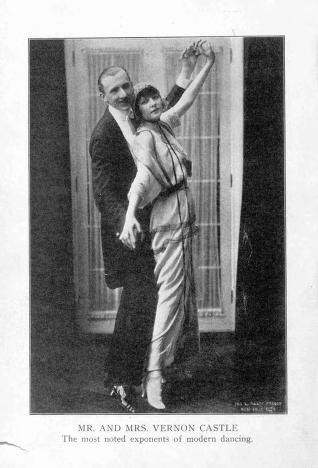
This image is essential evidence for understanding how ballroom dance technique was standardized, taught, and disseminated to the public in the early 20th century. It shows the exact moment when tango and related dances were being transformed from scandalous novelties into respectable, systematized social practices—and how photography became the medium through which that transformation was made visible and reproducible. For dancers and historians, it captures the birth of modern ballroom as a discipline with codified partnering roles and technical ideals.
What you are looking at
A man in formal evening dress—dark tailcoat, white shirt—holds a woman in a lifted position, her body arched and extended upward with one arm raised. She wears a light-colored (white or cream) dance dress with short sleeves, and her posture suggests both strength and grace in the lift. The photograph is taken indoors against a plain backdrop with vertical architectural details (columns or wall panels) visible behind them. The lighting is even and frontal, typical of studio photography. The moment is one of dynamic suspension: the woman is fully supported by her partner and appears weightless, her body forming a long diagonal line from his supporting arm to her extended fingertips.
The dancing
The man stands with his weight grounded, his posture controlled and upright, one arm supporting the woman's body at waist or hip level while his other arm extends. The woman is lifted clear of the floor, her back arched, her raised arm reaching upward and outward in an extended line. Her legs are not visible in the frame, but her torso and the lift itself speak to ballroom partnering technique: the man is demonstrating secure control and the woman's trust and flexibility. This is a partnership of clear hierarchies—he is the base, she is the lifted figure—yet both bodies are working.
The dance depicted
This is a posed demonstration of modern ballroom dance technique, most likely tango or a closely related American smooth or standard ballroom style, given the formal dress and the dramatic lifted position. The catalogue identifies this as illustration from *The Tango and Other Up-to-Date Dances: A Practical Guide* (1914), and the image functions as instructional material showing correct partnering form. The lift—a signature move in competitive and social ballroom dancing of this era—demonstrates the man's role as leader and the woman's as follower, a fundamental principle of the dance that was being codified and taught systematically in the early 20th century. The photograph's studio setting and clear technical demonstration suggest this was created to educate dancers and the curious public about the proper execution of modern dance.
How it was made
This is a black-and-white photograph, likely gelatin silver print or similar photographic process standard to 1914. The even lighting and neutral background indicate a professional studio setup. Photographs were a powerful medium for dance instruction at this period, more accessible and repeatable than live demonstration, and this image was reproduced as a halftone for inclusion in a printed instructional guide—a format that made ballroom technique visible and teachable to a mass audience. The technical clarity of the photograph allows viewers to study body position and weight distribution in ways that written description alone could not convey.
About this work
This is a studio photograph from an instructional manual on modern ballroom dance, showing a man and woman in formal evening dress performing a lifted position characteristic of tango and early 20th-century American smooth style. The image is both a portrait of two dancers and a technical diagram, demonstrating the partnering principles and physical vocabulary that were being standardized and taught to a rapidly expanding ballroom dancing public. It belongs in a gallery of dance in art because it captures a precise historical moment: the professionalization and democratization of ballroom dance, the codification of partnering technique, and the use of photography as a tool for dance pedagogy.
The photograph also documents gender and power in dance—the formal roles of lead and follow that structure ballroom partnership. The woman's lifted, arched body and the man's grounded, controlling position encode a social choreography as much as a physical one. For 1914, this image was avant-garde in its elevation of ballroom dancing from social amusement to a serious, teachable discipline with proper technique and professional standards.
How to look at it
Look first at the bodies: the woman's arched spine and extended arm, the man's grounded stance and controlled lift. This freeze-frame captures the instant of suspension, the moment of maximum extension—the photographer chose the peak of the movement, not its approach or recovery. The formal evening dress normalizes what had recently been shocking; the studio backdrop erases context and makes the bodies themselves the sole subject. Notice how the photograph's clarity and frontality make the lift readable as a technical feat: you can assess the man's control, the woman's flexibility, the alignment of their bodies. The image functions as both art and instruction manual, which was its purpose.
The artist
The photograph is credited in the catalogue record only to the publication *The Tango and Other Up-to-Date Dances: A Practical Guide* (1914), and the individual photographer is not recorded. The two figures are identified in the caption as Mr. and Mrs. Vernon Castle, who were among the most prominent and influential ballroom dancers of the early 20th century. The Castles (Irene and Vernon) were professional performers and teachers who brought ballroom dance to mainstream American audiences through theatrical performances, social teaching, and instructional materials like this one. Vernon Castle died in 1918 during World War I, but during his lifetime he and Irene were celebrities whose dance style was widely imitated and whose instructional publications shaped how millions of Americans learned to dance.
The period
In 1914, ballroom dance was undergoing rapid transformation. Tango, imported from Argentina in the early 1910s, had ignited public passion and moral panic in equal measure. Dancing schools proliferated, and professional dancers like the Castles built careers not only performing but teaching and publishing—creating a market for instructional materials. Simultaneously, photography had become the preferred medium for capturing and disseminating dance technique, superior to text or still drawing. The image sits at the intersection of several cultural forces: the Jazz Age's embrace of modern social dance, the Edwardian and Progressive era's faith in systematic instruction and technical mastery, the rise of photographic media, and the professionalization of dance as a teachable discipline with proper form. This was the moment when ballroom dancing stopped being folk practice or scandalous novelty and became respectable, middle-class recreation—formalized, standardized, and teachable.
Where it lives
This photograph comes from the Library of Congress collections and was reproduced as a halftone illustration in the instructional publication *The Tango and Other Up-to-Date Dances: A Practical Guide to All the Latest Dances* (1914). The source record identifies it as an artwork of the Ragtime/Early Jazz period (1900–1920), though it is more precisely a document of early ballroom dance pedagogy and the rise of the Castles as dance educators.
Dance in this work
Questions about this work
Who are the dancers in this photograph?
The caption identifies them as Mr. and Mrs. Vernon Castle—Vernon Castle and his wife Irene. The Castles were among the most famous ballroom dancers of the 1910s, known for bringing tango and other modern dances to mainstream American audiences. They were professional performers, teachers, and authors of instructional materials. Vernon Castle was killed in World War I in 1918, but during his lifetime the Castles shaped how millions of Americans learned to dance.
Why is the woman lifted?
The lift is a signature move in ballroom dance partnering, particularly in tango and American smooth styles. It demonstrates the man's strength and control and the woman's trust and flexibility. Lifts were (and are) part of the physical vocabulary of ballroom dance, and showing proper technique was central to instructional materials of this era. The lift also makes for a visually dramatic image that catches the eye and conveys mastery.
What is this image from?
This photograph was reproduced as an illustration in *The Tango and Other Up-to-Date Dances: A Practical Guide to All the Latest Dances* (1914), an instructional manual published during the height of the tango craze in America. The manual taught readers the proper steps, partnering technique, and style of modern ballroom dances through text, diagrams, and photographs like this one.
Why was ballroom dance instruction so popular in 1914?
Tango and other modern ballroom dances had arrived from Europe and Latin America in the early 1910s and created huge public demand. Many people wanted to learn to dance socially, and dancing schools proliferated. Instructional materials—books, photographs, and later films—helped spread technique beyond those who could afford private lessons. For the middle classes, learning to dance "properly" was a mark of respectability and modernity.
More Tango artwork
![[Les noces de trottoir, par les compagnies Tango Sumo et Vendaval. Chalon dans la rue. 2007 / photographies de Joël Verhoustraeten] by Verhoustraeten, Joël (1954-2019). Photographe](https://gallica.bnf.fr/iiif/ark:/12148/bc6p058zgkc/f1/full/800,/0/native.jpg)