49 works in this view — arrow keys or swipe to move between them.
Dance in Art
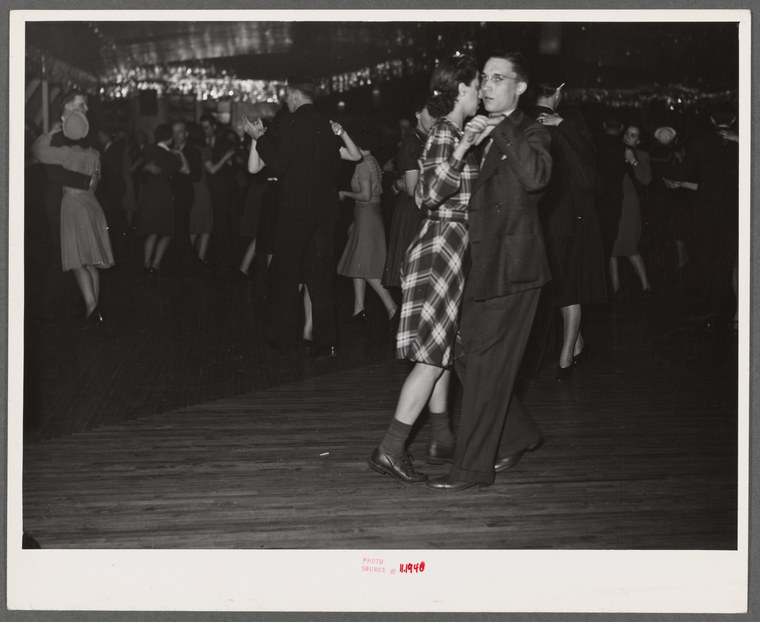
Dance hall, Saturday night. Marshalltown, Iowa
Unknown artist
- Medium:
- Source:
- New York Public Library
- Rights:
- Public domain — free to use, share and adapt.
- Recorded as:
- public_domain
This photograph documents American social dance at the grassroots level during a period when ballroom dancing was a primary form of community entertainment and courtship ritual. It provides visual evidence of the posture, frame, and social conventions of partner dancing in a specific time and place—information that historians and dancers use to reconstruct how this era actually danced. The image also testifies to the architecture of social life: the role of public dance halls in small towns, the mixing of genders and ages, the relationship between music venues and community identity.
What you are looking at
A crowded dance hall in full swing, captured in black and white with the photographer positioned at floor level among the dancers. The space is packed with couples and groups moving across what appears to be a wooden dance floor, with spectators visible standing in the background against the far wall, suggesting a venue designed for social dancing. The lighting is low and ambient, typical of period dance halls, creating pools of visibility around the dancers nearest the camera. The composition emphasizes the democratic bustle of community dance—no single couple dominates; instead, the eye moves across multiple simultaneous moments of movement and interaction. The photograph captures the informal energy of a Saturday night gathering, with dancers at various stages of their movements and social interactions, some couples locked in close embrace, others moving more freely through the space.
The dancing
The nearest couple to the camera shows a man and woman in a closed social dance position, the woman wearing a checked or plaid dress with her body angled into the frame. Several other couples are visible at middle distance, most in closed or semi-closed holds characteristic of ballroom-style social dancing of the period. The dancers' posture and frame suggest a relaxed, social version of dance rather than formal theatrical performance—bodies are upright but not rigidly controlled, and the holds appear comfortable rather than precision-based. Weight appears to be distributed naturally through the body rather than held forward on the balls of the feet as in theatrical forms. The variety of relative positioning among couples suggests this is improvised social dancing rather than choreographed group movement.
The dance depicted
This is social ballroom dancing, most likely the Foxtrot, Waltz, or general American smooth style dancing that dominated American dance halls in the 1930s–1940s era. The closed position, the relaxed upright frame, and the informal setting all point to the vernacular American ballroom social dance of this period—not competition dancing but the everyday partner dancing that took place in public halls across small-town America. Marshalltown is a small Iowa city, and this photograph documents how ordinary people danced together in their community spaces. The multiple couples dancing simultaneously and the casual mixing of the crowd suggest this is not a formal event but a regular Saturday night social gathering where dancing was the primary purpose of the venue.
How it was made
This is a black-and-white photograph, almost certainly a documentary or press photograph given its candid framing and its presence in the New York Public Library collection. The low-angle perspective and the photographer's position within the crowd suggest a hand-held camera rather than a formal studio setup. The print quality and the visible grain suggest this may be a newspaper photograph or archival print from the mid-twentieth century. Documentary photography of this kind was a staple of American journalism and archival practice, used to capture vernacular life and community culture. The technique allowed photographers to document social life as it happened rather than as arranged for the camera, giving this image historical weight as evidence of how Americans actually danced in their own spaces.
About this work
This is a documentary photograph of a Saturday night dance at a public dance hall in Marshalltown, Iowa—a record of American social dancing in an era when such venues were central to community life and leisure. The photograph captures the democratic, informal character of ballroom dancing as a social practice rather than a performance art: couples of varying skill moving through a crowded space, some attentive to their partners, others absorbed in the music and the moment. The image belongs in a gallery about dance not because it depicts virtuosity or theatrical technique, but because it documents how ordinary people danced together, how they held each other, how they shared space and music in a small American town. It is evidence of a dance culture that existed outside concert halls and competition stages—the vernacular social dancing that shaped how most Americans experienced dance.
How to look at it
Look first at the nearest couple and the angle of their bodies—the woman's plaid dress and the man's formal attire establish the social conventions of the time. Then trace the multiple couples visible at different depths in the frame, observing how they adapt their positions to the crowded space and how their movements differ from theatrical ballroom dancing. Notice the relaxed posture of the spectators in the background and the way the photographer has captured a moment of social momentum rather than a posed arrangement. The low angle and crowded composition force the viewer to experience the dance hall as the dancers themselves did—immersed in the crowd, moving with others, surrounded by social activity.
The period
American social dancing in the 1930s and 1940s was dominated by ballroom styles imported from Europe and adapted to American popular music and social custom. The Foxtrot, Waltz, and variations on Latin styles were the standard vocabulary of partner dancing, taught in studios and danced socially in halls and nightclubs across the country. The American smooth style developed as a looser, more relaxed version of its European precedents—suited to popular swing and jazz music and to the democratic mixing of social classes that characterized American dance halls. This same era saw the rise of dance halls as commercial venues in small towns, making social dancing accessible to working-class Americans in ways that had not been possible before. The photograph captures this moment when social dancing was a mass practice rather than a preserve of the wealthy or trained.
Where it lives
This photograph is held by the New York Public Library, where it is catalogued as a print documenting vernacular American social life. Its presence in a major institutional collection indicates it was either acquired as documentary evidence or preserved as part of a press photography archive.
Dance in this work
Questions about this work
What dance style is being performed?
The dancers appear to be performing American smooth ballroom styles, most likely the Foxtrot or Waltz, which were standard partner dances in American dance halls of this era. The relaxed frame, closed position, and informal setting distinguish this from formal competition ballroom dancing—it is social dancing for pleasure and courtship rather than exhibition.
When was this photograph taken?
The catalogue record does not provide a specific date, but the clothing styles, the dance hall setting, and the print quality suggest this is from the 1930s or 1940s. Marshalltown, Iowa was documented by photographers interested in American vernacular life during this period.
Why is this dance hall important?
Dance halls were central social institutions in small American towns, providing spaces where working-class people could gather, dance, meet potential partners, and participate in contemporary popular culture. This photograph documents that social infrastructure and its role in community life.
How do these dancers compare to ballroom dancers today?
These social dancers are less formally trained and less precise than contemporary competitive ballroom dancers. Their frame is more relaxed, their hold less rigid, and their movement more responsive to the social context. They represent vernacular social dancing rather than the standardized technique that ballroom competition eventually developed.
More dance artwork