49 works in this view — arrow keys or swipe to move between them.
Dance in Art · 2019
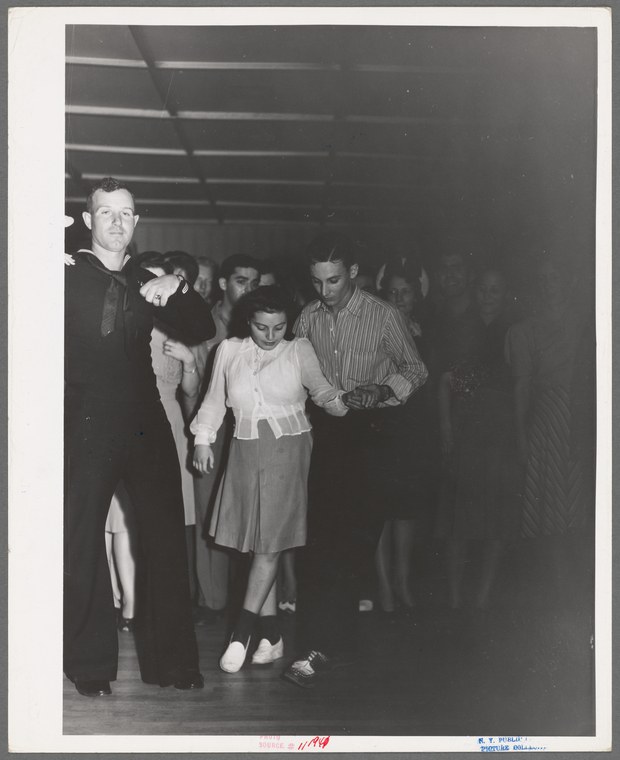
Couple at Sherman's dance hall (newlyweds). San Diego, California
Unknown artist
- Source:
- New York Public Library
- Rights:
- Public domain — free to use, share and adapt.
- Recorded as:
- public_domain
This is direct visual evidence of how Americans danced socially at a specific venue in a specific era. It shows the body mechanics, the physical intimacy, the dress, and the social context of swing-era ballroom dancing—information that cannot be reliably reconstructed from dance instruction manuals or performance films. For historians of American social dance and gender relations, it is documentary proof of how couples actually held each other and moved together in public.
What you are looking at
A black and white photograph captures an informal moment in an indoor dance hall: a young couple in the foreground, the woman in a light-colored blouse and dark skirt with white shoes, the man beside her in a dark suit jacket and striped shirt, both moving together through a crowded floor. The woman's posture is slightly forward, her gaze down; the man looks away. Behind them, other dancers and patrons fill the hall in soft focus—some standing, some moving—creating a sense of active social dancing. The ceiling shows distinctive parallel beams or panels, and the lighting is flat and documentary, suggesting this was shot with available indoor light. The scene reads as a moment of social dancing capture rather than posed performance.
The dancing
The central couple stands in close proximity but not in a formal closed ballroom hold. The man's arm is positioned at or near the woman's back or shoulder; her arm position is unclear, suggesting an informal, improvised embrace. Both figures show a forward-hinged posture, weight shifting slightly forward through the hips. The woman's white shoes are visible and appear to be ordinary street shoes rather than dance shoes. The gesture is intimate but tentative—neither stiff nor fully committed to a classical ballroom frame. The crowd around them suggests this is social dancing, not rehearsed choreography.
The dance depicted
The image documents social ballroom or swing-era social dancing, likely from the 1940s based on the dress and setting. The catalogue identifies this as a 'newlyweds' moment at Sherman's dance hall in San Diego, suggesting this was a public social venue where couples came to dance informally. The hold and posture suggest a slow foxtrot, waltz, or similar American smooth style danced in social settings of the period—relaxed, close, and improvisational rather than competitive. The presence of other couples dancing simultaneously confirms this was public social dancing, not theatrical performance. The exact style cannot be pinned down from posture alone, but the era and venue strongly suggest American smooth social dancing.
How it was made
This is a black and white photograph, likely documentary in intent—possibly commissioned journalism or archival record-keeping. The film stock, exposure, and flat indoor lighting suggest mid-twentieth-century news or WPA-style photography. The focus is sharp on the foreground couple and slightly soft on the background, achieved through depth of field control. The technique allows candid capture of actual social behavior, freezing a moment the photographer considered worth recording. The print quality and composition suggest professional photography, not amateur snapshot work.
About this work
This photograph documents social ballroom dancing at Sherman's dance hall in San Diego, capturing an intimate moment between a couple identified as newlyweds among a crowd of other dancers. It is a rare visual record of how American couples actually danced in public social venues during the swing era—informal, close, and improvisational rather than formally trained. The image sits at the intersection of social history and dance documentation, showing the venue, the dress, the posture, and the public nature of ballroom dancing as a participatory social activity, not just as a performance art or competitive sport. The photograph is valuable precisely because it treats social dancing as worthy of documentary attention, capturing the texture of everyday dance culture rather than staged performance.
How to look at it
Notice the informality of the hold: this is not the upright, frame-conscious posture of a competition foxtrot or waltz, but a more relaxed, body-close embrace common in social dancing of the era. The woman's forward posture and the couple's obvious comfort with proximity suggest this was a learned social convention of the time. The crowd in the background matters too—ballroom dancing was not an intimate private act but a semi-public performance watched by other dancers, a key part of dance-hall culture. The photographer has chosen to freeze a quiet moment rather than a dramatic turn or dip, suggesting an interest in documentation rather than drama.
The period
The 1940s were a peak era for public ballroom dancing in the United States, particularly in the West. Dance halls like Sherman's were commercial social venues where working-class and middle-class couples came to dance, often on weekends. The war years and immediate postwar period saw a surge in social dancing as a form of recreation and courtship. This photograph likely dates from the 1940s or early 1950s, when such venues were thriving before the rise of rock and roll and club culture reshaped American social dancing. The formal ballroom styles taught in dance studios coexisted with the looser, more intimate versions danced socially—this image captures the latter.
Where it lives
The photograph is held in the New York Public Library collection. The caption identifies it as documenting Sherman's dance hall in San Diego, California. The image appears to be part of a documentary or archival project, though the specific source collection and photographer attribution are not recorded in the current catalogue.
Dance in this work
Questions about this work
What dance style is this couple doing?
Based on the posture, the era, and the setting, this appears to be a social foxtrot, waltz, or similar American smooth style as danced in ballrooms of the 1940s. Social dancing of this kind was looser and more intimate than the competition styles, and the couple's informal hold and forward-hinged posture are consistent with social ballroom dancing of the period. Without clearer view of footwork, exact style cannot be certain.
What is Sherman's dance hall?
Sherman's was a public ballroom in San Diego, California, where working-class and middle-class couples came to dance socially. Dance halls of this type were common in American cities during the swing era and postwar period. They were commercial venues that generated income through admission and beverage sales, making social dancing economically important to the communities that danced there.
When was this photograph taken?
The catalogue record does not provide a specific date, but the dress, the photograph stock and technique, and the social context (ballroom dancing in a commercial hall) all point to the 1940s or early 1950s. This was the height of the swing era and the public ballroom dance hall period in the United States.
Why is a newlywed couple the subject?
Dance halls were important venues for courtship and early married life in this era. The identification of this couple as newlyweds suggests the photographer was interested in capturing a ceremonial or marked moment—their first public dance as married partners. This also reflects the photographer's documentarian intent: capturing social life and significant moments, not just formal dance performance.
More dance artwork