49 works in this view — arrow keys or swipe to move between them.
Dance in Art
Waltzing
Unknown artist
- Medium:
- Lithograph
- Dance:
- Waltz
- Era:
- Early 1800s (Waltz Revolution)
- Source:
- New York Public Library
- Rights:
- Public domain — free to use, share and adapt.
- Recorded as:
- public_domain
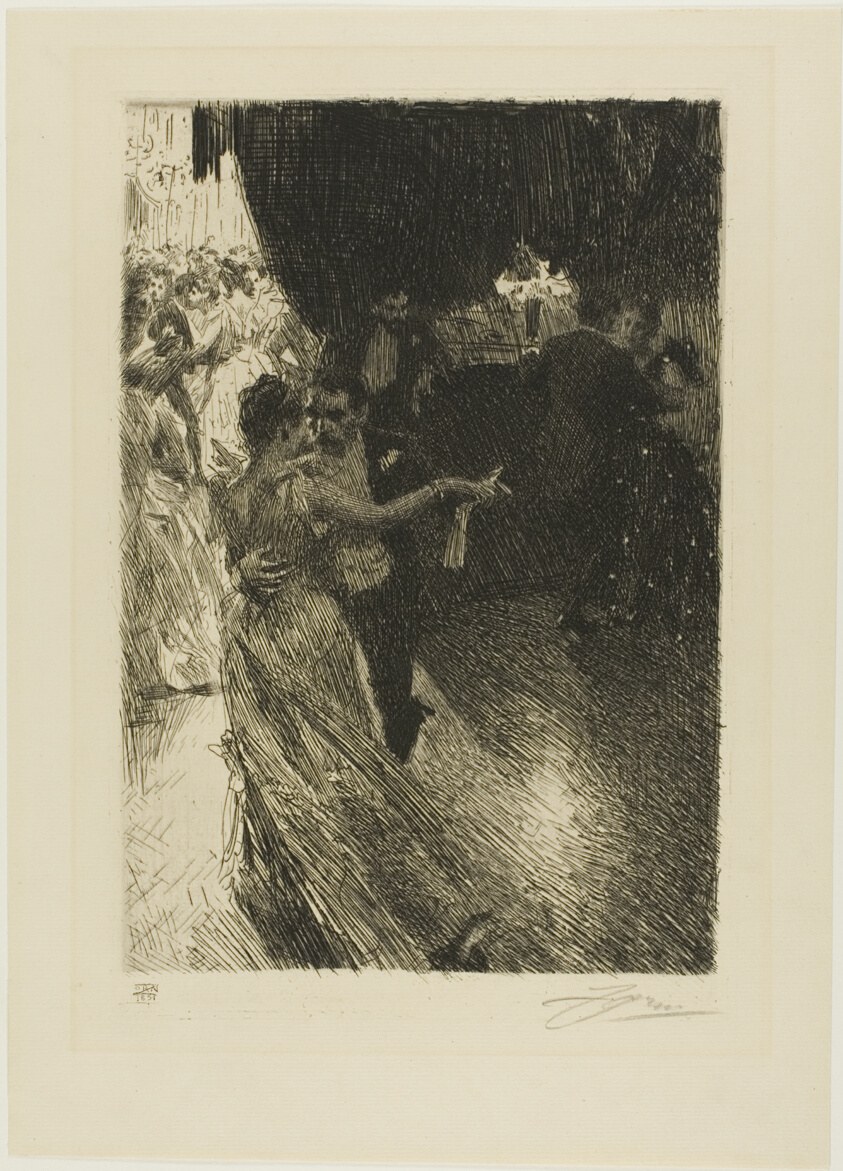
The waltz transformed partner dancing from a formal, geometric, ensemble practice into an intimate rotational dance requiring close physical contact—a revolution in both technique and social acceptability. This image captures that transformation at its moment of maximum cultural heat, when the dance was simultaneously the height of fashion and an object of moral panic. For historians and dancers, it documents exactly how the waltz was performed, held, and understood in the early 1800s, before it became conventional.
What you are looking at
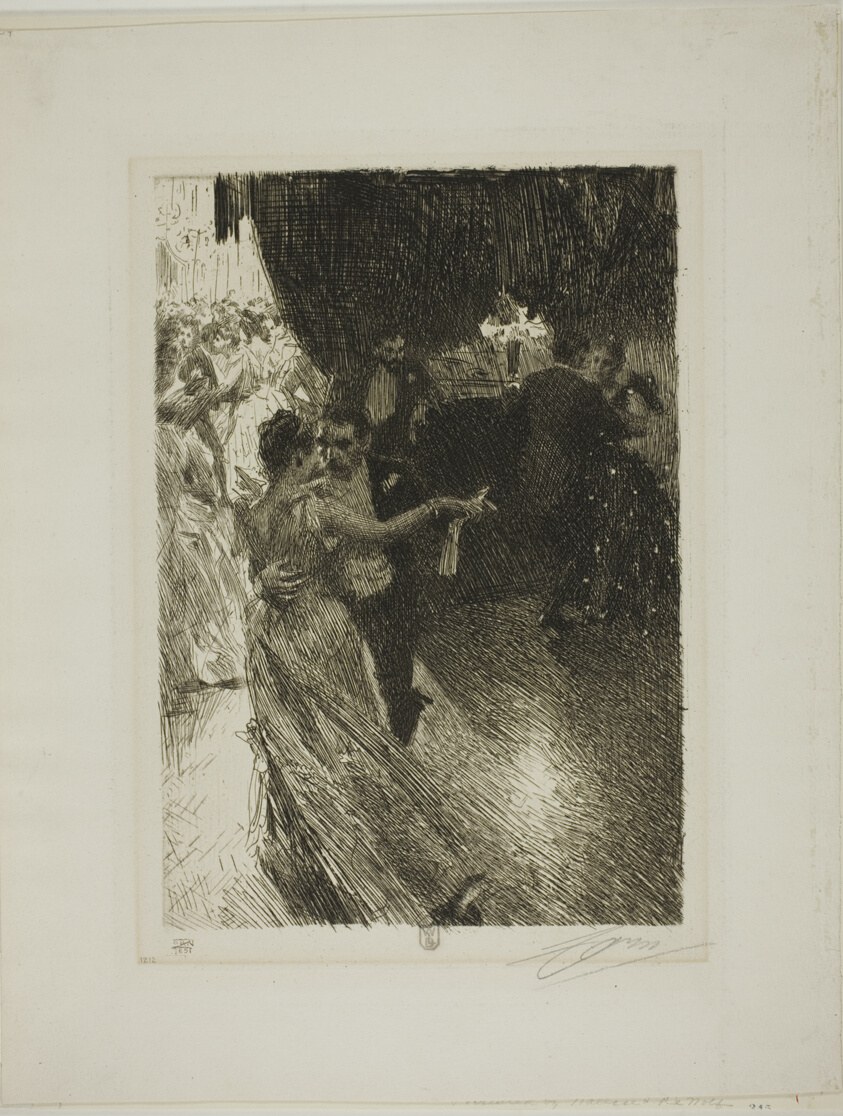
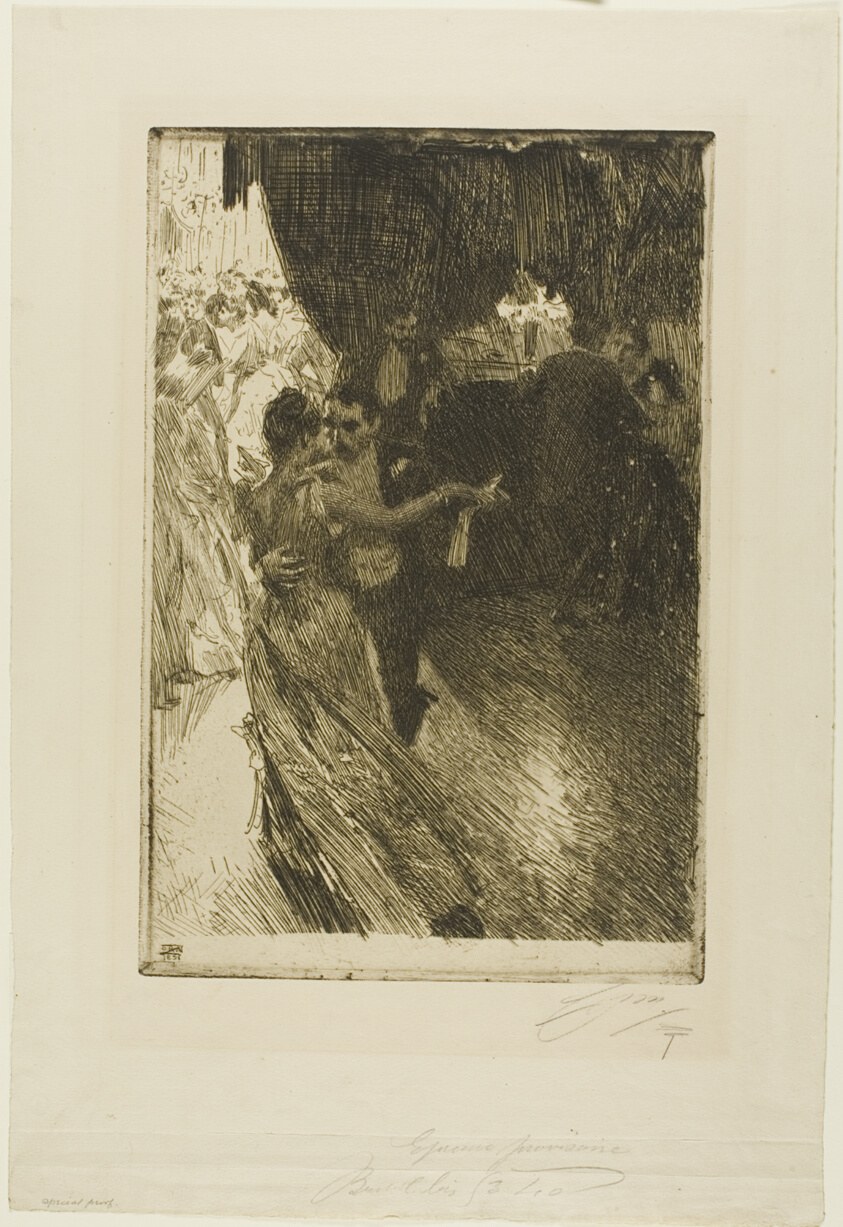
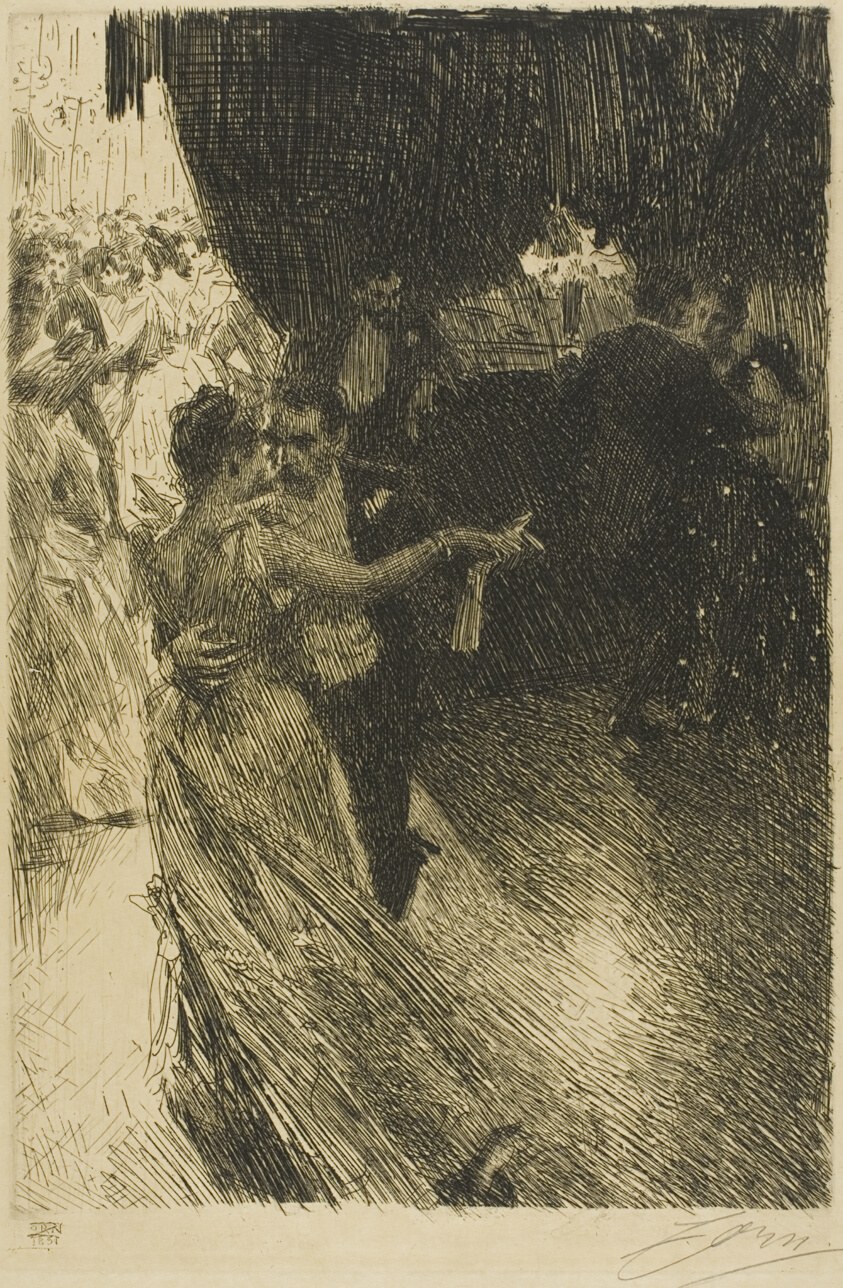
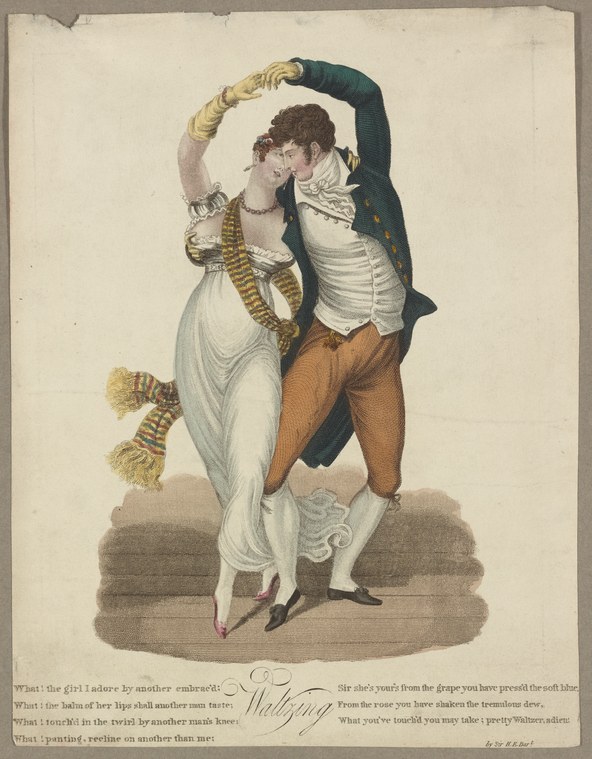
A couple performs a waltz in a formal interior setting, positioned center-stage on a gray stone plinth or platform. The man, in dark tailcoat and orange-brown breeches, clasps the woman's raised right hand while his left arm encircles her waist; her body is tilted back in an elegant arch, her white muslin gown sweeping around her legs. She wears a low-cut bodice with what appears to be a gold or metallic sash or belt, and her dark hair is gathered atop her head in the Regency fashion. The composition captures mid-movement—her trailing skirts and his positioning suggest a turn or pivot executed with the formal, upright carriage demanded by the dance. Below the figures, four lines of verse appear, discussing the waltz itself: questions about the intoxicating nature of the dance and its effects on propriety.
The dancing
The couple holds the closed ballroom position standard to the waltz: the man's right hand on the woman's left shoulder blade, her right hand raised to his shoulder or upper arm, their outside hands (his left, her right) meeting at approximately heart height. Both bodies are upright but the woman's torso curves backward in a dramatic lean, displaying the flexibility and trust the waltz demanded. His frame is square and controlled; hers is elongated and flowing. The positioning shows the close embrace that made the waltz controversial—bodies nearly touching, an intimacy unprecedented in previous dances.
The dance depicted
This is unmistakably the waltz, the revolutionary couple-dance that swept through Europe in the early 1800s, replacing the formal geometry of country dances and cotillions with continuous rotational movement and a close frame. The woman's arched back and the man's secure hold demonstrate the technical demands of the style—the waltz required strong core control, trust between partners, and precise timing to the ¾ music that defined it. The verse below the image addresses the dance's notoriety: the waltz was condemned by conservative society for its impropriety, the closeness of the couple and the dizzying rotations making it a symbol of modernity and moral danger.
How it was made
This is a hand-colored lithograph, a medium that allowed for broad distribution of popular imagery. The process would have involved drawing on stone or the plate, then hand-coloring each impression—visible here in the careful shading of the man's coat, the subtle gradations in the woman's muslin, and the warm terracotta-brown of his breeches. Lithography's accessibility made it ideal for spreading images of fashionable dances and deportment to a wide middle-class audience. The crisp outlines and relatively flat color fields are characteristic of the medium in this period, and the inclusion of didactic verse suggests this was a teaching or moralizing print as much as a celebration of the dance.
About this work
This is a hand-colored lithograph documenting the waltz during the era of its greatest controversy and widest adoption in Europe and America, roughly 1800–1830. It captures not merely the dance itself but the cultural anxiety surrounding it: the accompanying verse addresses head-on the seduction and impropriety the waltz represented to conservative observers. The print served a dual purpose—documenting fashionable ballroom practice while engaging in the moral debate the dance provoked. The lithograph format ensured wide circulation among the urban middle classes learning to navigate ballroom culture, making this both a historical record and a artifact of social messaging.
How to look at it
Watch the woman's arch and the proximity of their bodies—this is what scandalized Europe. The artist has frozen a moment of rotation, capturing the dynamic tilting and turning motion that made the waltz feel thrilling and dangerous. Notice the verse below: it is not mere decoration but part of the image's argument, asking the viewer to reflect on what the dance means. The formal setting and fashionable dress indicate this is aspirational—an image for people learning to dance, not a satirical or condemning view of the waltz.
The period
The waltz emerged in Vienna in the late 1700s and spread rapidly through Europe and America during the Napoleonic Wars and the Regency era. By the 1810s–1820s, it had become the defining dance of progressive, cosmopolitan society, displacing the quadrille and cotillion in fashionable ballrooms. Conservative critics denounced it as German barbarism, sexual provocation, and a symptom of social dissolution; physicians worried that the spinning motion caused vertigo and damaged women's health. Yet it persisted and eventually became normalized, a marker of the transition from 18th-century formality to 19th-century individualism and romantic partnership. Print culture—engravings, lithographs, satirical cartoons—played a crucial role in spreading both the practice and the debate.
Where it lives
From the New York Public Library collection. The print is catalogued as an artifact of the 'Waltz Revolution' (early 1800s). Lithographs of this type were commonly produced for popular consumption, sold individually or in series, and often included instructional or moralizing text alongside the image of the dance.
Dance in this work
Questions about this work
Why is the woman leaning so far back?
That dramatic arch is characteristic of early 19th-century waltz technique. It displays both the physical demands of the dance—requiring the woman to trust her partner completely and maintain balance during rapid rotation—and the aesthetic ideal of the period, which valued elongation and fluidity of the female form. The lean is also a product of the rotational motion: as the couple spins, centrifugal force naturally tilts the woman's body outward.
Was the waltz really considered scandalous?
Yes. The close frame, the absence of the geometric formations of earlier dances, and especially the woman's back arch made the waltz an object of genuine moral panic in conservative circles. Medical authorities warned it damaged women; clergy condemned it as sexually provocative; newspapers published satirical attacks. The verse on this print engages directly in that debate, asking whether the waltz is an intoxicating, improper influence.
What do the verses say?
The four lines discuss the nature of the waltz's appeal and its moral implications. They address questions of seduction, propriety, and the dance's effects on the participants—essentially asking: What is the waltz doing to society, and to women in particular? This is a document of the cultural anxiety the dance provoked, not a neutral record of technique.
More Waltz artwork