25 works in this view — arrow keys or swipe to move between them.
Dance in Art · 2019
Tango americano
Unknown artist
- Medium:
- Illustration
- Dance:
- Tango
- Era:
- 1900-1920 (Ragtime/Early Jazz)
- Source:
- New York Public Library
- Rights:
- Public domain — free to use, share and adapt.
- Recorded as:
- public_domain
This image is primary evidence for how tango was understood, marketed, and performed in early 20th-century Europe, before it became codified into the precise, closed-frame ballroom dance taught in modern dance schools. It shows that early European tango was conceived as passionate, improvisational, and individually expressive—qualities that later standardized technique would subordinate to frame, hold, and prescribed footwork. For dancers and historians tracking the internationalization of tango and the role of commercial print culture in shaping dance fashion, this is a crucial document.
What you are looking at
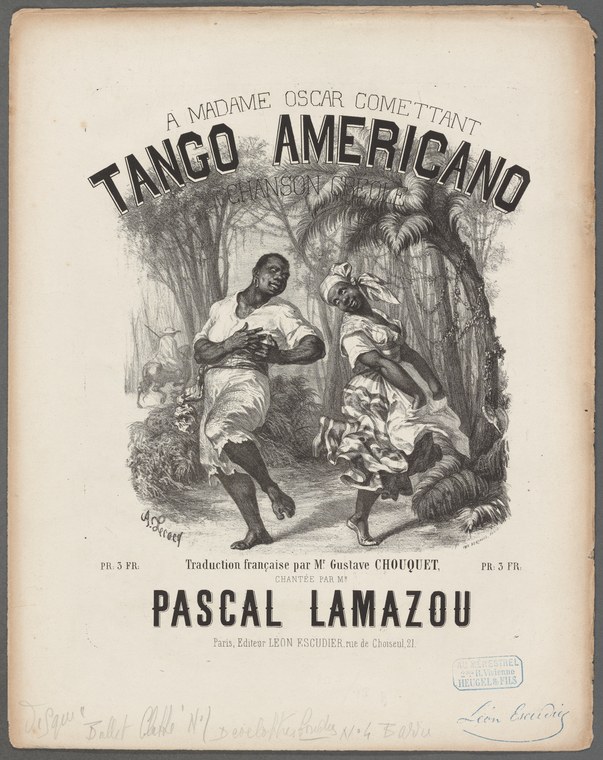
This is a French illustration promoting tango americano, dedicated to Madame Oscar Comettant. The composition depicts two figures in a wooded setting with tall trees framing the scene. On the left stands a figure in white clothing with arms spread open in an expressive gesture; on the right, a second figure in lighter dress appears to be in mid-movement, leaning backward with arms extended. The woodland backdrop, rendered in fine cross-hatching and line work, creates an intimate, theatrical mood. The overall composition suggests spontaneity and passion rather than formal ballroom posture, with the figures' bodies angled toward each other across a small gap. The work is an engraving or lithograph, printed in black and white, bearing a publisher's mark for Léon Escudier in Paris and priced at 3 francs.
The dancing
The two dancers occupy the frame asymmetrically, neither in a closed ballroom hold. The figure on the left displays an open-armed, expansive posture with the torso upright and arms spread wide—a gesture of invitation or emotional expression rather than technical control. The figure on the right leans away with a curved spine and extended limbs, suggesting a moment of response or surrender. Neither dancer's feet are clearly articulated, but the weight distribution and body angles suggest an improvised, social quality rather than the precise frame characteristic of competitive ballroom dance. The relationship between the figures is energetic and dialogic rather than locked or formalized.
The dance depicted
This is tango as understood in early 20th-century France during the dance's rapid spread beyond Buenos Aires and into European salons and music halls. The engraving is titled 'Tango Americano'—a designation reflecting the geographical confusion and commercial rebranding that attended tango's international circulation in the 1900s-1920s. The image depicts tango as a social, improvisational embrace rather than a codified technique, emphasizing emotional engagement and bodily spontaneity. The woodland setting and theatrical presentation suggest this was circulated as popular entertainment media, promoting tango to French audiences as an exotic, sensual import compatible with both bohemian aspiration and salon performance.
How it was made
This is a wood engraving or steel engraving, executed in fine parallel lines and cross-hatching to model form and suggest atmosphere. The technique allowed rapid, economical reproduction for mass distribution—critical to tango's promotion as a fashionable dance in early 20th-century Europe. The dedication to a named patron (Madame Oscar Comettant) and the publisher's imprint (Léon Escudier, a major French music publisher) indicate this was circulated as a commercial print, likely accompanying printed music or as promotional material for dance instruction or performance venues. The relatively modest price (3 francs) suggests a wide intended audience.
About this work
This French engraving is evidence of tango's rapid assimilation into European popular culture in the early 1900s. The work captures a moment of international dance transmission when tango—newly arrived from Buenos Aires—was being repackaged and promoted in Paris as exotic, modern, and commercially viable. The image itself reveals what French audiences and promoters understood tango to be: an improvisational, emotionally charged social dance performed by couples in informal intimacy, worlds away from the standardized technique that would later define competitive ballroom tango. The woodland setting and theatrical composition distance the dance from its social hall origins, presenting it instead as a subject worthy of artistic attention and popular consumption.
For dance historians, the work documents both the dance's early aesthetic and the machinery of its internationalization—the role of publishers, teachers, and cultural mediators in transforming a local Argentine tradition into a European fashion. The print's circulation through commercial channels and its appeal to patrons (Comettant) and educated buyers reveals how tango entered European consciousness not through immigrant communities or working-class venues, but through the artistic and commercial infrastructure of the belle époque.
How to look at it
Observe the moment the artist chose: neither a formally composed ballroom pose nor a narrative climax, but a moment of mutual gesture and response between the two figures. The open arms and curved spines suggest the artist was interested in capturing tango as emotional exchange and bodily conversation rather than technical mastery. Notice how the woodland framing—romantic and somewhat theatrical—transforms what was originally a working-class, urban social dance into a subject worthy of artistic elevation. The engraving's fine detail and careful modeling indicate the artist took the subject seriously, despite (or because of) its association with popular entertainment and cultural anxiety.
The artist
The engraving is unsigned, and the catalogue record does not identify the artist. The work was published by Léon Escudier, a major Parisian music publisher active from the 1840s onward, who specialized in popular music and dance-related prints. Escudier's imprint suggests the work was part of a broader commercial strategy to capitalize on tango's popularity in Paris; such prints frequently accompanied sheet music or were sold independently as promotional or souvenir items. The professional quality of the engraving and the cultural status of the dedicatee indicate this was a serious commercial and artistic production, not a casual sketch.
The period
This print dates to the height of tango fever in Paris, approximately 1910–1920, when the dance had recently arrived from Buenos Aires via London and was sweeping European salons and music halls. The period was marked by intense debates about tango's morality and propriety; conservative commentators condemned it as licentious and foreign, while modernists and the fashionable elite embraced it as cutting-edge and cosmopolitan. Artistically, the early 1900s saw growing interest in dance as a subject for fine and commercial art—a legacy of the Impressionists' fascination with Parisian entertainment culture and the rise of the decorative arts. The woodland setting and romantic mood of this engraving reflect broader artistic traditions of representing dance and courtship in idealized natural settings, even as tango itself was understood as quintessentially modern and urban.
Where it lives
The work is held in the New York Public Library's dance or music collection, as recorded in the library's digital inventory. It is an original print, likely one of many circulated by Escudier as part of a commercial campaign to promote tango in Paris. The dedication to Madame Oscar Comettant suggests it may have been a gift or tribute to a patron, teacher, or performer of note.
Dance in this work
Questions about this work
What is 'tango americano'?
This refers to tango as it was promoted and performed in Europe, especially France, in the early 1900s. The term 'americano' is somewhat misleading; it reflects confusion about tango's origins and the commercial practice of rebranding dances for European audiences. The image shows tango as a passionate, improvisational couple dance, performed in close but not strictly formalized contact.
Is this the same tango danced today?
Not entirely. Modern competitive Argentine tango and ballroom tango are more technically standardized, with precise frame, hold, and footwork. This early image shows tango before such codification—looser, more individually expressive, and more concerned with emotional communication than technical precision. The modern dance's structure emerged gradually through the 1920s-1950s as teachers and competitors formalized the technique.
Who was Madame Oscar Comettant?
The catalogue record does not identify her. The dedication suggests she was a person of sufficient social or cultural status to merit a patron's honor—possibly a dance teacher, performer, or wealthy supporter of the arts in Paris. Many such dedications were common in commercial dance prints of the period as a form of marketing and social acknowledgment.
Why is this set in a woodland rather than a ballroom?
The romantic, natural setting reflects both artistic convention (idealizing leisure and courtship in nature) and the desire to elevate tango from its working-class, urban origins into a subject worthy of serious artistic attention. It also echoes European artistic traditions of representing dance as a timeless, poetic activity rather than a contemporary social fad.
More Tango artwork
![[Les noces de trottoir, par les compagnies Tango Sumo et Vendaval. Chalon dans la rue. 2007 / photographies de Joël Verhoustraeten] by Verhoustraeten, Joël (1954-2019). Photographe](https://gallica.bnf.fr/iiif/ark:/12148/bc6p058zgkc/f1/full/800,/0/native.jpg)