49 works in this view — arrow keys or swipe to move between them.
Dance in Art · 2023
The dance
Unknown artist
- Medium:
- Source:
- New York Public Library
- Rights:
- Public domain — free to use, share and adapt.
- Recorded as:
- public_domain
For historians of dance, this image is primary evidence for the posture, hold, and social context of early 19th-century ballroom dancing—information that written dance manuals alone cannot fully convey. For art historians and curators, it exemplifies the widespread use of dance as a subject for popular illustration, reflecting the centrality of dancing to the social imaginaire of the era.
What you are looking at
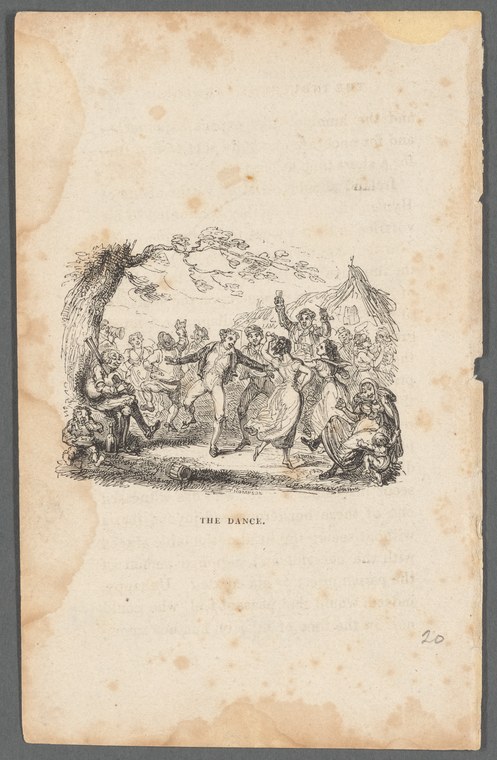
A crowded outdoor dance unfolds beneath a large tent or canopy, rendered in fine pen lines with cross-hatching for shadow. The composition is dense and celebratory: couples and groups occupy the foreground, middle ground, and background in a roughly circular arrangement around a central space. The figures wear the dress of the early 19th century—women in high-waisted gowns with full skirts, bonnets, and parasols; men in tailcoats, breeches, and top hats. The scene captures a moment of social animation: some figures are actively dancing in pairs or small groups, others stand conversing or watching, and musicians or attendants cluster at the periphery. The perspective is intimate rather than grand—we are close enough to read individual gestures and expressions, but far enough back to see the whole gathering as a social occasion. The artist has chosen a moment of peak liveliness, with bodies in various attitudes of motion and repose, and has used the density of the crowd itself as the subject.
The dancing
The dancers are arranged in couples and small groups using closed holds typical of the period—men with hands at women's waists, women with hands on men's shoulders or arms. The weight appears to be carried upright and controlled rather than relaxed; this is formal social dancing, not folk or recreational movement. The women's full skirts create volume and line, and several figures show the characteristic posture of the Regency and early Victorian era: straight backs, controlled arm positions, deliberate stepping. A few figures appear to be mid-stride or mid-turn, suggesting active movement, while others are stationary or transitional. The overall count is difficult to determine precisely due to the density of the composition, but there are easily twenty to thirty figures visible, with perhaps eight to twelve actively dancing in pairs.
The dance depicted
This depicts a formal social dance of the early 19th century, most likely a quadrille or cotillion—dances that were central to polite society in the Regency and early Victorian periods. The outdoor setting under a tent and the mixed composition of active dancers and onlookers is consistent with garden parties or public assembly rooms of the era. The closed holds, upright carriage, and deliberate stepping all match the conventions of these dances. The work documents not the dance itself in abstract but the social occasion of dancing: the interaction of dancers and spectators, the role of dress in signaling status, and the public nature of courtship and social display. Without an artist's signature or inscription, attribution and dating rely on stylistic evidence—the fashion, the engraving technique, and the subject matter all point to the 1830s–1850s.
How it was made
This is a wood engraving or steel engraving, identifiable by the fine parallel lines, cross-hatching, and precise tonal gradation characteristic of the medium. The technique allows for sharp detail and can be reproduced many times without significant wear, making it ideal for book illustration or cheap popular prints. The handling here is assured and lively—the artist has used varied line density to suggest depth, light, and the texture of fabrics. The title is printed below the image, indicating this is a finished illustration, not a preparatory study. The condition—age spots, creasing, and paper browning—suggests this is an original or early proof rather than a later reprint.
About this work
This is an early 19th-century engraving documenting a formal social dance under a tent, capturing the full social ecology of the occasion: the dancers themselves, the onlookers, the musicians, the dress, and the moment. It records not a named choreography or virtuosic performance but the everyday ritual of social dance as practiced by the middling and upper classes of the era. The work is valuable both as a source for the history of dance and as a window into the social manners and gender relations of the period—it shows dancing as a structured, public, and courtship-inflected social practice. It belongs in a gallery about dance because it treats dance not as an art form to be analyzed but as a human activity embedded in fashion, etiquette, and social ambition.
How to look at it
Examine the variety of body positions and attitudes: notice which figures are actively dancing (in closed holds, mid-stride) and which are stationary or conversing. The artist has packed the composition densely, so scan from foreground to background to understand the spatial arrangement. Pay attention to the women's skirts and bonnets—these are not incidental detail but are rendered with care and specificity, indicating the importance of dress to the social meaning of the occasion. Finally, look at the frame and setting: the tent, the trees, the informal outdoor venue suggest a garden party or public ball rather than a private drawing room, which tells us something about the social status and occasion.
The period
This work dates to the height of the quadrille's popularity in Europe and America. The quadrille, which originated in France in the late 18th century, became the dominant form of formal social dancing during the Regency and Victorian eras, taught in dancing schools and performed at every respectable assembly. The same period saw an explosion of printed illustrations of social scenes—costume plates, satirical scenes, and sentimental genre scenes—for a newly literate and affluent middle class. Engraving and wood engraving were the dominant reproductive technologies before photography, and publishers issued thousands of such prints for books, periodicals, and sale as individual sheets. Dance illustrations served multiple purposes: as guides to fashion and etiquette, as records of social aspiration, and as sentimental or satirical commentary on manners.
Where it lives
The work is held in the New York Public Library collection. It is an original print or early proof from the early 19th century, removed from a book or periodical or issued as a standalone sheet. The title printed below suggests it was a commercial illustration rather than a unique artwork.
Dance in this work
Questions about this work
What dance is being shown?
Most likely a quadrille or cotillion, the two dominant forms of formal social dancing in the Regency and Victorian eras. The closed holds, upright posture, and outdoor ballroom setting are all consistent with these dances. The image documents the social occasion of dancing rather than the steps themselves, so we cannot identify a specific choreography or figure.
When was this made?
The catalogue record does not give a date. Based on the fashion (high-waisted gowns, Regency and early Victorian silhouettes), the engraving technique, and the style of printing, this likely dates to the 1830s–1850s. A definitive date would require further research into the publisher and artist.
Who are these people?
They are unnamed individuals of the middle and upper classes, gathered for a public or semi-public social dance. The image documents a type of occasion and a social practice rather than specific named people. The presence of onlookers and the formal dress suggest this is neither a private ball nor a professional performance.
Is the artist known?
No. The catalogue record does not identify the artist, and there is no visible signature on the print. The work is known only by its title and its holding in the NYPL collection.
More dance artwork