13 works in this view — arrow keys or swipe to move between them.
Dance in Art
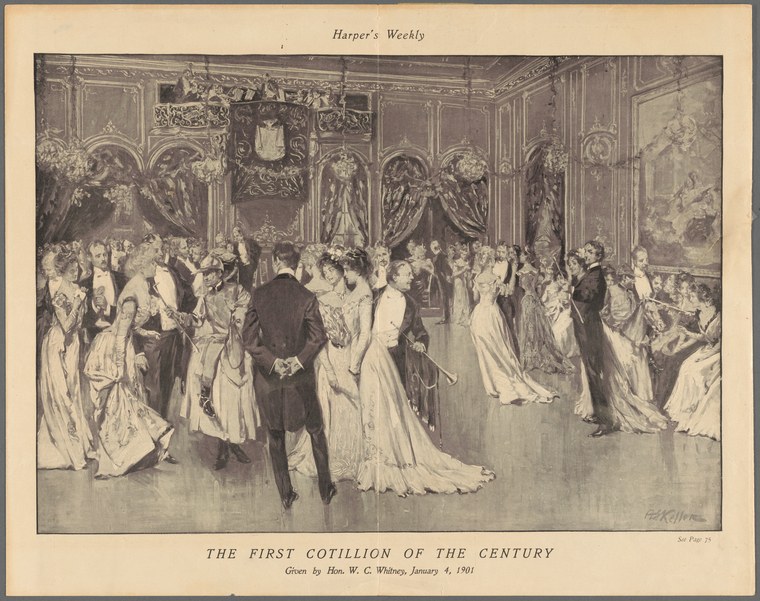
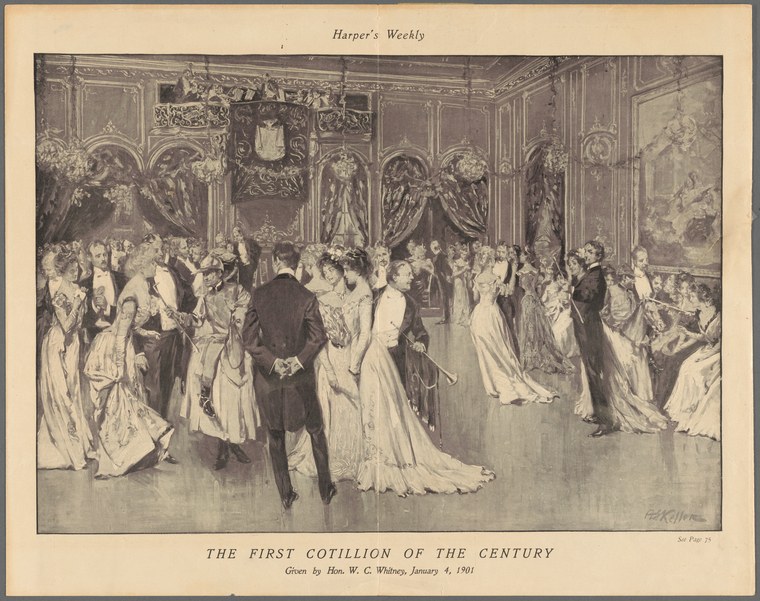
The first cotillion of the century, given by Hon. W.C. Whitney, January 4, 1901
Unknown artist
- Medium:
- Lithograph
- Dance:
- Cotillion
- Era:
- Late 1800s (Victorian Ballroom)
- Source:
- New York Public Library
- Rights:
- Public domain — free to use, share and adapt.
- Recorded as:
- public_domain
The cotillion was the defining formal dance of the nineteenth-century American elite, and detailed visual records of its actual performance are uncommon. This lithograph, created for a weekly magazine and thus intended for wide circulation, documents not an imagined or theatrical version of the dance but the real event as witnessed and reported. The work thus bridges social history, dance history, and the visual record of how nineteenth-century ballroom culture looked and functioned.
What you are looking at
A formal ballroom reception unfolds in an ornate interior with high ceilings, elaborate wall panels, and monumental classical sculptures. The room is filled with formally dressed figures—men in black tailcoats and women in white or pale ball gowns with long trains. The composition centers on the dancing couples and standing figures distributed across a polished floor, with onlookers massed in the background. The artist has captured the moment mid-dance, with couples moving through the figures of the cotillion while others wait their turn or converse at the margins. The scale and formality of the event—evident in the expensive furnishings, the number of attendees, and the precision of their dress—conveys this as a society event of the highest rank. The lithographic technique allows fine gradation of tone, creating depth between the crowded foreground and the receding architectural details.
The dancing
The dancing couples are shown in closed or semi-closed hold, moving with the formal uprightness characteristic of late-nineteenth-century ballroom carriage. The women's long trained gowns sweep across the floor, their arms raised or extended in the frame of the period. The men stand tall in tailcoats, guiding their partners through what appear to be progressive figures. Some couples are mid-stride; others stand poised at the start or end of a movement. The surrounding figures—both dancers and spectators—are rendered with anatomical accuracy, their postures reflecting the social conventions of formal dress and public deportment.
The dance depicted
This depicts a cotillion, the formal group dance of the Gilded Age ballroom. The cotillion was structured, multi-couple event requiring careful choreography and typically lasted the better part of an evening; it was danced in figures, with couples progressing through a set pattern. The presence of numerous couples distributed throughout the room, some dancing while others wait, accords with the actual structure of cotillion dancing. This particular event—given by the prominent financier William C. Whitney on January 4, 1901—was a significant New York society occasion, and the lithograph commemorates it as such. The dress and decorum suggest this is the formal cotillion of the turn of the century, when the form was approaching the end of its dominance in American high society.
How it was made
This is a lithograph, a technique that allowed the artist to work with a greasy crayon on a prepared stone surface to create an image suitable for large-scale printing and distribution. Lithography was well suited to social documentation and society journalism in this period; the medium allowed fine detail and tonal nuance while remaining economical enough for publication in newspapers and magazines. The image comes from the New York Public Library's collection, suggesting it was originally published in Harper's Weekly, which regularly used lithographed illustrations to report on major social events. The technique preserved both the architectural detail of the ballroom and the individuating character of the fashionable attendees.
About this work
This is a documentary lithograph recording one of the most lavish social events in New York at the turn of the century: a cotillion given by a leading Gilded Age industrialist. The work captures not only the spectacle of the event but also the precise form of the cotillion itself—a structured group dance that required the coordination of multiple couples moving through predetermined figures. As a work of social reportage, it preserves the visual and kinetic character of a dance form that was already becoming historically marked by 1901. For dance historians, it offers rare evidence of how cotillions were actually organized and executed in the highest circles of American society, frozen in the moment by an artist working for the popular press.
How to look at it
The artist has chosen to show the cotillion mid-performance, with active dancers visible in multiple parts of the floor. Notice the careful attention to the hold and frame: the formal uprightness, the positioning of the woman's hand and arm, the man's guiding posture. The long trains of the white gowns are allowed to trail dramatically, creating visual momentum and emphasizing the scale of the room. The depth of the composition—with dancers at varying distances, and the elaborate architecture framing and containing the action—conveys both the formality and the spectacle of the occasion. The stillness and precision of the figures, contrasted with the crowd of onlookers, underscores the ritualized nature of the cotillion itself.
The artist
The artist is not recorded in the catalogue, but the style and format indicate this was created by a professional illustrator working for Harper's Weekly, one of the leading illustrated magazines of the era. Harper's employed experienced lithographers and engravers to cover major social events, and they developed a house style suited to rapid production and clear legibility for print. The competent rendering of architecture and figures, along with the attention to costume detail, marks this as the work of a trained professional rather than an amateur chronicler.
The period
The cotillion reached its apotheosis in the Gilded Age, when wealthy American families competed in the elaborateness and social prominence of their balls. The form had originated in eighteenth-century France and had been refined over the nineteenth century into a highly codified social ritual. By 1901, however, the cotillion was beginning to decline in favor as new dances—particularly the waltz and later the one-step and foxtrot—gained ground. This lithograph thus captures the cotillion at the moment of its institutional dominance but social obsolescence. In artistic terms, the work belongs to the tradition of society illustration, a major publishing category in the nineteenth century, and reflects the cultural prestige accorded to accurate social documentation in the era before photography became universal.
Where it lives
This lithograph is held in the New York Public Library collection and was originally published in Harper's Weekly, a major illustrated weekly magazine that reported on society events, politics, and culture. The inscription on the print gives the date and the host, making it both a work of art and a historical document—a common hybrid status for society journalism illustrations of this period.
Dance in this work
Questions about this work
What is a cotillion?
A cotillion is a formal group dance, typically involving multiple couples who progress through a set series of figures. The dance originated in eighteenth-century France and was adapted into a fixture of ballroom culture, particularly in the nineteenth-century United States. It required coordination, practiced steps, and strict adherence to the choreographed sequence, making it a marker of social class and accomplishment.
Why were cotillions important in Gilded Age society?
Cotillions were among the most prestigious social events, typically hosted by wealthy families as a means of displaying status, introducing young women into society, and cementing social alliances. The ability to host a successful cotillion required not only wealth but also social standing and access to the best musicians, caterers, and cotillion leaders (choreographers and dance masters).
Who was W.C. Whitney?
William C. Whitney was a prominent New York financier, railroad magnate, and art collector of the Gilded Age. His cotillion, given on January 4, 1901, was one of the most celebrated society events of the era and was extensively covered in the illustrated press.
How do we know this is really a cotillion and not some other ballroom dance?
The title explicitly identifies it as a cotillion, and the visual evidence supports this: multiple couples distributed across the floor in a structured progression, the formal dress and deportment, and the presence of onlookers all accord with how cotillions were organized and performed. The date and the name of the host confirm it was a documented historical event.
More Cotillion artwork