49 works in this view — arrow keys or swipe to move between them.
Dance in Art
Dancing
Unknown artist
- Medium:
- Source:
- New York Public Library
- Rights:
- Public domain — free to use, share and adapt.
- Recorded as:
- public_domain
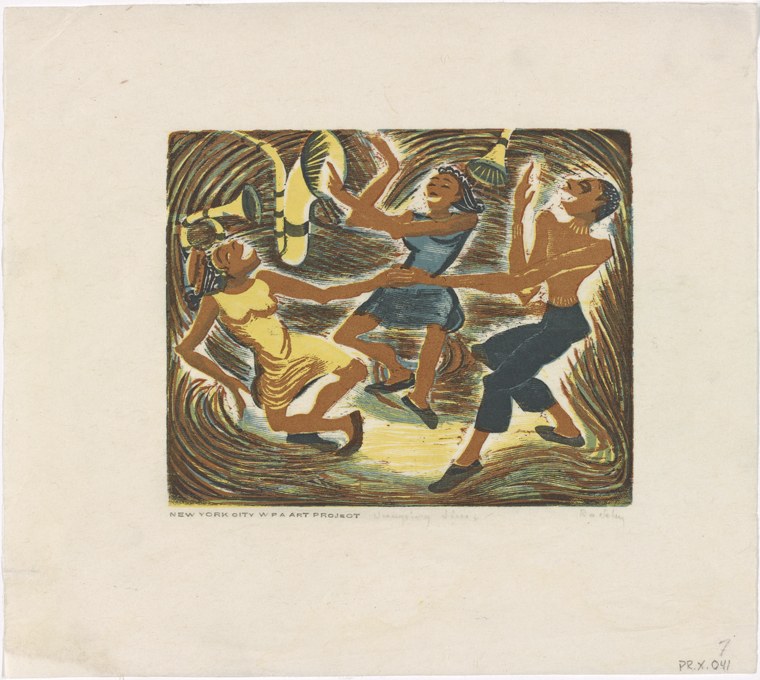
The print demonstrates how American modernist artists of the 1930s and 1940s engaged with dance as a subject for formal experimentation rather than representation. It also documents the WPA's role in supporting printmakers during the Depression—a program that democratized art-making and connected artists to public audiences at scale. For dancers and historians, it offers a window into how dance was understood as a subject worthy of artistic attention outside theatrical performance or ethnographic documentation.
What you are looking at
Four figures in energetic motion occupy a compressed, stylized space defined by bold concentric striations in warm ochre and dark browns. The dancers wear minimal clothing—one in yellow, one in blue, one in dark trousers, one unclothed—their brown skin rendered in warm earth tones that contrast with the patterned background. The composition is tightly framed and rhythmically composed, with the figures arranged in overlapping diagonals suggesting simultaneous movement from different directions. One figure lunges forward with arms raised; another arches backward with one leg extended; a third reaches upward; a fourth crouches low. The setting is entirely abstract—no floor, walls, or landscape—leaving the impression of movement captured in pure spatial compression rather than within a naturalistic place.
The dancing
The four dancers occupy distinct spatial planes and movement directions, suggesting an ensemble work rather than paired or coupled dancing. One figure extends a leg high while the torso twists; another arches backward with arms flung open; a third reaches upward with both arms; a fourth assumes a grounded, compact posture. The bodies show flexible, articulate movement with weight shifting between balanced and off-balance positions. There is no formal hold or frame connecting the dancers; instead they move as individuals within a shared energy field. The anatomical rendering, though stylized, suggests trained bodies with control and awareness of direction and level.
The dance depicted
This appears to be an early-twentieth-century modernist interpretation of social or popular dance, possibly informed by African diasporic movement traditions or avant-garde theatrical dance. The absence of costume, the energetic asymmetrical composition, and the abstract setting suggest this is not documentation of a specific named dance but rather an artist's expressive vision of communal or celebratory movement. The title *Dancing* reinforces that reading—a generic, universal category rather than a style-specific label. The dynamic intensity and the figures' varied spatial planes align more closely with early modernist theatrical or experimental dance than with social ballroom or folk forms.
How it was made
This is a woodblock print or linocut, identifiable from the bold, flat areas of color (ochre, blue, brown, pale yellow), the crisp black outlines, and the characteristic linear patterning of the background created through parallel cuts. The medium's expressionist quality suits the subject matter: the reduction of form to essential gesture, the high contrast between figure and ground, and the rhythmic repetition of the background striation all derive from and amplify the inherent strengths of relief printing. The source attribution to the New York Public Library and the stamped credit line "NEW YORK CITY W.P.A. ART PROJECT" indicates this was created under the Works Progress Administration's Federal Art Project (1935–1943), a program that supported printmakers and graphic artists during the Great Depression.
About this work
This is a WPA-era modernist print depicting four dancers in dynamic, abstract space, rendered through the bold formal language of woodblock or linocut. The artist has stripped away narrative detail and architectural setting to focus on the pure energy and spatial complexity of human movement. The dancers are shown in simultaneous action from multiple viewpoints—a compositional strategy borrowed from early-twentieth-century avant-garde practice—creating a sense of kinetic urgency and communal participation rather than the ordered patterns of ballroom or theatrical dance.
The work sits at the intersection of several currents: the WPA's democratic commitment to public art and printmaking; modernism's formal radicalism and interest in non-Western aesthetics; and the early-twentieth-century fascination with the expressive power of the body. It belongs in a gallery of dance in art because it shows how artists of that period understood movement—not as narrative spectacle or skilled technique to be documented, but as an abstract formal property capable of generating meaning and emotion.
How to look at it
Pay attention to how the four figures occupy the composition: they are not arranged in a line or paired formation, but scattered across the picture plane in overlapping, intersecting diagonals. Each dancer is at a different moment in a different movement—one arching, one reaching, one lunging—which creates a visual rhythm rather than a single frozen moment. Notice how the background's bold linear pattern creates a sense of motion and energy that mirrors the dancers' own movement. The artist has used minimal detail and maximum contrast (the dark bodies against the light and patterned ground) to emphasize gesture and spatial tension over anatomical accuracy. The absence of any setting or costume invites you to read the bodies themselves as the primary subject.
The period
This print was created during the 1930s–1940s under the Works Progress Administration's Federal Art Project, a New Deal program that supported visual artists during the Great Depression. Printmaking—particularly woodcut and linocut—was a favored medium for WPA artists because it was economical, tactile, and capable of bold social messaging. In dance, this period saw the rise of American modern dance as a distinct form, with figures like Martha Graham, Lester Horton, and Katherine Dunham exploring movement grounded in the body rather than in classical ballet technique. There was also growing interest among avant-garde artists in non-Western and African diasporic movement forms, partly through the influence of Primitivism and partly through genuine cultural exchange. The abstract, energetic quality of this print reflects those crosscurrents: it engages modernist formal principles while depicting bodies in motion with a vitality associated with jazz, social dance, and modern movement.
Where it lives
The work is held in the New York Public Library's collection and carries a stamped attribution to the "NEW YORK CITY W.P.A. ART PROJECT," indicating it was created under the Federal Art Project of the Works Progress Administration between 1935 and 1943. The print reflects the WPA's mission to support American artists and to place original art in public hands during the economic crisis of the Great Depression.
Dance in this work
Questions about this work
What dance is this depicting?
The title *Dancing* is deliberately generic, and the composition does not reference any specific named dance form. Instead, the artist has created a modernist abstraction of movement itself—the energy, spatial complexity, and communal joy of dancing in general. The style and composition align more with early-twentieth-century modern dance experimentation than with ballroom, folk, or theatrical traditions.
Why is the background so patterned and abstract?
The bold linear background is characteristic of woodblock or linocut technique, where parallel lines are an efficient way to create tonal variation and visual texture. But it also serves an expressive purpose: the striated pattern creates a sense of motion and energy that echoes the dancers' own movement, making the entire composition vibrate. It removes the dancers from any recognizable place, letting us focus on the movement itself.
What does the WPA credit line mean?
The Federal Art Project of the WPA (1935–1943) was a New Deal program that paid thousands of American artists—including printmakers—to create art during the Great Depression. It was one of the most successful government art programs in U.S. history. This print is evidence of that initiative and of the government's commitment to supporting artists and making art accessible to the public.
Who is the artist?
The artist is not recorded in the catalogue information available. This is not uncommon for WPA-era prints, many of which were distributed and collected without individual artist attribution. If you have information about this print's artist, the Library would likely welcome that information.
More dance artwork