37 works in this view — arrow keys or swipe to move between them.
Dance in Art · 2019
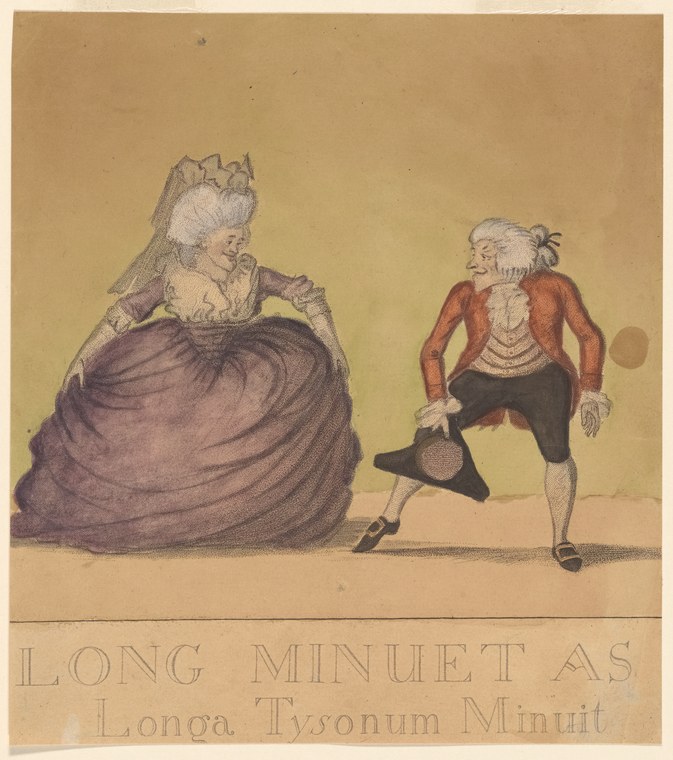
A long minuet as [danced at Bath], Longa Tysonum Minuit
Unknown artist
- Medium:
- Engraving
- Dance:
- Minuet
- Era:
- 1700s (Enlightenment/Minuet Era)
- Source:
- New York Public Library
- Rights:
- Public domain — free to use, share and adapt.
- Recorded as:
- public_domain
This print documents how the minuet—often treated in art history as an abstract formal achievement—was actually subject to mockery and anxiety about bodily adequacy. It shows that the 18th-century dance world included satire, parody, and body humor, not just idealization. For dancers and historians, it reveals that the minuet's rigor and propriety were visible enough to be targets of ridicule, and that anxieties about bodily size and age in dance are not modern but deeply rooted in European court culture.
What you are looking at
A satirical engraving presents two figures in exaggerated poses that parody the minuet, the era's most formal and elegant dance. On the left stands a woman of considerable girth, her massive skirts billowing outward in voluminous folds of purple-grey fabric, her elaborate coiffure and tiny feet rendered absurd by the contrast with her immense silhouette. She gazes down with evident satisfaction. To her right, a thin, elderly man in a crimson coat and black breeches strikes an exaggerated bow, one leg extended in parody of the minuet's characteristic reverence, his hat held low. The pose is inherently ridiculous: the extreme disproportion between the figures, the man's age and wasted frame, and the impossibility of their ever achieving the graceful synchronicity the minuet demands. The composition is set against a plain warm ground with no architectural or social setting, throwing all focus onto the grotesque bodies and their mockery of courtly refinement.
The dancing
The woman stands upright, motionless, her weight settled into her enormous skirts which dominate the composition. The man bends deeply from the waist in a minuet's opening révérence, his left leg extended backward, his hat swept low in an exaggerated gesture of respect. His posture exaggerates the minuet's formal bow to an almost contorted degree. The two figures do not face each other directly; they are not in closed hold or even the proper open frame of the minuet—they are placed side by side in a way that emphasizes their unsuitability as partners. The disparity in their physiques—his skeletal thinness and age against her mountainous bulk—makes the notion of their dancing together the visual joke.
The dance depicted
This is clearly a minuet, as stated in the title and confirmed by the man's révérence (the formal opening bow) and the aristocratic dress. The minuet was danced by couples of matched grace and proportion; satire here lies in depicting the worst possible partners. The inscription 'Longa Tysonum Minuit' appears to be a playful corruption or misspelling (possibly satirizing the dance's pretentious nomenclature), and the subtitle notes this is 'as danced at Bath'—Bath being a fashionable resort where the minuet was danced in assemblies. The image satirizes both the fashion for extreme corpulence in women and the pretensions of aging men to courtly grace. It reflects 18th-century anxiety about whether bodies could actually perform the minuet's idealized elegance.
How it was made
This is a hand-colored engraving, as indicated by the fine linear work and the carefully applied watercolor or gouache tints. Engraving allowed precise, controllable line and the rendering of fine detail in fabric and physiognomy—essential for satire, where the accuracy of ridiculous particulars is the point. The technique permitted circulation as a print, making this work a mass-produced satirical commentary accessible to the middling and upper classes who attended assemblies and knew the minuet. The coloring appears to be applied by hand, suggesting either a unique impression or a small print run hand-finished for individual sale.
About this work
A hand-colored satirical engraving from the 1700s that lampoons the minuet by showing it danced by an impossibly mismatched couple: a woman of enormous girth and a skeletal elderly man. The work belongs to a long tradition of 18th-century graphic satire that used exaggerated bodies to mock fashion, social pretension, and the gap between courtly ideals and lived reality. The minuet's strict formality and reputation for requiring perfect proportion and synchronicity made it an easy target for ridicule. This image circulated among the genteel classes who danced the minuet themselves, and represents the period's simultaneous investment in and skepticism about the social rituals it prescribed.
How to look at it
Notice the man's révérence—the deep bow with weight on the back leg—which is the authentic opening of a minuet, rendered absurd by his age and thinness. The woman's complete stillness and her downward gaze suggest she is unmoved by his courtly respect; there is no reciprocal gesture, no mirroring of movement. Observe how the enormous skirts dominate the left side of the composition, literally and physically preventing the kind of proximity and synchronized movement the minuet demands. The artist has frozen the moment of greeting, before any dance could occur, emphasizing that these two bodies could never move together.
The period
The minuet was the dominant social and theatrical dance of the 18th century, taught in dancing masters' studios and danced in assemblies, courts, and theaters. It required partners of roughly equal height and grace, and was codified in strict positions and movements. The 1700s saw intense concern with fashion, particularly the enormous panniers and skirts that created silhouettes like the woman depicted here. Satirical prints were a major medium of social commentary in the period; caricature engraving flourished in England in particular. This print likely dates to mid-18th century, when the minuet's conventions were stable enough to be obvious targets for satire.
Where it lives
Held in the New York Public Library collection. The work is catalogued as a print from the 1700s; the source record provides minimal additional provenance or accession information.
Dance in this work
Questions about this work
Was the minuet really this formal and strict?
Yes. The minuet required dancers to maintain specific positions, execute prescribed steps in strict time, and present an image of grace and decorum. Dancing masters taught it through detailed notation and repetition. This satire works because the constraints were real and widely known.
What does 'Longa Tysonum Minuit' mean?
The inscription appears to be a playful corruption or macaronic misspelling of 'long minuet'—possibly 'Longa' (long) + a nonsense or corrupted term. It may mock the fancy French and Latin nomenclature often applied to dances in the period.
Why would Bath be mentioned?
Bath was a fashionable English resort town in the 18th century with public assemblies where genteel visitors danced the minuet. It was also known for its spa culture and was sometimes satirized as a place where aging or corpulent people gathered for health reasons.
Is this about body-shaming or about something else?
The satire operates on multiple levels: it mocks fashion extremes, aging male vanity, and the gap between the minuet's elegant ideal and the actual bodies attempting to perform it. It reflects real 18th-century anxieties about whether the body could sustain refinement—a concern that affected social dancing.
More Minuet artwork