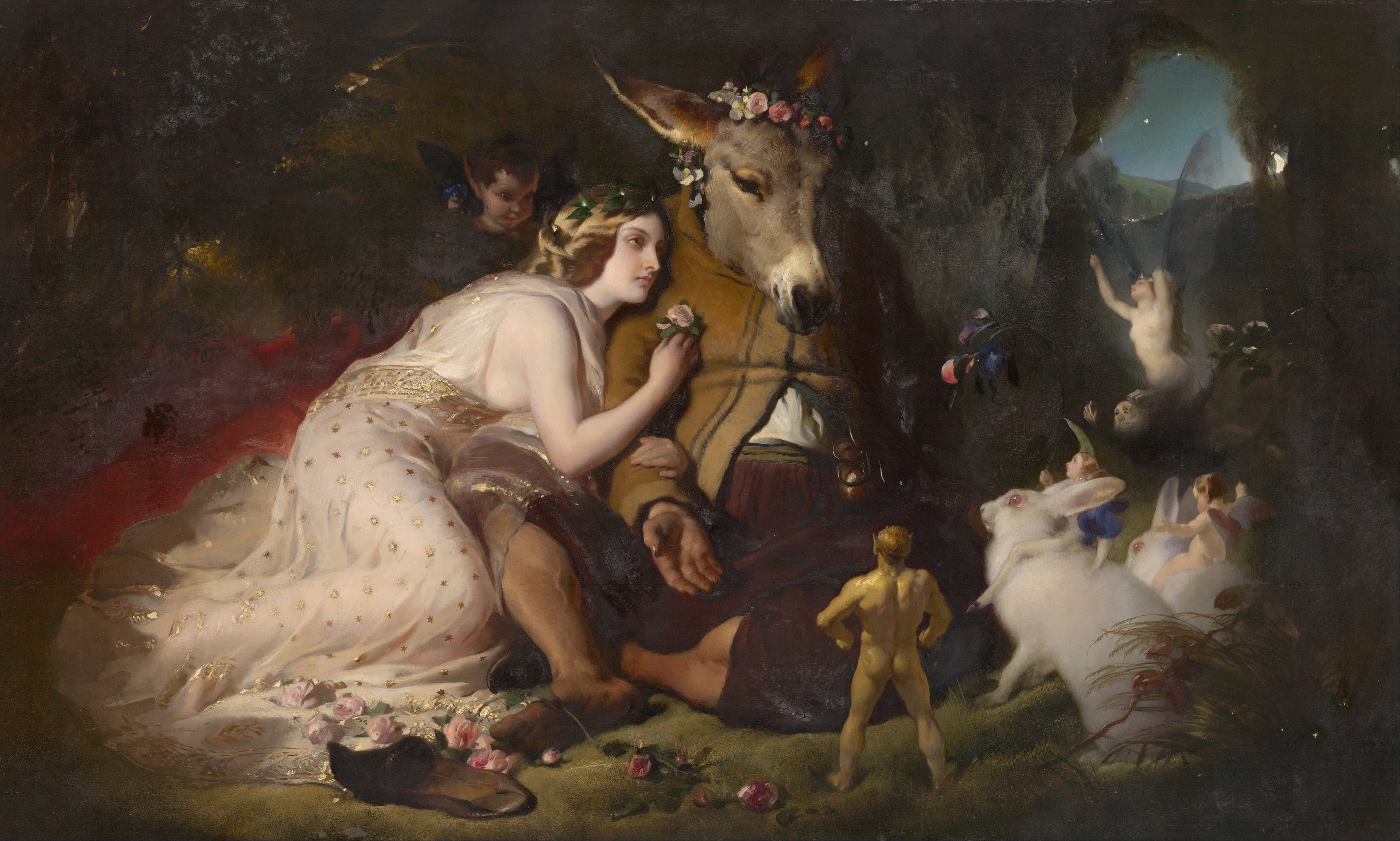
Edwin Landseer — qAFcRhWcRy2Zeg at Google Cultural Institute maximum zoom level · Public domain
A Midsummer Night's Dream is a two-act narrative ballet choreographed by George Balanchine to a score assembled from Felix Mendelssohn, based on Shakespeare's play. It premiered with New York City Ballet on 17 January 1962, and the article identifies it as Balanchine's first completely original full-length ballet — a distinction that matters because his other long works of the period were largely stagings or restagings of existing repertory.
What it contains
- Classical Ballet · Act II, the wedding celebration — Act II abandons the narrative of Act I entirely for a suite of formal classical dance built as a wedding celebration, functioning as a plotless classical divertissement independent of the story. Source: "Act I tells Shakespeare's familiar story of lovers and fairies while Act II presents a strictly classical dance wedding celebration."
What is danced
The article gives only a coarse structural division, but it is a load-bearing one: Act I carries Shakespeare's plot of lovers and fairies, while Act II drops narrative altogether for what the article calls 'a strictly classical dance wedding celebration' — effectively a plotless classical divertissement grafted onto the end of a story ballet. That two-part shape (story act, then a formal dance suite unconnected to plot) is the single concrete piece of choreographic information the source provides.
Beyond that division, the article notes the ballet 'employs a large children's corps de ballet,' which tells us the fairy scenes of Act I use child dancers alongside the adult company, but it gives no detail of steps, partnering, or technique for either act. The named principal roles at the 1962 premiere — Oberon (Edward Villella), Titania (Melissa Hayden), Puck (Arthur Mitchell), and Theseus (Francisco Moncion) — indicate a cast built around a virtuoso male lead (Oberon), a ballerina role (Titania), and a demi-caractère role (Puck), which is consistent with what is danced in the wider repertory record, but the article itself does not describe their movement.
Balanchine built the score not from the familiar incidental music alone but by adding other Mendelssohn works — the overtures to Athalie, Son and Stranger, and The Fair Melusine, the String Symphony No. 9 in C minor, and The First Walpurgis Night — which suggests the choreography for Act II's wedding celebration was constructed as an independent suite of dances set to music not written for the play at all.
Because the source is a plot-and-production summary rather than a scene-by-scene account, it cannot support detailed movement vocabulary claims for individual numbers (e.g. a named pas de deux or divertissement variation), and none are attempted here.
Context
The article situates the ballet at a specific institutional moment: it premiered with New York City Ballet in January 1962 and, two years later, opened the company's first season at its new home, the New York State Theater, in April 1964 — tying the work to NYCB's consolidation as a resident company with its own purpose-built house. The article's framing of it as Balanchine's 'first completely original full-length ballet' marks a departure within his own output, since large-scale, evening-length works were not his usual mode.
Staging history
The article lists an extensive line of choreographers who made independent versions of the Shakespeare play as ballets — Frederick Ashton (The Dream), Christopher Wheeldon, Bruce Wells, Ib Andersen, David Nixon, John Neumeier, François Klaus, Heinz Spoerli, Lourdes Lopez, John Clifford, and Liam Scarlett — indicating this Balanchine version is one of several distinct ballets on the same play rather than a single tradition passed hand to hand. For the Balanchine work specifically, the article documents multiple filmed records: a 1966 filming released in 1967 with Suzanne Farrell, Edward Villella, Arthur Mitchell and Gloria Govrin; a 1986 Live from Lincoln Center broadcast (re-released online during the 2019–20 pandemic); a 1999 Pacific Northwest Ballet performance at Sadler's Wells released on DVD; a Paris Opera Ballet pandemic-era recording with Eleonora Abbagnato, Laëtitia Pujol, Alice Renavand, Stéphane Bullion, Hugo Marchand and Karl Paquette; and a San Francisco Ballet 2020 season recording made in an empty house after the run was cut short.
How to watch it
Watch for the seam between the two acts: Act I carries the Shakespearean plot with a large children's corps for the fairy scenes, while Act II drops the story to present formal classical dance for its own sake, set to Mendelssohn music not drawn from the original incidental score. The absence of Shakespeare's play-within-a-play finale is itself a choreographic choice worth noting when comparing this version to others, such as Ashton's The Dream.
Structure
- Act IFollows Shakespeare's story of the lovers and fairies, using a large children's corps de ballet.
- Act IIA strictly classical dance wedding celebration, dispensing with Shakespeare's play-within-a-play finale.
Structure read from an encyclopaedia article, not from a libretto or score we hold. Confirm against a programme before treating the numbering as authoritative.
Credits
- composer: Felix Mendelssohn
More from George Balanchine
Other staged works in the register connected to this one by author or lineage.
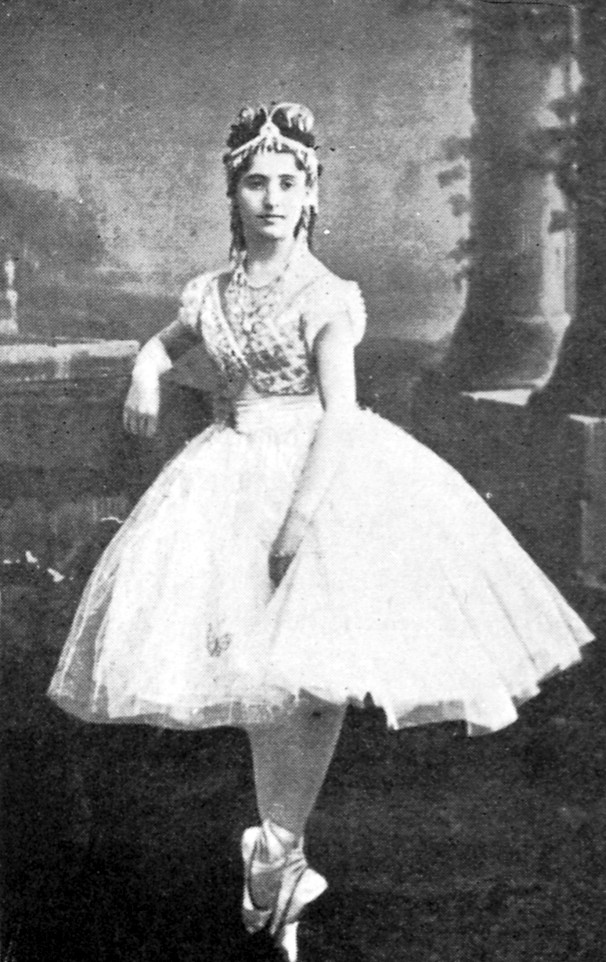 CoppéliaBallet · 1870Balanchine · video
 ApolloBallet · 1928Balanchine · video
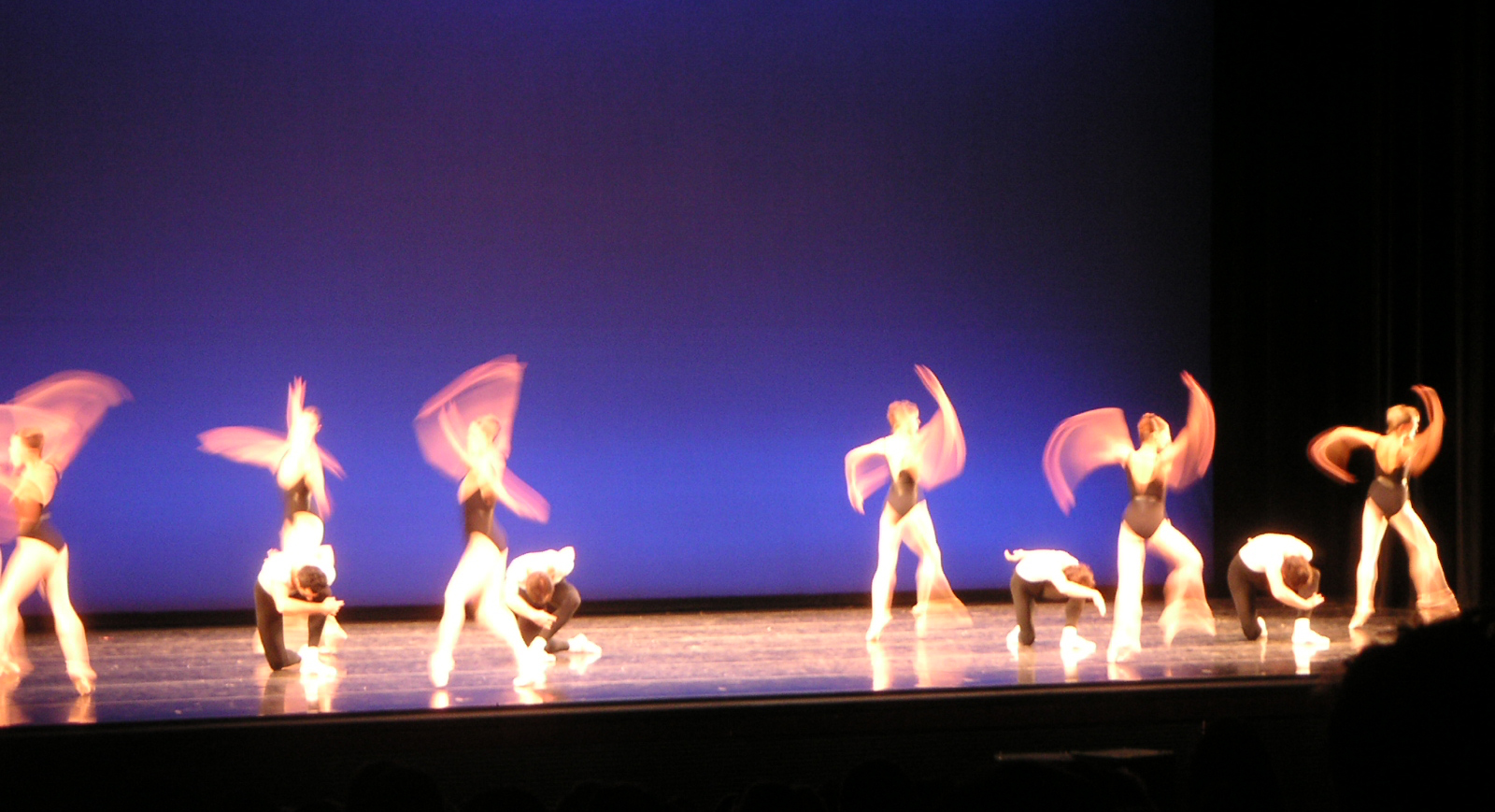 AgonBallet · 1957Balanchine · video
 Le chant du rossignolBallet · 1920Balanchine · video
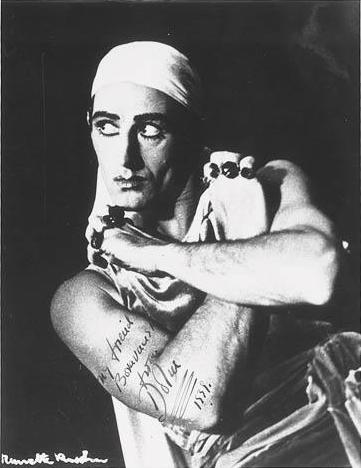 The Prodigal SonBallet · 1929Balanchine · video
 The Seven Deadly SinsBallet · 1933Balanchine · video
 Jeu de cartesBallet · 1937Balanchine · video
 The Magic PillsBallet · 1886Same lineage