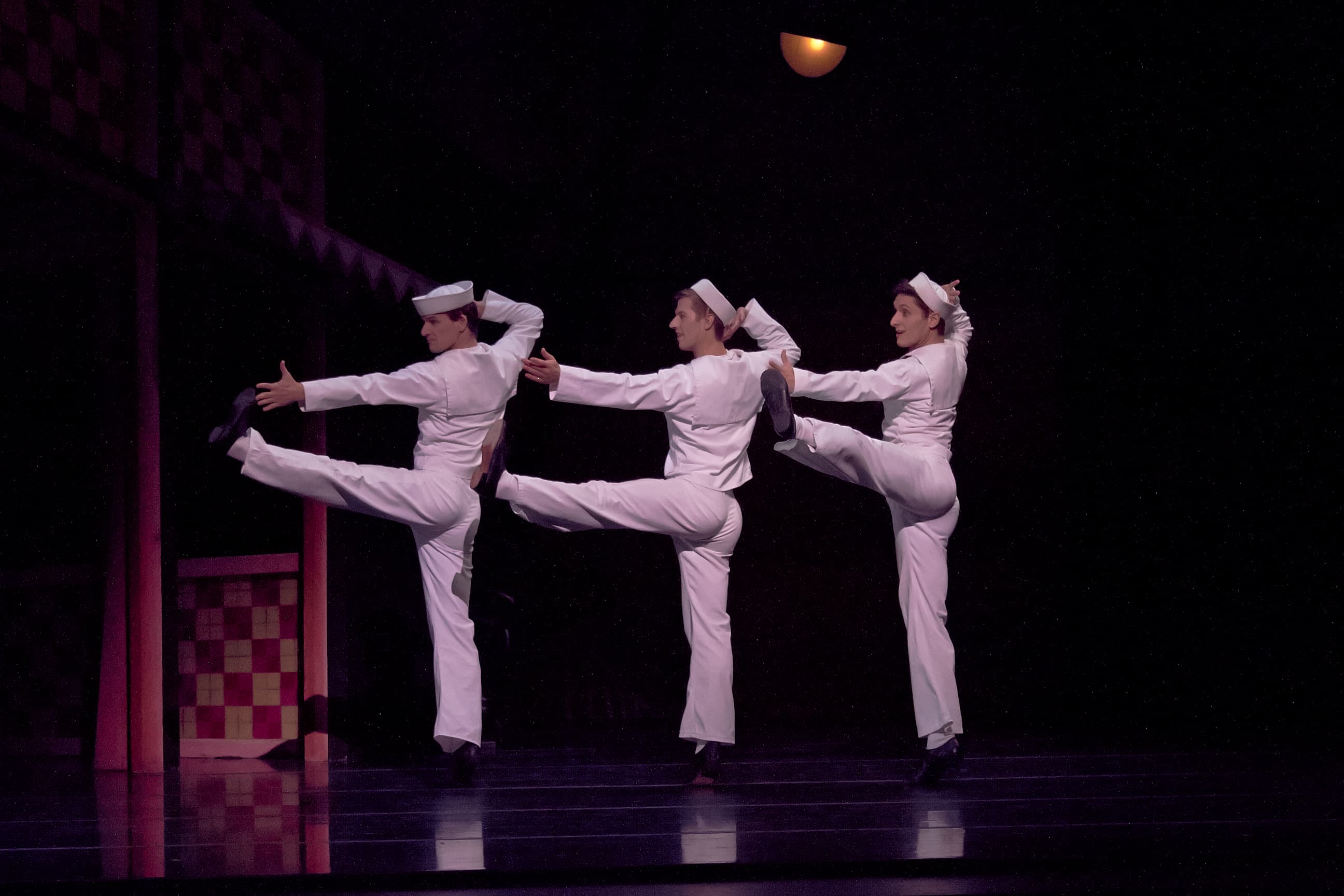
KCBalletMedia — https://www.flickr.com/photos/67555847@N06/10210862565/ · CC BY 2.0
Fancy Free is a one-act ballet made for Ballet Theatre in 1944, with a score by Leonard Bernstein (his first for the stage) and choreography by Jerome Robbins, in his choreographic debut. It tells a slight, comic wartime story — three sailors on shore leave in New York competing over two women — and its success led directly to the 1944 Broadway musical On the Town, which used the same premise with a new score.
What it contains
- Classical Ballet — Pas de Deux · The central duet between the third sailor and the second girl — A formal partnered duet ('pas de deux') built on lifts and adagio partnering, following a mimed exchange, contrasting the comic ensemble sections around it. Source: "they dance a passionate pas de deux"
- Classical Ballet — The Competition Scene · The three-way competition scene — Each man dances a discrete 'solo variation' in the classical sense — an individual set piece performed for the group to judge — structured back-to-back like variations in a classical divertissement. Source: "Each sailor performs a solo variation (a galop, a waltz, and a danzon), but they're so equally matched"
- Galop — Galop Variation · The first sailor's solo in the competition scene — A solo variation explicitly identified by the article as 'a galop,' i.e. built on galop rhythm and character rather than neutral classical bravura. Source: "a solo variation (a galop, a waltz, and a danzon)"
What is danced
The ballet is built around a small cast (three sailors, two women, a bartender) and moves between ensemble horseplay and set dance numbers. The two named structural pillars are a 'passionate pas de deux' for the third sailor and the second girl — a classical duet built around partnering and lifts rather than pantomime alone — and a competition sequence in which each of the three sailors dances a solo variation, explicitly described as a galop, a waltz, and a danzon, so equally matched that the contest cannot be judged and ends in a fistfight instead. This variation-and-pas-de-deux architecture (solo turns framed by a central duet, capped by an ensemble finale) follows the classical ballet grammar of the pas de deux/variations/coda, even though the surface material is vernacular and comic rather than courtly.
Context
The article does not describe the broader dance landscape of 1944, so this section rests on what can be drawn from the record itself: Fancy Free was made for Ballet Theatre (the company later known as American Ballet Theatre) at the old Metropolitan Opera House, and it marked Robbins's first ballet as choreographer and Bernstein's first stage score. Its wartime, American-vernacular subject matter — sailors on liberty, a bar, a pickup — sits inside a classical pas-de-deux/variations structure, and the work's popularity was substantial enough that it was reworked, within the same year, into the Broadway musical On the Town.
Staging history
The article records two premieres: the original Ballet Theatre production on 18 April 1944 at the old Metropolitan Opera House, and a New York City Ballet premiere on 31 January 1980. It also notes that a portion of Bernstein's score was reused in the opening scenes of Alfred Hitchcock's Rear Window, and that the 1946 Decca recording of the ballet score (conducted by Bernstein) included the prologue song 'Big Stuff,' originally recorded by Bernstein's sister Shirley for the stage performances but later recorded by Billie Holiday, who Bernstein had written the song for.
How to watch it
Watch the shape of the competition scene: three men dancing back-to-back solo variations for the same two women is a comic restaging of the classical 'variations' convention, and the differences between the galop, waltz and danzon sections should read as distinct rhythmic characters rather than interchangeable bravura turns. The central pas de deux is the one moment of unforced sincerity in an otherwise brash, joking ballet, so its contrast in tone with the surrounding bar-room comedy is worth tracking.
Structure
- Big Stuff (Prologue)A recorded torch song plays before the curtain rises, setting the wartime bar-room mood; it is a sung prologue rather than a danced number.
- Opening DanceThree sailors on liberty arrive boisterously and head into the bar.
- Scene at the BarThe sailors have a drink, two of them conning the third into paying, before going out to look for women.
- Pas de DeuxLeft behind by the first girl, the third sailor meets a second woman, mimes his military exploits, and dances a passionate pas de deux with her.
- The Competition SceneAll three sailors and both women reassemble; couples dance and swap partners until the men agree to settle the extra man by a contest.
- Galop VariationOne sailor dances a solo variation built as a galop as part of the three-way contest.
- Waltz VariationA second sailor dances a solo variation built as a waltz.
- Danzon VariationThe third sailor dances a solo variation built as a danzon.
- FinaleThe equally matched contest collapses into a fistfight, the women flee, and the sailors, undeterred, take another drink and pursue a new passerby.
Structure read from an encyclopaedia article, not from a libretto or score we hold. Confirm against a programme before treating the numbering as authoritative.
More from Jerome Robbins
Other staged works in the register connected to this one by author or lineage.
 West Side StoryMusical theatre · 1957Robbins · video
- DybbukDybbukBallet · 1974Robbins
 The ConcertBallet · 1956Robbins · video
 Antique EpigraphsBallet · 1984Robbins · video
 A Suite of DancesBallet · 1994Robbins · video
- AndantinoAndantinoBallet · 1981Robbins
 Stars and StripesBallet · 1958Same lineage · video
 Allegro BrillanteBallet · 1956Same lineage · video