
Хомелка — Own work · CC BY-SA 3.0
This is Fikret Amirov's two-act ballet on the frame story of the Thousand and One Nights, made for the Azerbaijan State Academic Opera and Ballet Theater in Baku in 1979 to a libretto by Maqsud and Rustam Ibrahimbeyov, choreographed by the theatre's resident ballet master (rendered in the source as Naila Nazirova). It sits in the line of Soviet 'national' full-length ballets that set a classical vocabulary against a folkloric or 'oriental' one, following on from Amirov's earlier mugham-based symphonic works and consciously answering the precedent of Rimsky-Korsakov's and Ravel's Eastern-themed scores.
The ballet frames Shahrizade's storytelling against the fury of Shahriyar, condensing the vast tale-collection to three inset stories (Sinbad, Aladdin, Alibaba) performed as a 'ballet within a ballet' in Act II. It belongs in a performance catalogue both as a landmark of Azerbaijani ballet-making (it won the USSR State Prize in 1980) and as a rare full-length Soviet ballet built expressly to fuse classical technique with an imagined pan-Eastern folk idiom, credited by the composer himself to research trips through Iran, Iraq, Turkey, Egypt, Syria, Morocco and India rather than to any single national source.
What it contains
- Classical Ballet · Throughout the ballet, in the danced frame story and the Act II tale-suites alike — Classical partnering and pointe-based female roles (Shahrizade, Nurida, Budur, Marjana) and ensemble set pieces run on a classical ballet base throughout, deliberately fused with stylised Arab/Eastern folk steps, national mass dances, game episodes and acrobatic elements in scenes such as the Orgy, the Dance of the Archers and the Dance of the Executioners. Source: "Organically connecting classical choreography with elements of folk dances, including Arab folk dances, N. Nazirova created a memorable and beautiful performance."
What is danced
The article's account of the choreography is general rather than step-by-step, but it is explicit that the vocabulary is classical ballet carrying an overlay of folk and 'Eastern' material: 'Organically connecting classical choreography with elements of folk dances, including Arab folk dances, N. Nazirova created a memorable and beautiful performance.' The same source adds that 'in addition to classical, national and mass dances, game episodes and acrobatic elements are also given in the choreography of the performance' — indicating ensemble 'national' set-pieces and acrobatic business alongside the classical line, though the article never specifies which steps, lifts or acrobatic forms are used.
Named dramatic set-pieces recur across the structure: a 'Duet of Shahriyar and Nurida', a 'Dance of the Archers', an 'Orgy', a repeated 'Dance of the Executioners' (built, per the music analysis, on a hard syncopated rhythmic formula that 'almost rests on the surface of the play's music'), a women's lament ('Women's prayer and supplication'), and the central classical pas de deux for Shahriyar and Shahrizade that closes both Act I and the ballet. Act II is structured as three self-contained tale-suites (Sinbad, Aladdin/Budur, Alibaba/Marjana), each opening with a 'Night' tableau and closing with the executioners' motif, and each functioning, in the source's words, as 'a ballet within a ballet' — implying a shift toward more pictorial, divertissement-style dancing (a marketplace scene, a seduction dance for Marjana before the bandit chief, a 'Dance of the Coral') distinct from the more symphonically continuous frame narrative.
A later Donetsk staging (1983) is described by a reviewer as achieving 'the organic unity of three aspects — the plasticity of Eastern dances, classical elements and modern dance lexicon,' with 'sharp dances of the executioners' and 'the sword-like cut of crossed hands' singled out, and Shahrizade's final section praised for fusing 'the classical duet with a short steady, typical oriental pose.' This suggests the choreographic language, in at least some productions, deliberately holds classical steps in tension with a more angular, gestural 'oriental' pose vocabulary at key dramatic moments, though this specific staging may not reflect Nazirova's original 1979 choreography.
Context
The ballet dates from a moment when Soviet republics were still producing large-scale 'national' full-evening ballets that paired academic (broadly Vaganova-lineage) classical technique with folkloric or orientalist material as a marker of local cultural identity within the Soviet system — the article situates Amirov's ballet explicitly against Rimsky-Korsakov and Ravel's earlier orientalist scores and credits it with opening 'a new stage in the history of Azerbaijani ballet' by combining multi-act dramatic structure with smaller-form, suite-like episodes. Amirov came to the ballet as an established symphonist whose earlier vocal-orchestral works (the mugham 'Gulustan-Bayati-Shiraz', the ballet 'Nasimi dastani') already used a wordless female chorus and voice as dramaturgical device, a technique carried over here for Shahrizade's musical identity.
Within Soviet ballet more broadly this places the work alongside other national companies' 'story ballets on borrowed epic material,' where the choreographic task was to keep a legible classical framework (pas de deux, corps ensembles, mime) while absorbing folk-dance and 'character' material associated with the story's setting — a pattern the source's reviewers repeatedly praise as successful 'synthesis' of 'classical heritage and national folklore.'
Staging history
Premiered in 1979 at the Azerbaijan State Academic Opera and Ballet Theater, with Tamilla Shiraliyeva as Shahrizade and Rafael Grigoryan as Shahriyar; the production (choreography, Togrul Narimanbeyov's designs, Tahir Tahirov's costumes) won its creative team the USSR State Prize in 1980. It then travelled widely within and beyond the Soviet sphere: Moscow (1981, three consecutive performances), Tbilisi (1981, Paliashvili Theatre, marking a Communist Party anniversary), Novosibirsk (1982, with conductor Boris Gruzin and ballerina Lyubov Kershinova as an early Shahrizade there), Morocco and Bulgaria (1982), Donetsk (1983, with a different choreographic hand credited to 'V. Shumeik' interpretation and dancers E. Rykova and A. Boyntsov), the Moscow Kremlin (15 October 1983), and Istanbul State Opera and Ballet Theatre (1985, prepared over three months with the original creative team).
More recent revivals cited include the Kremlin Ballet Theatre's 2010 Moscow production (designer Tahir Salahov, costumes Olga Polyanskaya, with the Rachmaninov Symphony Orchestra) and a 2014 Belarusian premiere at the Belarusian State Musical Theatre with new choreography credited to Madina Aliyeva, danced by Sergey Glukh and Irina Voytekunas as the leads.
How to watch it
Watch for the recurring 'theme of love,' sung wordlessly by a backstage female chorus at moments of crisis — the article treats this vocal entry as the ballet's structural signal for danced emotional climax, so its appearances mark the pas de deux and lament scenes worth attending to. Note the costume-color scheme, moving from dark to light on Shahriyar across the evening as a visual correlate of his change of heart, and the deliberate seam between the continuously danced Act I frame story and the more episodic, divertissement-like tale-suites of Act II, staged as 'a ballet within a ballet.'
Structure
- Act Introduction · Lento - AmoreAn orchestral introduction in which a wordless female chorus enters over harp, piano and high percussion, introducing the ballet's recurring 'theme of love'.
- Act IShahriyar discovers his wife's infidelity and decrees the daily execution of a young woman of the palace; Shahrizade offers herself and begins telling him tales to stay her death.
- Act II · Scene 1 · First Tale: The Maiden, Sinbad the Sailor, and the Spirit BirdShipwrecked Sinbad meets the Bird of Joy and fights off the predatory Ruhh bird to free it, its light then illuminating Sinbad's heart.
- Act II · Scene 2 · Second Tale: Aladdin and the magic lampIn the Baghdad marketplace Aladdin breaks a ban to look at Princess Budur; a sorcerous Moor steals his lamp and separates the lovers before Aladdin, aided by the genie, wins her back.
- Act II · Scene 3 · Third Tale: Alibaba and the Forty ThievesAlibaba steals gold from the thieves' cave; his wife Marjana dances before the visiting bandit chief to charm him before killing him, saving her husband.
- Act II · FinaleAfter a thousand and one nights of tales, Shahriyar tests Shahrizade once more; returning from a final hunt he finds her surrounded by her fairy-tale characters, and love and mercy triumph in his heart.
Structure read from an encyclopaedia article, not from a libretto or score we hold. Confirm against a programme before treating the numbering as authoritative.
Credits
- composer: Fikret Amirov
In the same lineage
Other staged works in the register connected to this one by author or lineage.
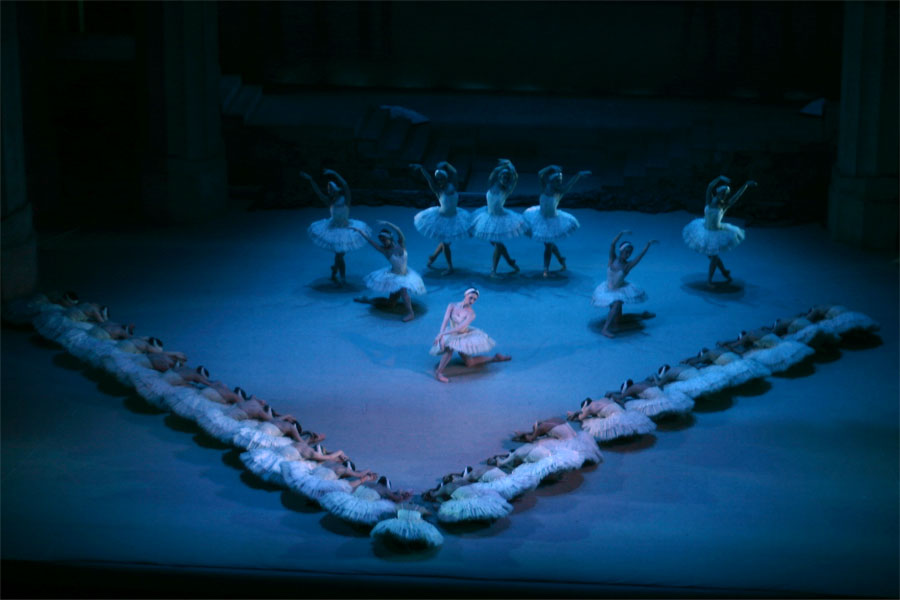 Swan LakeBallet · 1877Same lineage · video
 The NutcrackerBallet · 1892Same lineage · video
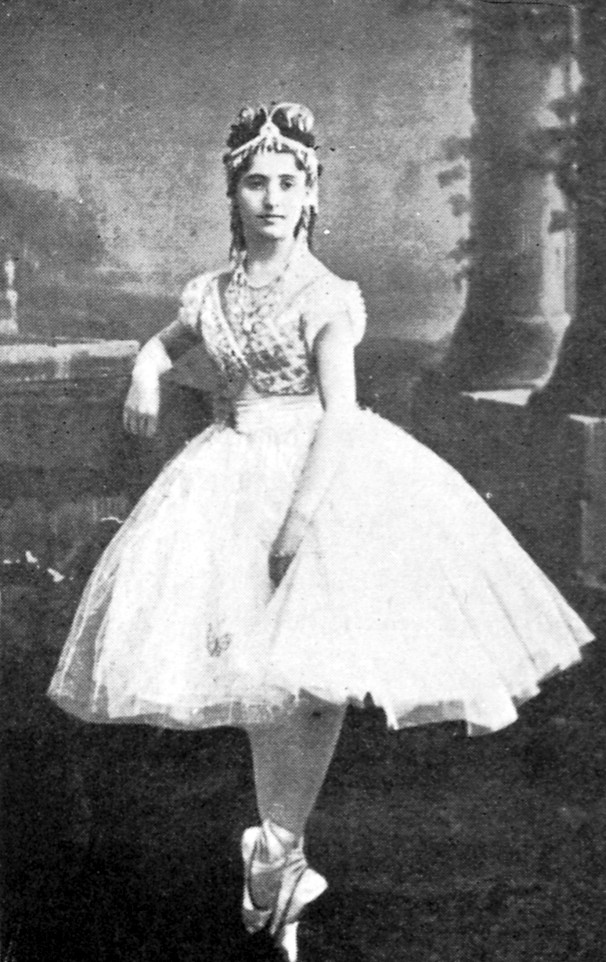 CoppéliaBallet · 1870Same lineage · video
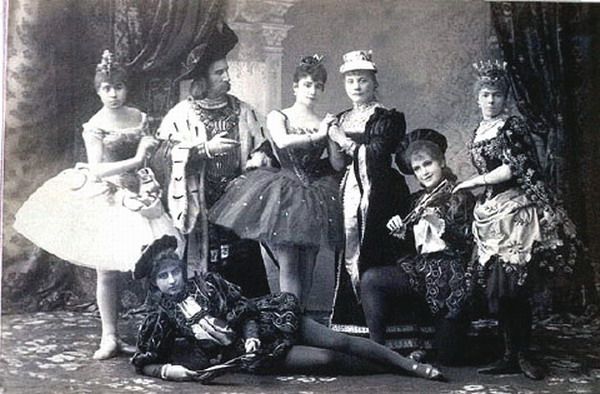 The Sleeping BeautyBallet · 1890Same lineage · video
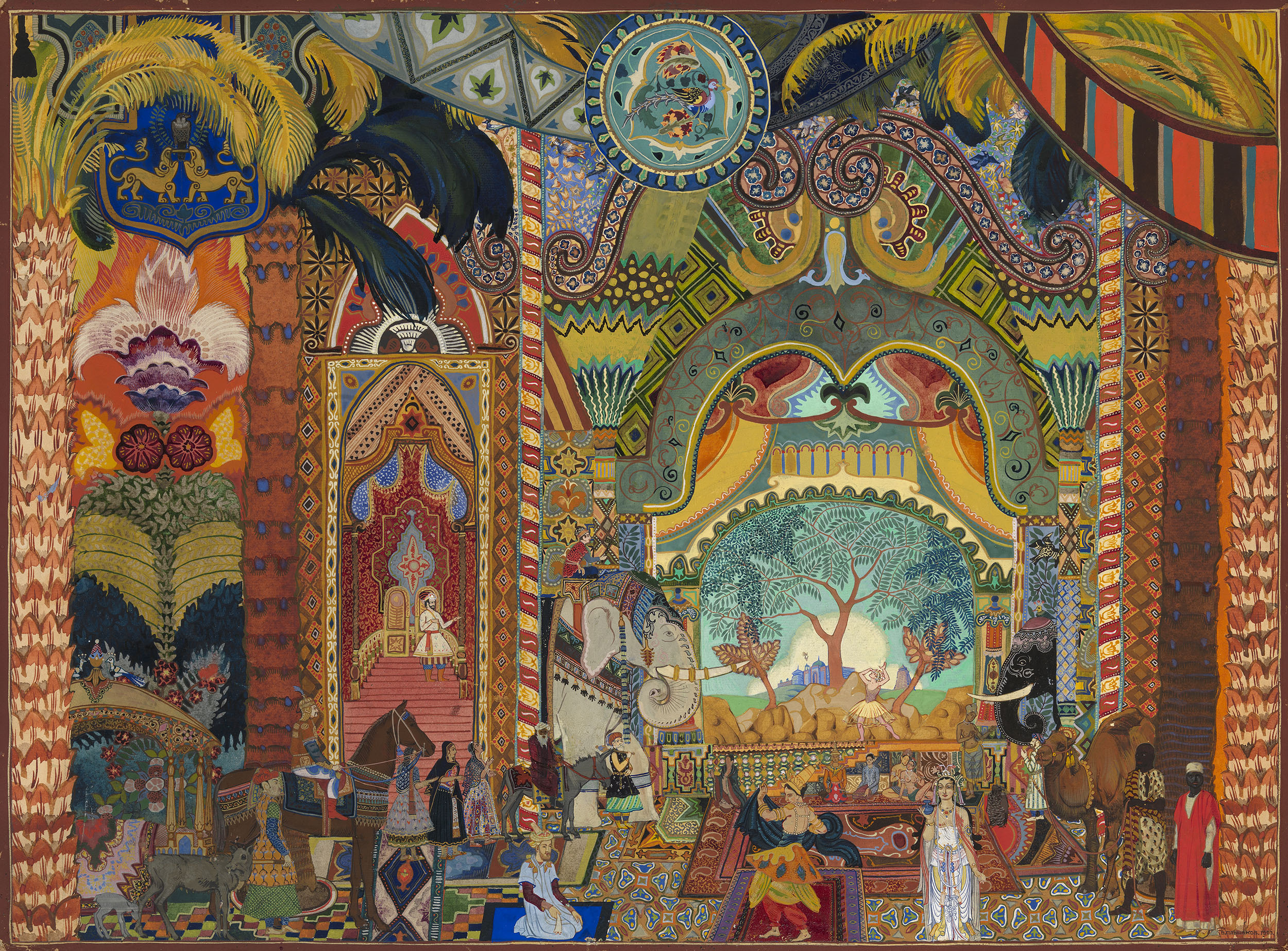 The FirebirdBallet · 1910Same lineage · video
 PetrushkaBallet · 1911Same lineage · video
 Les RendezvousBallet · 1933Same lineage · video
 Stars and StripesBallet · 1958Same lineage · video