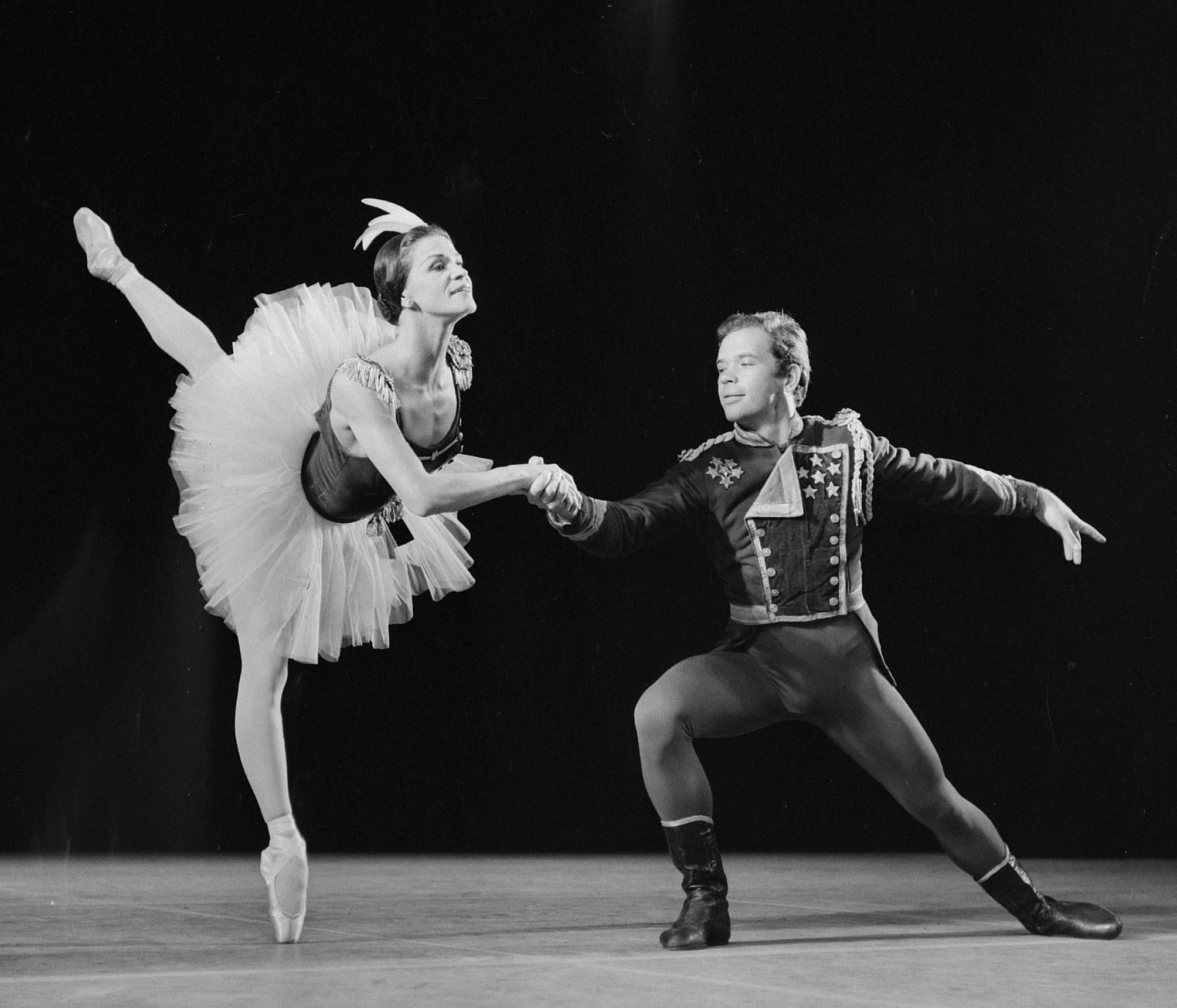
Kroon, Ron / Anefo — [1] Dutch National Archives, The Hague, Fotocollectie Algemeen Nederlands Persbureau (ANEFO), 1945-1989, Nummer toegang 2.24.01.03 Bestanddeelnummer 918-1102 · CC BY-SA 3.0 nl
Stars and Stripes is a neoclassical ballet made by George Balanchine to orchestrated marches by John Philip Sousa, conceived as a tribute to the United States, the country of Balanchine's naturalization. It premiered with New York City Ballet on January 17, 1958, at the City Center of Music and Drama, and is dedicated to former New York mayor Fiorello La Guardia.
The ballet sits in the catalogue as one of Balanchine's Americana works, built from a large corps (27 women, 14 men) organized into 'regiments' across five music-driven sections he called 'campaigns.' It has been read since its premiere both as patriotic spectacle and, in Lincoln Kirstein's phrase, as 'a musical joke' — a distinction that matters to how the piece is staged and taught.
What it contains
- Classical Ballet — The Liberty Bell / El Capitan · Fourth campaign, the pas de deux ('The Liberty Bell' / 'El Capitan') — A partnered classical pas de deux with bravura extensions, turns, and lifts, built on standard classical pas de deux structure but pushed to extreme difficulty. Source: "follows the structure of a classical pas de deux"
- Neoclassical Ballet · The whole ballet — Plotless, abstract patriotic spectacle built on classical technique fused with drill and march vocabulary throughout, rather than a narrative ballet. Source: "Stars and Stripes is a neoclassical ballet choreographed by George Balanchine"
- Precision Kickline · First, second, and fifth campaigns (marching regiments and finale) — Synchronized corps kicking and drill-team style unison marching and majorette-derived stepwork described as high kicks and heel stretches across large groups. Source: "There are high kicks galore, 'heel stretches,' tricks out of the circus and lifts"
What is danced
The ballet is structured in five 'campaigns,' each set to a Sousa march (orchestrated for full orchestra by Hershy Kay from Sousa's brass-only originals). The first, 'Corcoran Cadets,' opens with twelve women marching in drill-like corps patterns behind a baton-twirling female leader; the second, 'Rifle Regiments,' is danced by taller women in broader, sweeping marching formations. The third campaign, 'Thunder and Gladiator,' is an all-male section built around fast diagonal stage-crossings ('flying stage-crosses') around a spinning male soloist-leader, ending in a salute to the audience; a Balanchine Trust répétiteur has described every dancer in this section as needing soloist-level technique.
The fourth campaign, to 'The Liberty Bell' and 'El Capitan,' is a classical pas de deux of high bravura — described as following standard classical pas de deux structure but pushed toward 'virtually impossible bravura,' with brass (not violin) scoring specified by Balanchine. The finale, to 'The Stars and Stripes Forever,' reassembles all four regiments plus the principal couple in a cumulative march-parade that ends in a full-cast tableau in front of an American flag backdrop.
Critic John Martin's contemporary description catalogues the vocabulary directly: 'drilling, parade strutting, drum-majoretting... high kicks galore, "heel stretches," tricks out of the circus and lifts.' This blend of classical bravura technique (extensions, turns, partnered lifts) with drill-team and majorette showmanship, danced at the tempo and phrasing of march music rather than symphonic ballet scores, is the defining technical challenge of the work, especially for the corps de ballet.
Context
Balanchine made Stars and Stripes in 1958, well into his tenure building New York City Ballet's neoclassical repertory, at a point where he was also mining American vernacular and popular idioms (as in Western Symphony, also orchestrated by Hershy Kay) rather than only European classical or Stravinskian scores. Using Sousa's military marches — music associated with parades and civic ceremony rather than the concert hall or ballet pit — was itself an unusual and somewhat provocative choice, which Balanchine and Kirstein both treated partly as satire ('a musical joke') even as the piece became one of his most straightforwardly crowd-pleasing works, what Balanchine himself called 'the applause machine.'
The work extended Balanchine's practice of setting abstract, plotless ballet to non-balletic source music and of using large corps drill formations as a structural device, later paired in NYCB programming with his Union Jack (for Britain) and the Tricolore ballets (for France) as a trio of national tributes.
Staging history
Beyond its 1958 premiere, the ballet has been used repeatedly for occasions of state and civic ceremony: at Nelson Rockefeller's gubernatorial inauguration, at the 1964 opening of the New York State Theater, and — most notably — as a surprise encore performed by NYCB in 1981 after the end of the Iran hostage crisis, with dancers wearing yellow ribbons. Its finale was performed by Dance Theatre of Harlem at the 1984 Los Angeles Olympics closing ceremony.
The ballet has entered the repertory of American Ballet Theatre, San Francisco Ballet, Pacific Northwest Ballet, The Washington Ballet, Miami City Ballet, Suzanne Farrell Ballet, Dance Theatre of Harlem, BalletMet, Sarasota Ballet, Sacramento Ballet, Ballet San Jose, City Ballet of San Diego, and the School of American Ballet. A 2013 Washington Post report noted it is staged less often now because of its large cast and the corps-level technical demands. It has also been parodied (Robert La Fosse's Stars & Stripes Forever for Les Ballets Trockadero de Monte Carlo, 1996) and excerpted in the film Center Stage (2000).
How to watch it
Watch for the shift in register between sections: the first two campaigns are corps drill built on marching patterns and majorette-style baton work, the third is male bravura built on rapid diagonal crossings around a spinning soloist, and the fourth is a fully classical pas de deux pushed to extreme technical difficulty. The finale layers all four regiments together into a cumulative parade, so the choreography's clearest 'point' is the accumulation itself — watch how each regiment re-enters and how the stage fills toward the closing tableau in front of the flag backdrop.
Structure
- Corcoran CadetsTwelve women march in drill patterns led by a baton-twirling leader, ending with the corps marching toward the audience and offstage.
- Rifle RegimentsA taller female corps de ballet and leader perform broader, sweeping marching patterns.
- Thunder and GladiatorAn all-male group performs rapid diagonal stage-crossings around a spinning leader, ending with a salute to the audience.
- The Liberty Bell / El CapitanA bravura pas de deux following classical pas de deux structure, scored for brass at Balanchine's request; described as a tribute to Eisenhower and Mamie Doud during his West Point years.
- The Stars and Stripes ForeverDancers from all prior regiments return in sequence, the principal couple reviews the parade, the backdrop changes to a large American flag, and the ballet ends in a full-cast tableau.
Structure read from an encyclopaedia article, not from a libretto or score we hold. Confirm against a programme before treating the numbering as authoritative.
More from George Balanchine
Other staged works in the register connected to this one by author or lineage.
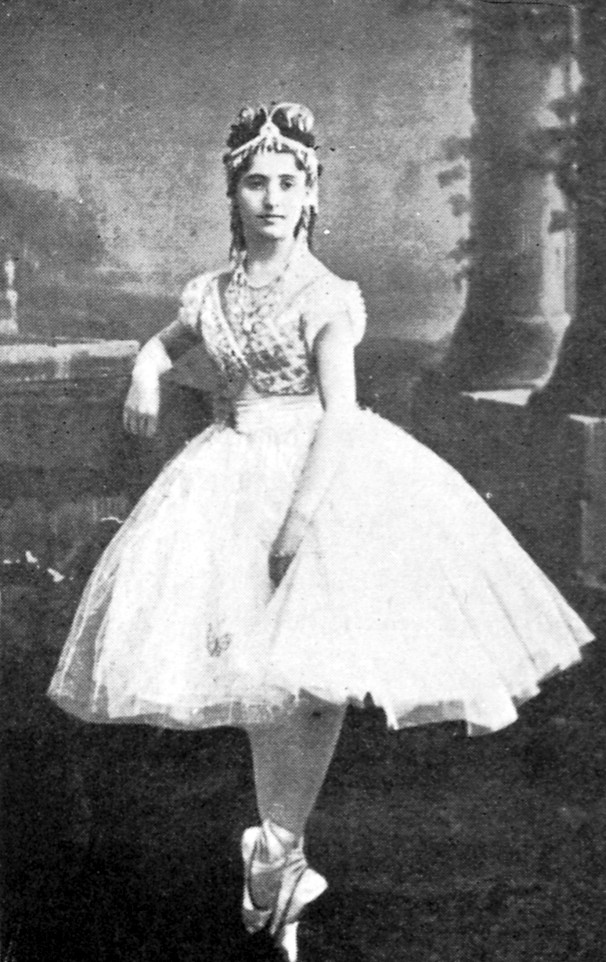 CoppéliaBallet · 1870Balanchine · video
 ApolloBallet · 1928Balanchine · video
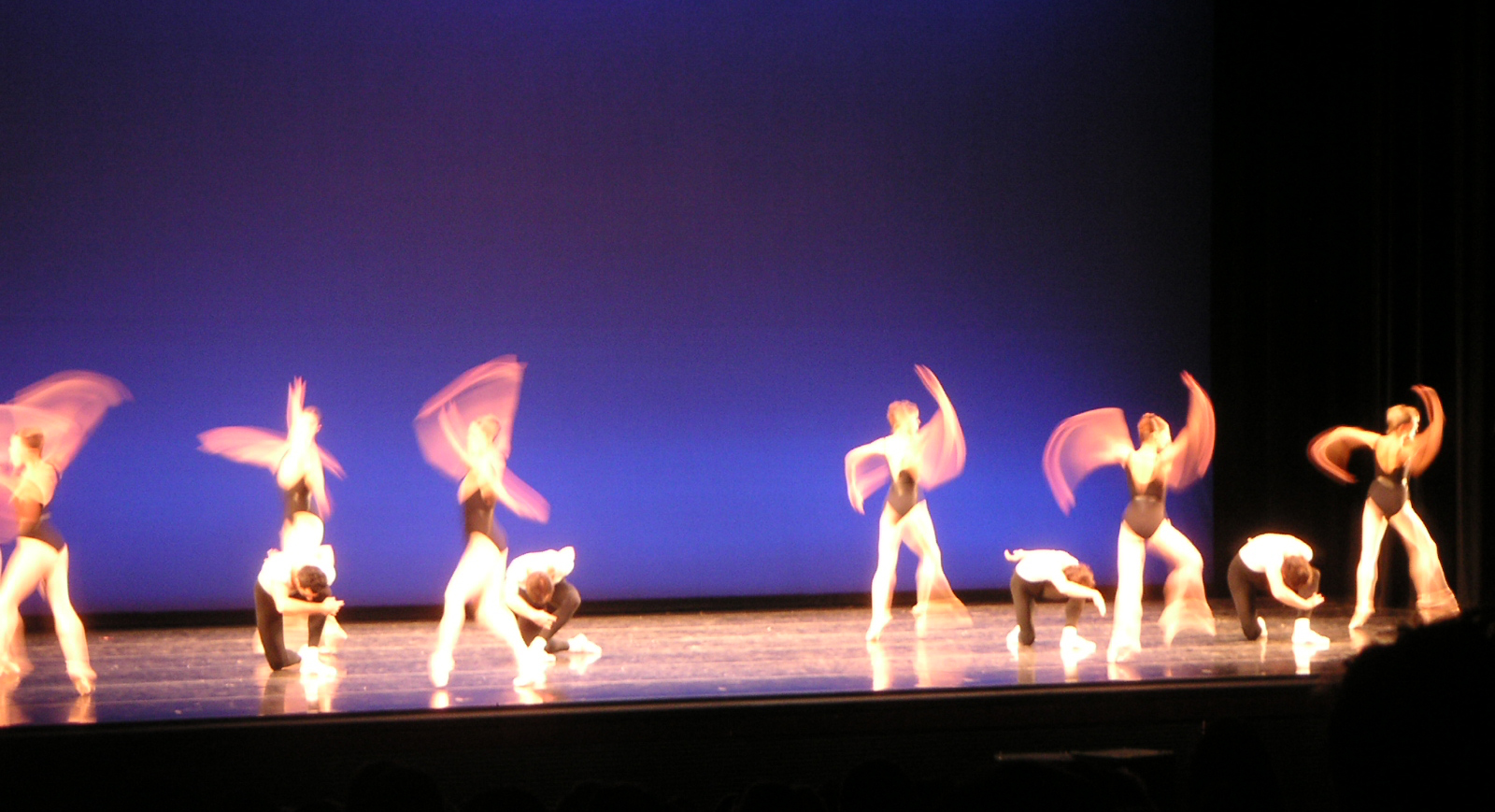 AgonBallet · 1957Balanchine · video
 Le chant du rossignolBallet · 1920Balanchine · video
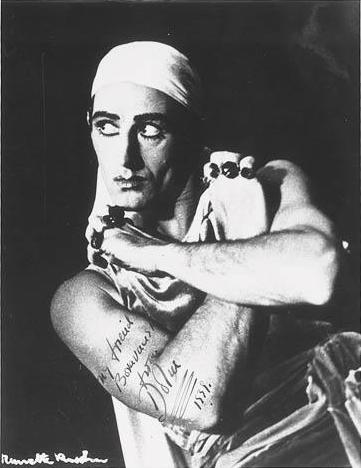 The Prodigal SonBallet · 1929Balanchine · video
 The Seven Deadly SinsBallet · 1933Balanchine · video
 The VestalBallet · 1888Same lineage
 ChaconneBallet · 1976Balanchine · video