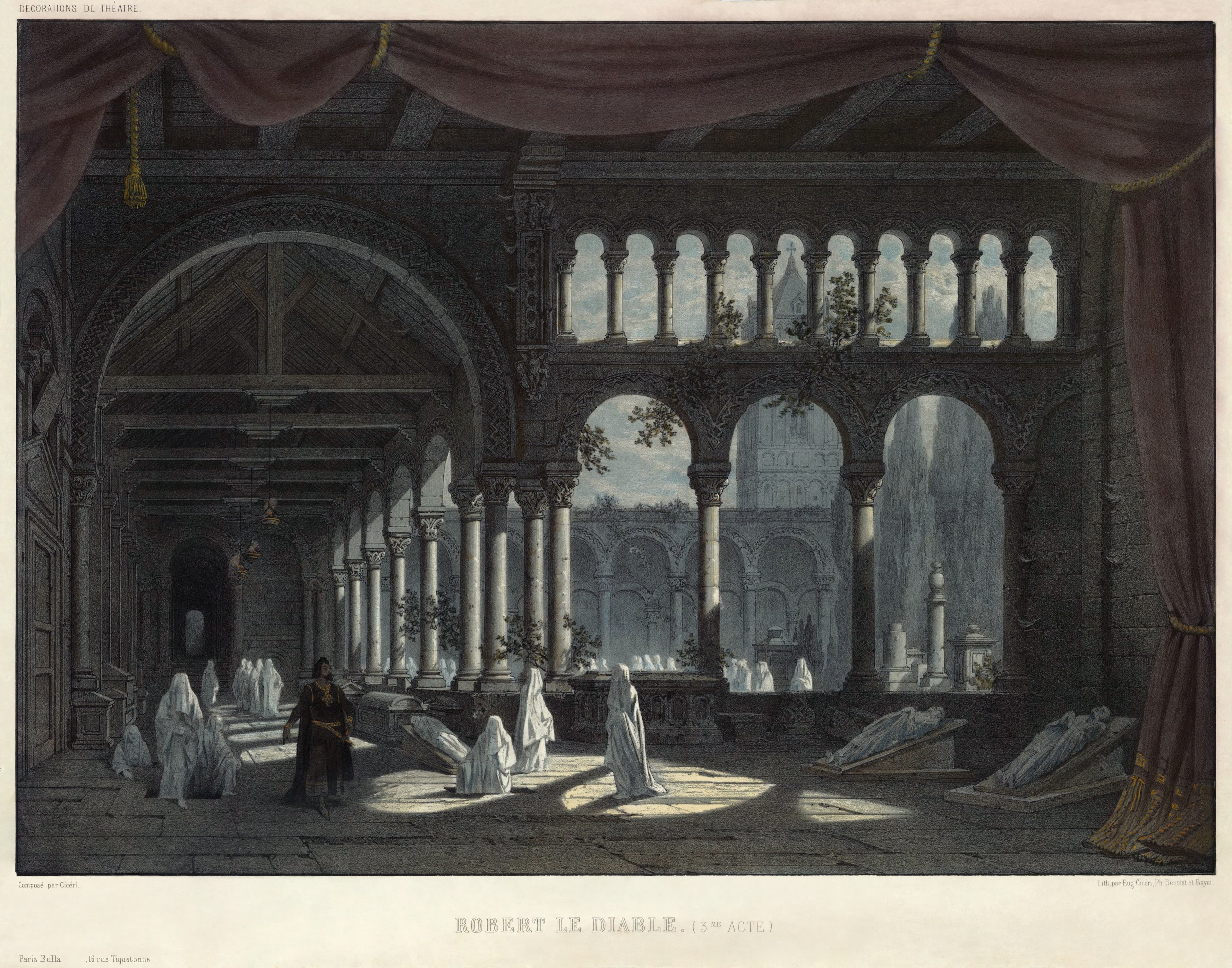
Pierre-Luc-Charles Cicéri and others · Public domain
Ballet of the Nuns is the danced episode that closes Act 3 of Meyerbeer's grand opera Robert le diable, first given at the Paris Opéra in November 1831. Choreographed by Filippo Taglioni (with Jean Coralli possibly responsible for the entry of the nuns), it shows the ghosts of unchaste nuns rising from their tombs to seduce the knight Robert into taking a talisman from a dead saint's hand. It is catalogued here as the origin point of two things at once: the ballet blanc, the convention of a corps de ballet in identical white, and Romantic ballet itself, the 19th-century vocabulary of the supernatural, the gothic and the erotically doomed that grew out of it.
What it contains
- Romantic Ballet · The whole episode, from the nuns' rising to their return to the tombs — Corps of white-clad ghost-nuns performing a supernatural seduction dance; Taglioni's performance fixed as 'ethereal', the visual and atmospheric template (moonlight, gothic ruin, white costume) that defines Romantic ballet's vocabulary and the ballet blanc convention it originates. Source: "Ballet of the Nuns is the first ballet blanc and the first romantic ballet."
- Viennese Waltz · The central set piece, when the Abbess orders the risen nuns to dance — A corps waltz performed by the ghost-nuns as their vows collapse, described as danced 'in spite of their sacred vows' and escalating into abandoned, bacchante-like movement. Source: "The Abbess Helena orders the ghosts to waltz. In spite of their sacred vows, the nuns waltz."
What is danced
The danced action is compact: nuns rise from open graves, the Abbess Helena commands them, and 'in spite of their sacred vows, the nuns waltz' — a corps number built on a couple-dance form pressed into service as a corps de ballet set piece, staged as a controlled loss of religious discipline rather than a social dance proper. The choreography is lost, so no step-by-step account survives; what the article gives is effect rather than technique — the nuns described as 'fluttering like white moths', a review comparing them to bacchantes who 'dance... play... drink' with abandon, and Fanny Appleton's account of dancers who 'drop in like flakes of snow' with 'most refined pirouettes'. Marie Taglioni created the role of the Abbess, and the article credits her performance here with cementing the 'ethereal qualities' that became her signature; this is consistent with her broader reputation for lightness and control on demi-pointe/pointe, though the article itself does not describe her footwork directly.
Context
The article frames this as the moment 18th-century ballet's 'rational thought and classical art' gave way to a stage vocabulary of trapdoors, gas lighting and gothic dread that had circulated in the popular boulevard theatres of Paris but had never been given official sanction at the Opéra. Meyerbeer's ballet was built specifically to show off the Opéra's newly installed gas lighting, and its success is credited by dance historians (Kisselgoff is quoted directly) with fixing the supernatural as a recurring preoccupation of 19th-century ballet more broadly. Andre Levinson's remark, quoted in the article, that ballet stopped being mere 'divertissement' and 'became a mystery' after this piece, is offered as the historiographical verdict on its significance.
Staging history
The opera-with-ballet was given 756 times at the Paris Opéra between 1831 and 1893. Taglioni was contracted to dance the Abbess about a dozen times but appeared only six, after which Louise Fitzjames took over and danced the role 232 times. August Bournonville saw Fitzjames in Paris in 1841 and built his own choreography from that viewing; his version was staged in Copenhagen between 1843 and 1863 and has been fully preserved — per the article, it is the only surviving record of the original steps, Taglioni's own choreography for the piece being lost. Degas painted the scene repeatedly between 1871 and 1876, evidence of its long visual afterlife independent of the opera's own performance run.
How to watch it
Attend to the staging as much as the steps: the piece was built to show off gas lighting effects that created 'ghastly' moonlit atmosphere, and the drama depends on that theatrical apparatus as much as on movement. Watch the shift within the waltz itself, from processional, ghostly entrance to an 'unholy' abandon that period critics likened to bacchantes — the tension the whole work turns on is nuns' habits and vows being danced away in real time, ending with the corps sinking back into the earth as the graves reseal.
Credits
- composer: Giacomo Meyerbeer
Related works
Other staged works in the register connected to this one by author or lineage.
 GiselleBallet · 1841Coralli · video
 La SylphideBallet · 1832Taglioni · video
- La fille du DanubeBalletTaglioni · video
 La PériBallet · 1843Coralli · video
 Leda, the Swiss MilkmaidBallet · 1821Taglioni · video
 La TarentuleBallet · 1839Coralli
 NamounaBallet · 1882Same lineage · video
 La sonnambulaBallet · 1946Same lineage · video
