
Louis Maleuvre · CC0 1.0
Leda, the Swiss Milkmaid (1821)
Choreography by Filippo Taglioni
The article documents this as a Demi-Caractère ballet in two acts, first staged in Vienna in 1821 with choreography by Filippo Taglioni and music by Adalbert Gyrowetz, under the German title Das schweizer Milchmädche. It belongs to the wave of pastoral/rustic-themed ballets popular in the early nineteenth century, and its afterlife runs through some of the most contested authorship disputes in ballet historiography, touching Filippo Taglioni, Marie Taglioni, Jules Perrot, Marius Petipa and Jean Petipa across Vienna, Paris and St. Petersburg.
What it contains
- Romantic Ballet · 1832 Paris revival, Nathalie, ou la Laitière suisse — Staged by Filippo Taglioni with Marie Taglioni as principal dancer at the Paris Opera in 1832, the same milieu and year in which Romantic ballet's ballerina-centred, lyrical style was being established. Source: "Revival by Filippo Taglioni for the Ballet du Théâtre de l'Académie Royale de Musique under the title Nathalie, ou la Laitière suisse, with Michele Carafa revising Gyrowetz's score. First presented in Paris, France, on November 7, 1832. Principal dancers: Marie Taglioni."
What is danced
The source article gives no synopsis, scene breakdown, or description of steps, holds, or vocabulary for any staging of the work. The only formal descriptor supplied is the genre label 'Demi-Caractère ballet in 2 acts' for the original, which places the work in a category that blended classical technique with national/character dance idioms typical of the period, but the article does not specify which dances or passages carried which idiom. The 1849 St. Petersburg revival is noted to contain a 'Scène dansante' and a 'Pas de trois', named numbers attributed to Jules Perrot by one historian, but no description of their content survives in this article. Because of this, no specific movement vocabulary can be responsibly assigned to sections of the work from the text given.
Context
The 1821 premiere predates the codification of Romantic ballet by roughly a decade, sitting in the demi-caractère tradition that mixed academic dance with rustic, folkloric-flavoured characterisation (here, a Swiss milkmaid subject typical of the era's taste for alpine and pastoral settings). The 1832 Paris revival, restaged by Filippo Taglioni with Marie Taglioni in the lead only months around the debut of La Sylphide, places the ballet directly inside the emergence of Romantic ballet and its new emphasis on ballerina-centred lyricism. The 1849 Imperial Ballet revival, credited variously to Perrot, Petipa and Jean Petipa with a rescored Cesare Pugni version, shows the work migrating into the Russian imperial repertory during the period when Petipa was beginning to consolidate authority there.
Staging history
The ballet was first given as Das schweizer Milchmädche in Vienna in 1821. It was revived in Paris in 1832 as Nathalie, ou la Laitière suisse with a rescored version by Michele Carafa and Marie Taglioni dancing the lead, and again in St. Petersburg in 1849 as Lydia, ou la Laitière Suisse with a further rescoring by Cesare Pugni and Fanny Elssler in the principal role. Authorship of the 1849 version is explicitly disputed in the article: Petipa's own memoirs claim sole credit, a contemporary review credited Perrot, and later historians (Pleshcheyev, Ivor Guest) split credit between Jean Petipa and Perrot for specific numbers. Separately, a balletmaster named Antoine Titus created an unrelated ballet of the same title for Paris in 1823, later restaging it in Berlin (1832, with Fanny Elssler) and St. Petersburg (1833, poorly received) — a parallel work sharing only the title.
How to watch it
Because no performance description survives in this record, a viewer or reconstructor would need to attend to the demi-caractère convention itself: passages of academic (pointe/turnout-based) dancing set against passages of stylised 'peasant' or national character dance, a contrast typical of ballets built around rustic heroines in this period. The presence of a named 'Scène dansante' and 'Pas de trois' in the 1849 version suggests the ballet retained at least one formal danced ensemble number and one soloist showcase, though their content is not described here.
Credits
- composer: Adalbert Gyrowetz
More from Filippo Taglioni
Other staged works in the register connected to this one by author or lineage.
 La SylphideBallet · 1832Taglioni · video
- La fille du DanubeBalletTaglioni · video
 Ballet of the NunsBallet · 1831Taglioni · video
 GiselleBallet · 1841Same lineage · video
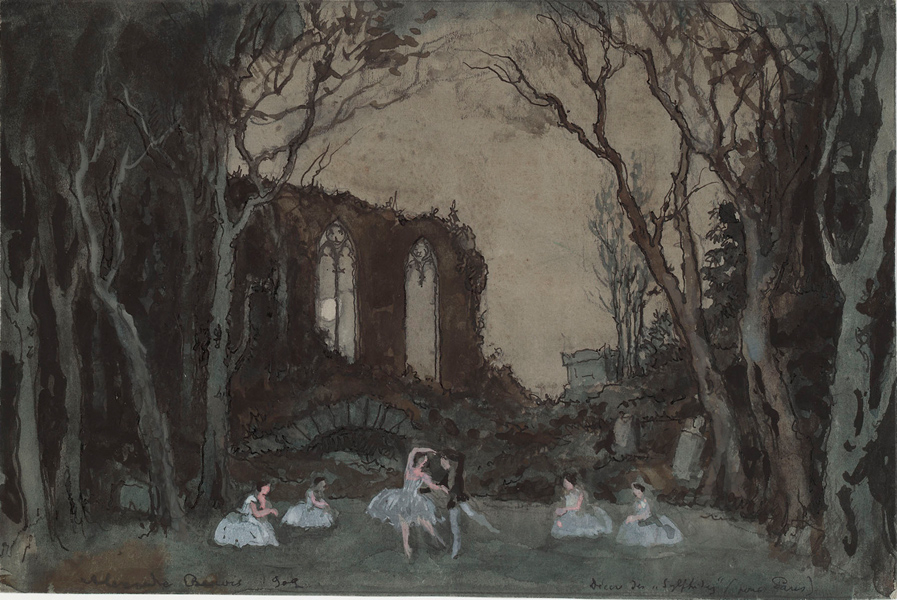 Les SylphidesBallet · 1908Same lineage · video
 La fille mal gardéeBallet · 1789Same lineage · video
 La sonnambulaBallet · 1946Same lineage · video
 The DreamBallet · 1964Same lineage · video
